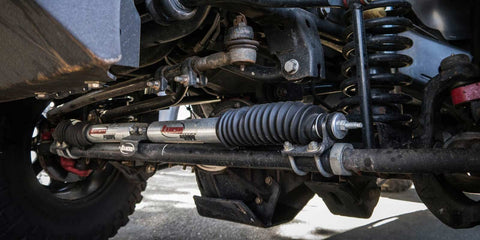
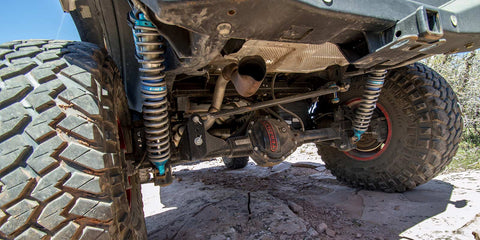
Bilstein ESCV vs Falcon Shocks Zone Rate Tuning: Two Solutions for the Same Problem
Posted by Sean Reyes on
Every shock eventually runs out of room. It's the moment your suspension slams into full compression on a G-out or hard curb, or yanks to a hard stop at full extension coming off a jump or even up sharp driveways. That harsh clunk at the limits of travel is one of the most common complaints we hear, and it's also one of the most misunderstood parts of shock design.
Bilstein and Falcon both built technology specifically to solve it. They just went after it from two completely different directions. Bilstein's ESCV (End Stop Control Valve) attacks it with damping. Falcon's ZRT (Zone Rate Tuning) attacks it with spring rate. Same problem, different tools.
Here's the 'Explain-it-like-I'm-5' version of what's actually happening inside each one, and how they compare.

In This Article
- Bilstein ESCV: The Cushion at Each End of the Stroke
- Falcon ZRT: Three Zones, One Spring
- Comparison Table
- The Bottom Line
Bilstein ESCV: The Cushion at Each End of the Stroke
Think of a shock like a syringe with oil inside instead of air. Most of the time, that syringe is just controlling how fast the piston moves, and that's the "damping" everyone talks about. But what happens in the last inch or two, right as the piston is about to run completely out of room?
On a standard shock, not much. You just hit the end. That's the clunk.
ESCV adds a second, independent spring system that only activates near the very ends of travel. As the shock nears full compression, a secondary piston meets what Bilstein calls a telescoping catch piston, and the two work together to build a progressive hydraulic cushion instead of a hard stop. The same thing happens in reverse at full extension, where a second ESCV system controls the rebound side so the suspension doesn't yank to a stop and jolt everything in the cabin.
That's why Bronco (and now late model Toyota) shocks running ESCV have that extra reservoir hanging off the side. It's not just there for oil capacity and cooling like a typical piggyback reservoir. It's isolating a separate compression zone so the shock can generate serious hydraulic force right at the end of the stroke without the oil cavitating or foaming under that kind of pressure spike.
The ELI5 version: a normal shock has one damping curve for the whole stroke. ESCV bolts on a second, smarter system that only wakes up in the last few inches on either end, so the middle of your travel feels normal and the extremes get a soft catch instead of a crash.

Falcon ZRT: Three Zones, One Spring
Falcon isn't solving this by adding a second damping system. They're changing how your factory spring behaves depending on where it is in the stroke, using pieces built into the shock itself.
Picture your suspension's travel as a hallway split into three rooms.
Extension Zone (top of the hallway): An internal negative-rate spring, mounted around the shock shaft, works against the coil spring's preload. That cancels out the clunk you'd otherwise feel when the suspension tops out, and it softens how hard the tire lands after it's been in the air.
Drive Zone (middle of the hallway): Nothing gets touched here. This is normal daily driving, and Falcon leaves the factory spring rate exactly as it is so the truck still rides the way it's supposed to.
Compression Zone (bottom of the hallway): A microcellular bump stop, tuned by its shape and density, progressively firms things up as you get close to full compression. That's what keeps you from bottoming out hard on a G-out or a big hit.
The ELI5 version: ZRT doesn't touch your factory spring. It fakes three different spring rates by softening the top, leaving the middle alone, and firming up the bottom, all through internal spring and bump stop tricks rather than adding a second hydraulic system.
Versus Mode
| Bilstein ESCV | Falcon ZRT | |
|---|---|---|
| What it actually changes | The shock's internal damping (hydraulic valving) | The effective spring rate at different points in travel |
| Where it works | Only at the very top and bottom of the stroke | Across three zones spanning the entire stroke |
| How it does it | Secondary valve, telescoping catch piston, isolated external reservoir | Internal negative-rate spring (top), stock spring (middle), progressive bump stop (bottom) |
| The ELI5 analogy | A cushion that only inflates right before impact | A hallway with three rooms your spring feels different in |
| What it's solving | Harsh mechanical clunk at full compression or full extension | Harsh spring feel at the extremes, while keeping factory ride quality in the middle |
The Bottom Line
ESCV is a damping fix. It's a second hydraulic system that only steps in right where the shock would otherwise crash into its own limits. ZRT is a spring rate fix. It reshapes how the factory spring behaves in three distinct zones without ever swapping the spring itself.
Both are chasing the exact same real-world complaint, that harsh bottoming or topping-out feeling, and both get there without asking you to run a completely different spring rate or valving package. They just come at it from opposite ends of the physics: one controls oil, the other controls spring force.
We'll be putting both platforms through real trail and highway testing soon, so keep an eye out for a full ride comparison once we've got seat time on both.