Eibach Stage 2R Review on the 2021+ F-150: Is It Enough?
Posted by Sean Law-Bowman on
Who is Steve?
Recently, Steve, our resident expert on recreational buggy vehicles (RBVs) and Eibach enthusiast, acquired a brand new 2024 F-150. This purchase allowed him to give his well-used Eibach Stage 2R equipped Ranger a break. Steve is a dedicated family man and a seasoned rock crawler. This F-150 serves multiple purposes: daily commuting, comfortable cross-country family trips, and towing his Jurassic Park-themed, solid-axle-swapped Explorer (affectionately known as old JP) to various off-road trails in the West. This is a demanding task for any truck and its suspension. The Eibach Stage 2R kit impressively delivered, especially in its intended areas.

About The Kit
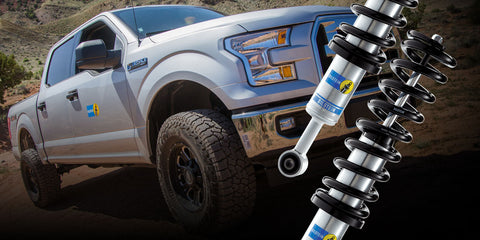
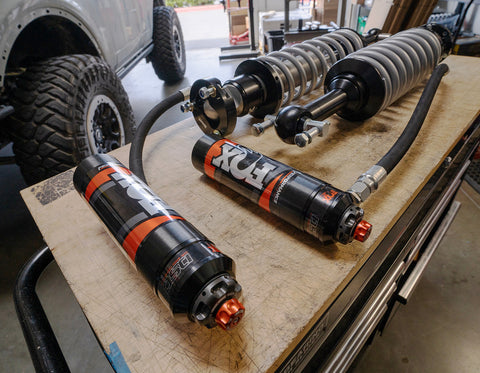
The Stage 2R kits include Eibach's 2.0 coilovers and reservoir rear shocks, designed for leveling and enhancing suspension, providing better on-road comfort and control, and improved usability for mild to moderate off-road driving. Eibach also offers Stage 2 kits with the same front coilovers but Pro Truck Sport IFP monotube rear shocks. The "R" in Stage 2R indicates the inclusion of reservoir rear shocks, which provide better heat dissipation and faster recovery compared to non-reservoir shocks. This difference became evident during our testing.
Eibach's 2.0 coilovers are unique as they allow on-vehicle adjustments. While you'll still need jack stands to take the weight off, the steel threaded bodies and slip washers prevent coil binding. The included spanner wrenches make adjustments straightforward. Out-of-the-box lift heights vary: about 3” on 2.7 Ecoboost trucks, 2” on PowerBoost models, and roughly 2.5” on Coyote or 3.5 Eco Boost trucks like ours. However, we observed more lift than expected initially.

Ride Height Adjustments
Coilovers are often assembled by hand, leading to potential inconsistencies in preload. This is where Eibach’s adjustability shines. Unlike many other brands requiring removal and spring compressors, Eibach coilovers can be adjusted on the truck with precise recommendations. We reduced the preload to achieve 2.5” of lift. At 3.5”, the ride was harsh with significant topping out due to limited droop travel. Eibach later lowered their maximum recommended lift height from 3” to 2.3”, which is a sensible adjustment.
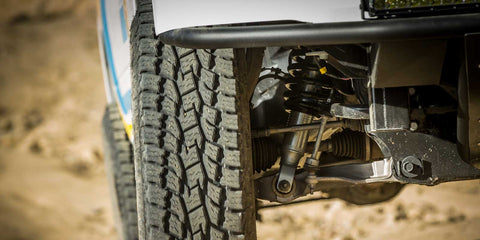
In terms of travel, the Eibach coilovers increased usable wheel travel from 7 ⅛” stock to just under 8 ½”, even with stock control arms. At 2.5” of lift, we lost about an inch of droop travel, but F-150s tend to be over-sprung in the rear and nose-heavy. Sacrificing some droop for improved bump travel was a worthwhile trade-off. While there was some topping out, it was less frequent than bottoming out with the stock suspension. The coilovers can also be adjusted down to 0.5” of lift.
Installation is relatively easy due to the loaded coilovers and pre-mounted reservoirs. For detailed installation guidance, check out our 6112 review from a few weeks ago.

In-Cab Testing and Limits
We admit, we did push these coilovers to their limit, and perhaps beyond. We tested them back-to-back with a similar F-150 equipped with Bilstein 6112s and 5160s to compare the benefits of a larger 2.6” Bilstein body versus the 2” Eibach 2.0s. We used a very rough test loop to evaluate temperature differences after the run, aiming to push the limits without excessive abuse.
However, Steve set a very fast pace on the first lap with the more robust Bilsteins, which was near their limit and far beyond what the Eibachs were designed for. To maintain test consistency, we tried to keep speeds the same, which proved problematic for the Eibach 2.0 coilovers. More details on the head-to-head shootout are coming in a separate video. We unintentionally set the Eibachs up to fail. Very early in the run, the truck became airborne, and the smaller 2.0s couldn’t recover. They endured the lap in full hysteresis, violently bottoming and topping out until the seal heads gave way. Despite this, they held together enough to get us back to the shop.
If the Eibach feel suits you, extreme driving might not be your style. In previous Stage 2R reviews, we’ve noted that if you need reservoir shocks for rear heat dissipation, you might also consider a 2.5” front coilover. For many, the Stage 2 kit might suffice, as the rear shocks are less likely to be the limiting factor.

Who Are They For?
The Eibachs feel like an OEM+ package, improving upon stock suspension without major compromises. Steve describes them as the “Goldilocks Shocks,” offering better small bump compliance than Bilstein but a tighter, more composed feel and handling than Fox. They’re the “tweener” shock ideal for daily drivers. They're not for the toughest trails or desert racing, but they suit how most people use their F-150s.
Tire size affects ride quality and suspension performance. With 2” bodies, the Eibachs have limits, so be mindful of unsprung mass increases with larger tires. Our truck ran 35s, which were a bit heavy and contributed to a harsher ride and more top outs. While 35s clear with a Tremor bumper and skid plate, 34s or smaller would be a better match. I had a similar issue with 37s on Eibach 2.0s on my Bronco, leading to tire cupping. This is another reason to consider larger 2.5” coilovers, even for those who don't off-road aggressively.
Ultimately, Stage 2 packages are perfect for daily drivers needing comfort, stability, and a level stance without added maintenance. Whether it's a dirt road to a campsite, a woodland trail to a hunting spot, or just a leveled look without spacers, these Eibachs deliver.

Introducing New 2.5s
Eibach is developing a new 2.5 series for more serious off-road use, addressing the limitations of 2” shocks. The 2015+ F-150 is among the first applications. We’ll review one of the first production sets. Expect many more F-150 reviews coming soon.
Up Next
Upcoming videos will cover why spacer lifts are bad, the Bilstein vs. Eibach shootout, and a review of Fox 2.0s. We’ll also review Radflo 2.0s, Dobinsons IMS, OME MT64s, and the new Eibach 2.5s. We might even look at 4” lift Icon kits. We're also reviewing an Icon 2.5 EXP kit on a third-gen Tundra and Bilstein 6112s and 6100s. We have Dobinsons IMS on a 6G Ranger and King adjustable coilovers on a 4G Tacoma, with Dobinsons MRRs and Bilstein 8112s on Broncos coming soon.