Fox 2.0 vs 2.5 HTO - Big Bore Upgrade
Posted by Sean Reyes on
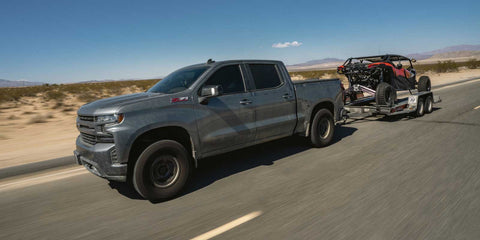
That tugging feeling is exactly what the Fox 2.5 HTO was built to fix. Its also the biggest reason we recommend 2.0 owners step into the 2.5 HTO.
The Quick n' Dirty: The Fox 2.0 is for comfort on a budget: daily drivers, lighter trucks, and casual trail use. The Fox 2.5 HTO is for heavier trucks, heavier loads, bigger tires, and more dirt miles. You get a half-inch bigger body and a piston about 20% larger, but the real upgrade is the hydraulic top-out piston inside the shock. That's mostly what it comes down to. Here's what you need to know before you spend the money.

Fox 2.0 vs 2.5 HTO at a Glance
| Fox 2.0 Performance (IFP) | Fox 2.5 HTO Performance | |
|---|---|---|
| Body diameter | 2.0" | 2.5" |
| Piston size | Baseline | ~20% larger |
| Ride feel | Linear, soft, comfort-first | More control, faster recovery |
| Top-out control | Standard | Hydraulic Top Out piston |
| Reservoir | IFP (RR and CD RR variants available) | IFP, no reservoir |
| Best for | Daily comfort, mild trail | HD trucks, towing, 35"+ tires, dirt miles |
| Price (per shock) | $229.95 | $349.95 |
Key Terms
- HTO: Hydraulic Top Out
- IFP: Internal Floating Piston
- Rebound: how the shock reacts after a compression event, when the wheel and tire droop down away from the chassis
- Compression: a force on the vehicle that compresses the suspension (springs and shocks)

Why Big Bore Matters
A bigger body means more oil, and a bigger piston moves more of it. That gives the shock more damping force to work with and more capacity to absorb heat before it starts to fade. More damping doesn't mean softer though! Dont expect these to ride more 'plush' because you're spending more money.
On a 2.0, heat is the limiting factor. The Fox 2.0 IFP isn't built to shed heat through sustained off-road use, and it can struggle under heavy loads. That's why we've said for years that 2.0 body shocks pair best with tires up to about 33–34". Once you're on 35s, the extra unsprung weight amplifies harshness and top-out. That's the point where we recommend stepping up to a 2.5.

What Is Hydraulic Top Out?
Size isn't the whole story. The 2.5 HTO adds a second internal piston between the main working piston and the seal head (where the shock tops out at full extension)
On a standard shock, full extension (a big bump taken too fast, a highway joint, or catching air with the wheels hanging) sends the main piston all the way to the end of the shock body, where it stops. The only thing slowing it down on the way is normal rebound damping.
With the HTO, the main piston runs into that top-out piston first and gets an extra layer of damping right at the end of the stroke. The wheels and tires stop acting like an anchor dragging the front end down. There's no secondary compression and no pogo down the highway. The chassis settles faster, and you feel less side-to-side sway and front-to-back porpoising in the cab.
This is why the HTO works so well on heavy-duty trucks. Bigger, heavier trucks carry more mass through every bump, highway joint, and rutted road, and all of that energy has to go somewhere when the suspension extends.
Where the Fox 2.0 Still Makes Sense
We're not going to tell you the Fox 2.0 is a bad shock. For a lot of drivers it's still a great choice. It's the softest, most forgiving option from Fox, and on a lighter truck or SUV that mostly lives on pavement, it delivers a comfortable ride without a big invoice.
The 2.0 family also gives you options:
- 2.0 IFP: comfort on a budget. Not built for serious off-roading or heavy loads.
- 2.0 Remote Reservoir: for off-roading where heat is the problem.
- 2.0 CD Adjustable RR: the most versatile 2.0, with adjustable compression for towing, hauling, or drivers who want more handling.
If one of those fits how you drive, you may not need a bigger body. Just be honest about the truck. Put a 2.0 IFP on a 7,500 lb diesel with a camper in the bed or 35" tires, and you're asking too much from 2-inch shocks.

Who Should Upgrade
Stay on the Fox 2.0 if you have:
- A daily driver or lighter truck/SUV on stock-size tires
- Mostly pavement miles, with light trail use now and then
- Comfort and budget as your main priorities
Upgrade to the Fox 2.5 HTO if you have:
- An HD truck (Super Duty, Ram 2500/3500, GM 2500/3500). This is the truck the HTO was made for.
- Regular towing or hauling. Heavier loads create more rebound energy, and the top-out piston keeps it under control.
- 35" or larger tires. Bigger, heavier tires mean more droop force and more top-out.
- Lots of dirt miles (washboard, ruts, rough forest roads). You'll benefit from the added heat capacity and faster recovery.
- A light truck or Jeep that sees a lot of dirt miles, sees a lot of speed, and needs damping at faster speeds in the dirt.
Look past the HTO if you want reservoirs or adjusters. The 2.5 Performance Elite and Factory Race series sit above the HTO for drivers who push harder or want to tune their ride.
The Verdict
The Fox 2.0 is for comfort and value on lighter rigs. The Fox 2.5 HTO is for heavy trucks, heavy loads, and big tires, where the problem isn't the first bump but everything that happens after it.
Is the 2.5 HTO perfect? No. There's no reservoir and no adjusters, and if you're pushing hard through the desert you'll outgrow it. But for most HD truck owners who tow on weekends and hit highway joints all week, it's the right big-bore upgrade at the right price.
Not sure which one fits your truck? Call or chat with our team. We've driven them.
Fitment
All links go to the complete front and rear set for that vehicle.
| Vehicle Make and Model | Year Range | Shop Now |
|---|---|---|
| Ford F-250 Super Duty 4WD | 2005–2016 |
Shop Now |
| Ford F-250 Super Duty | 2017–2026 |
Shop Now |
| Ford F-350 Super Duty 4WD | 2005–2016 |
Shop Now |
| Ford F-350 Super Duty | 2017–2026 |
Shop Now |
| Ram 2500 HD | 2014–2025 |
Shop Now |
| Ram 3500 HD | 2014–2024 |
Shop Now |
| Chevrolet Silverado 2500 HD | 2011–2019 |
Shop Now |
| Chevrolet Silverado 2500 HD | 2020–2026 |
Shop Now |
| Chevrolet Silverado 3500 HD | 2011–2024 |
Shop Now |
| Chevrolet Silverado 3500 HD | 2020–2024 |
Shop Now |
| GMC Sierra 2500 HD | 2011–2019 |
Shop Now |
| GMC Sierra 2500 HD | 2020–2026 |
Shop Now |
| GMC Sierra 3500 HD | 2011–2024 |
Shop Now |
| GMC Sierra 3500 HD | 2020–2026 |
Shop Now |
| Jeep Wrangler JL | 2018–2026 |
Shop Now |
| Jeep Gladiator JT | 2020–2026 |
Shop Now |
Frequently Asked Questions
Hydraulic Top Out. It's a second internal piston, positioned between the main piston and the seal head, that adds damping as the shock reaches full extension.
Yes, if you drive an HD truck, tow or haul regularly, run 35"+ tires, or spend a lot of time on dirt. For a lighter daily driver on stock tires, the 2.0 is usually enough.
No. It's an IFP design (internal floating piston). If you want reservoirs or adjustability, look at the Fox 2.5 Performance Elite or Factory Race series.
On normal day to day driving, the 2.5 HTO shocks ride sportier and firmer than the 2.0 - by design.
Fox 2.5 HTO shocks can be serviced and rebuilt by a shock tech, or by sending the shocks to Fox directly for service.