ford super duty
The Best Shocks for the 2017-2026 Ford F250/F350 Super Duty (Comparison)
Posted by Sean Reyes on
Shock Surplus · Buyer's Guide The Super Duty is a working truck. Whether you're pulling a fifth wheel, hammering down lease roads, or just trying to get across town without rattling your fillings loose — the shock absorbers make more difference than most owners realize. Here's an honest breakdown of every option worth considering, from the factory shocks to the Fox 2.5 HTO, based on true experience.
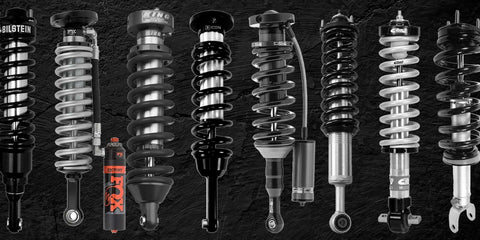
Shock Surplus · Product Comparison Find YourPerfect Shock Honest side-by-side breakdown of every major tier. Toggle any shock to add or remove it from the comparison.
Compare
Products
Products
OEM / FactoryStock ShocksSmall Bore, Sad LifeOEM
Performance
Road ComfortDaily drive smoothness — pavement, highways, broken asphalt
Dirt Road ComfortWhether it's lease roads, farm country or weekend trails
Handling & ControlBody roll reduction, cornering stability, responsiveness
Haul & TowStability under load, sway control, trailer confidence
Specs & Materials
Shock DesignInternal construction type
Twin-Tube
Monotube
Monotube
Monotube
Twin-Tube
Monotube
Monotube
Monotube w/ Reservoir
Body MaterialOuter body construction and finish
Steel / Painted
Steel / Painted
Steel / Zinc Plated
Steel / Zinc Plated
Steel / Painted
Aluminum / Clear Anodize
Aluminum / Clear Anodize
Aluminum / Clear Anodize
Cost & Value
Price PointRelative investment tier — see scale below
Ideal Use Case
Best ForPrimary recommended applications
Honest TakeWhat we actually tell customers
The stock shocks get it done, but don't ask too much of them. They won't blow up on the trail, but hard to beat factory-level comfort on the daily drive.
A basic stock upgrade that provides noticeable improvement to handling. If you feel your stock vehicle is sloppy, this is an inexpensive solution.
Not the softest shocks on the block, but this is prime confidence through control. There are softer shocks for the dirt, but none will match durability and longevity.
A heavily recommended setup. When you're looking for a balanced approach to your vehicle, but still like to rip around in the dirt.
An adjustable classic — the RS9000XL can be your daily comfort or workhorse. But these shocks still suffer from inadequate rebound damping which doesn't resolve the slop from a heavy truck.
Regularly one of the most comfortable options in this range, where comfort doesn't end when the pavement does.
Big trucks need big support, and the Fox 2.5 delivers at a great price. Keeps road comfort intact while delivering far more stability to trucks doing truck-things.
If you're playing in the dirt often and drive your truck like a UTV, these shocks should be considered. For the price point, we direct most HD truck buyers into the 2.5 HTO.
Standard Rating
Best in Class
Adequate / Limited
Price Scale
Under $250
$250–$600
$600–$1,000
$1,000–$2,500
$2,500+
Every Option Explained Every Shock, Broken Down What you need to know before you buy
OEM / FactoryStock ShocksThe baseline you're trying to beatOEM
Ford's factory shocks are a twin-tube design built to a cost target. They're fine off the lot but lose ground quickly under hard use, heavier loads, or a lift kit. Typical life is 30–50k miles, though trucks in snowy or dusty environments often see them degrade faster. The core limitation is the small piston bore, which produces poor rebound damping — you'll feel it on every dip exit, cattle guard, and uneven driveway.
DesignTwin-Tube
Price Range$250 – $600
Road Comfort3 / 5
Haul & Tow3 / 5
The KYB Gas-A-Just is a monotube gas shock that slots in as a direct OEM replacement — same mount points, same ride height. A meaningful step up from the factory twin-tube, offering better rebound control and a firmer, more responsive feel. If you're running at stock height doing daily driving with the occasional load, this gets the job done without spending Bilstein money. Worth noting: the Excel-G is KYB's budget-tier option; if you're going to upgrade, the Gas-A-Just is the version worth buying.
Shop Now →
DesignMonotube
Price Range$250 – $600
Road Comfort3 / 5
Haul & Tow4 / 5
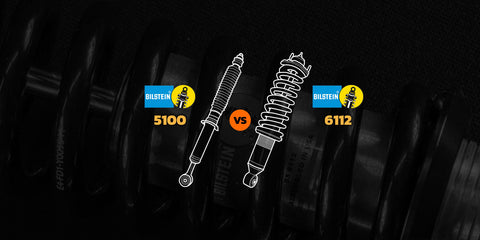
The Bilstein 5100 is one of the most recommended shocks for the Super Duty — digressive valving that gets firmer as inputs get bigger. Exceptional under tow loads and rough terrain while staying manageable on the highway. Comes in 0–2″ and 2–2.5″ front adjustable options. Road comfort trades off slightly — these are working shocks, not luxury units. But nothing in this price range matches their longevity. Zinc-plated body, quality seals, Bilstein's reputation.
Shop Now →
DesignMonotube
Price Range$250 – $600
Handling5 / 5 — Best
Haul & Tow5 / 5 — Best
A heavily recommended setup for owners who want solid daily driving without giving up capability on dirt roads or light trails. Eibach pairs shock valving with spring rates designed to work together — the result is a more cohesive suspension system rather than just a shock swap. Handling rates best-in-class. If your Super Duty sees a mix of pavement and occasional off-road, this is the pick. Zinc-plated steel body holds up better than painted options.
Shop Now →
DesignMonotube
Price Range$250 – $600
Dirt Road4 / 5
Handling5 / 5 — Best
The classic adjustable shock — a nine-position dial from soft comfort to stiff performance. It's a twin-tube with a 37mm piston, which is the limiting factor. Road comfort is good at 4/5 on the soft setting, but that small bore means rebound damping suffers when loaded or terrain gets rough. If adjustability is the priority and you're not pushing it hard, the RS9000XL fills a niche. But for a heavy-duty truck doing heavy-duty things, the piston size puts a ceiling on performance.
Shop Now →
DesignTwin-Tube (37mm)
Price Range$250 – $600
Road Comfort4 / 5
Haul & Tow4 / 5
Consistently one of the best-riding shocks you can put on a Super Duty — 5/5 road comfort, best in class. The aluminum body and Fox's internal floating piston design maintain consistent damping even as the shock heats up. The 2.0 is a 46mm monotube, so rebound damping is significantly better than stock or any twin-tube in this class. You get a noticeably more comfortable daily drive, and the same shock keeps performing when you exit the pavement. If ride comfort is the priority, this is the move.
Shop Now →
DesignMonotube (46mm)
Price Range$600 – $1,000
Road Comfort5 / 5 — Best
Dirt Road4 / 5
The Fox 2.5 HTO (Heavy Truck Off-Road) is built from the ground up for trucks like the Super Duty — big bore, high oil volume, tuned specifically for the weight demands of a heavy-duty pickup. Earns 5/5 best-in-class for haul and tow stability. The larger 2.5″ body holds more oil for better thermal capacity and consistent damping on long pulls or heavy trail days. Road comfort stays at 4/5 — you're not sacrificing the daily drive. Most HD truck buyers we work with end up here.
Shop Now →
DesignMonotube (2.5″)
Price Range$1,000 – $2,500
Road Comfort4 / 5
Haul & Tow5 / 5 — Best
Adds an external reservoir to the standard 2.0 platform for more oil volume and heat dissipation. The reservoir prevents fade on long descents, rocky trails, or back-to-back obstacles — earns 5/5 best-in-class for dirt road comfort. The tradeoff: not the best choice for a daily driver with occasional trail use. The Fox 2.5 HTO gives better haul-and-tow performance at a similar price. This shock is for the truck that lives in the dirt. For most HD buyers, we point toward the 2.5 HTO.
Shop Now →
DesignMonotube + Reservoir
Price Range$1,000 – $2,500
Dirt Road5 / 5 — Best
Haul & Tow3 / 5
Common Questions Frequently Asked Questions Straight answers from the guys at Shock Surplus
The best shocks come down to your use case — there's no universal answer. If you want a basic stock replacement with upgraded control and longevity, it's hard to go wrong with the Bilstein 4600. Options like the KYB Excel-G aim to be direct factory replacements, but they won't go the distance like Bilstein can. As you move up in budget, the Fox 2.0 is the ride-comfort leader, and the Fox 2.5 HTO is where most heavy-use trucks end up.
The Bilstein 5100s are geared toward lifted Ford Super Duty trucks, but you could technically run the 2″ 5100s on a factory-height truck without much consequence if it's just a daily driver with light trail use. The 5100s are valved for more control with bigger wheels and tires, heavier loads, or the taller center of gravity from a lift kit. If you're going for a straight factory replacement, grab the 4600s.
The typical 30–50k miles holds true for the factory black shocks, but from our experience these shocks can deteriorate much faster if you're in areas with a lot of snow or dirt. Salt, grit, and constant contamination accelerate seal wear. If you're in the southwest on dry pavement you may squeeze more life out of them, but don't push it past the symptoms.
If you notice excessive bouncing on the road — more than 2 bounces off a driveway or highway joint — or if there's more side-to-side slop than usual when going through a dip, the shocks are probably toast. You can also do the bounce test: push down hard on each corner of the truck. A good shock rebounds once and settles. More than that and it's done.
New shocks aren't required — but they're heavily recommended. Shock extenders are available for the front shocks which help limit issues with droop travel. But leveling kits usually come with bigger wheel and tire packages that the stock shocks aren't designed for. You're adding unsprung weight, changing the geometry, and stressing components sized to a minimum. Save yourself the headache and upgrade them at the same time.
Bilstein 4600 and 5100 shocks are the go-to for good reason — digressive valving produces improved control under load. The Fox 2.5 HTO also earns best-in-class marks for haul and tow stability. KYB Monomax is another solid option for those who don't mind a weird red shock. Avoid twin-tube designs for serious towing — the rebound control just isn't there when you're moving weight.
Yes — and noticeably so. One of the biggest differences with upgraded aftermarket shocks is the larger bore of a monotube. This always comes with better rebound damping. You'll notice it immediately after going over big bumps, up driveways at an angle, or on back roads — better rebound damping means less side-to-side slop and a truck that settles faster and feels more planted.
At stock height, almost everything in this guide applies — you have the full range of options. With a 2–3″ level, the Bilstein 5100 is specifically built for this application. As the vehicle height increases beyond 3″, aftermarket options narrow to Bilstein, Fox, Rancho, Skyjacker, and others built specifically for lifted trucks.
This is a pretty straightforward job if you're mechanically familiar. The rear shocks are simple — two bolts, swap it out. Up front you have to deal with the coil spring. There are ways to manipulate the spring back into the spring seat beyond using a spring compressor, but it all comes down to your comfort level under the truck. If you've done struts before, this isn't a stretch.
Big heavy trucks undoubtedly benefit from beefier shocks. Twin-tube shocks typically have small pistons — 37mm on the RS9000XL — and suffer from poor rebound damping when the suspension extends after a bump. Monotube shocks come with a larger piston (46mm), allowing far better valving across the full range of inputs. The result is noticeably better handling straight away, and the advantage grows under load and on rough terrain.