The F-150 Bilstein 6112 Guide: 2004 to Today
Posted by Sean Reyes on
You're doing 45 down a graded dirt road and the front of your F-150 drops into a dip. The factory strut blows through the first half of its travel like it isn't there, slams into the bump stop, then bounces the nose back up twice before it settles. Your coffee is in your lap. The kids are awake.
That's the F-150 front end in a nutshell, and from what we see come through the shop, the story doesn't change much from 2004 to today. Different bodies, different engines, same over-sprung and under-damped front end. We put a lot of seat time into our 2023 PowerBoost test truck (Max Tow package, so not a light truck) finding the fix. One we keep coming back to is the Bilstein 6112.
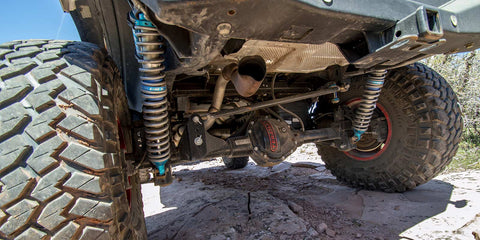
The Bilstein 6112 is the front coilover we'd put on most 4WD F-150s built from 2004 to today. You get a 2.6" body with a 60mm digressive piston, adjustable lift from stock height to as much as 2.5" depending on your truck, and a ride that rivals 2.5" race-series shocks. Dont let the word 'digressive' scare you, its how Bilstein tunes for control. Pair it with a Bilstein 5160 out back and the truck is planted on the highway, composed on dirt, and doesn't move around with a trailer behind it. Buy it assembled and it's a bolt-in.

Every F-150, Every Lift Height
The same circlip setting lifts a SuperCab differently than a SuperCrew, and a PowerBoost differently than a 2.7L. Weight on the nose is the whole story. Find your truck to find your range.
| Vehicle | Engine / Configuration | Front Lift Range |
|---|---|---|
|
2021–2026F-150 4WDSuperCab & SuperCrew Bilstein 47‑323841Details ↓ |
5.0L V8 & 3.5L EcoBoostNon-Tremor | Stock – 2.5" |
| 2.7L EcoBoostNon-Tremor | 0.4" – 2.4" | |
| 3.5L PowerBoostNon-Tremor | Stock – 1.9" | |
| Tremor5.0L V8 & 3.5L EcoBoost | Stock – 1.5" | |
| 2015–2020F-150 4WDBilstein 47‑310995Details ↓ | Gas2.7L & 3.5L EcoBoost, 5.0L V8 | Stock – 2.0" |
| Diesel3.0L Power Stroke | Stock – 1.5" | |
| 2009–2013F-150 4WDBilstein 47‑310698Details ↓ | SuperCabAll engines | Stock – 1.75" |
| SuperCrewAll engines | Stock – 1.75" | |
| 2004–2008F-150 4WDBilstein 47‑310780Details ↓ | SuperCrewV8 | 0.25" – 2.25" |
| SuperCabV8 | Stock – 2.0" |
Lift values are approximate and measured at the front over stock height. Every product page has the full groove-by-groove chart for that part number.
Why the 6112 Is Our Pick
Size isn't the whole story, but it helps. The 6112 runs a 2.6" body around a 60mm piston. More oil, more piston surface area, more heat capacity than the 2.0" shocks most F-150 owners compare it to.
The bigger deal is the valving. Bilstein's digressive valving keeps the shock firm in the middle ride zone, then softens up once the shock moves further, so small, quick hits see heavy resistance, while big hits open up the suspension to keep the truck tracking with confidence. The faster you go, the smoother it gets. On our 14th-gen test truck, that meant broken pavement stopped chattering into the cab, and the dips that used to bottom the front end got swallowed.
That's why the 6112 came out of our F-150 shock shootout as the Value Champion, ahead of the Eibach Pro-Truck Stage 2R and the Fox 2.0 on price-to-performance.

Why We Sell It Assembled
Every kit in this guide ships assembled: shock, spring, and upper mount built into one unit. We think our mounts are better than OE. No spring compressor. No fighting a loaded coil in your driveway. Pull the factory strut, bolt in the 6112, get an alignment, and you're off to the trails.
How Lift Works on a 6112
The spring sits on a circlip that clips into one of several grooves on the shock body. Higher groove, more preload, more lift. The catch is that the truck's weight decides how much each groove actually gives you. A heavier front end compresses the spring more, so the same groove lifts it less. That's why the chart above breaks out every engine and cab, and why every one of our product pages carries the full chart for that part number.
2021+ F-150
Bilstein 6112 Assembled · 47-323841 · 4WD SuperCab & SuperCrew
This is our truck. We ran the 6112 on a 2023 PowerBoost with the Max Tow package through a three-way shootout against the Eibach Pro-Truck Stage 2R and the Fox 2.0 Performance Series. Stock, the front end was underdamped: soft initial compression, a harsh bottom-out, too much body roll, and a bouncy rebound. The 6112 fixed all four.
The 60mm piston cleaned up small-bump harshness without giving up control on the big stuff. The owner of Shock Surplus called it "surprisingly buttery." At speed, the truck felt planted and confident. With a trailer hooked up, no wallow and no fade. For the money, nothing else we tested on this truck came close.
The 14th gen has more configurations than any F-150 in this guide, so lift varies the most here. The PowerBoost carries the extra weight of the hybrid system, so it gets less lift per groove. That lines up with what we measured: right around 2" on our PowerBoost. The 2.7L is the lightest of the bunch, which is why even the lowest groove adds 0.4". The Tremor already rides taller from the factory, so Bilstein caps it at 1.5".
One part number covers 2021 through 2026, including the 2024 refresh. It doesn't fit the Raptor or the Lightning; those run completely different suspension.
↑ Back to top2015–2020 F-150
Bilstein 6112 Assembled · 47-310995 · 4WD
Ford went to an aluminum body in 2015 and pulled serious weight off the truck. Lighter truck, but the same factory damping story: it floats over the small stuff and runs out of answers on the big stuff. The 6112 brings the same fix here that it brought to our 14th gen.
Bilstein splits this generation by fuel. The diesel gives up half an inch at the top because the Power Stroke puts more weight on the nose, so the spring sits more compressed and every groove gives you less.
If you bought the diesel to tow, the 6112 is right in its wheelhouse. Digressive valving controls the rebound cycle that makes a loaded truck porpoise down the highway, and the 2.6" body has the heat capacity to keep doing it on a long pull.
↑ Back to top2009–2013 F-150
Bilstein 6112 Assembled · 47-310698 · 4WD
This is the F-150 you see everywhere. 2011 brought the 5.0L Coyote and the first 3.5L EcoBoost, and a lot of these trucks are still racking up miles. Most of them are also still on struts that gave up the ghost years ago.
Good news: Bilstein treats every engine the same on this generation. Same max on both cabs, but the SuperCrew gets there one groove sooner. Max lift is lower than the other generations, and that's fine. Keep front lift as low as possible and as high as absolutely necessary. 1.75" takes a big bite out of the factory rake and keeps the front-end geometry happy.
Running a 2014? This part number covers 2009–2013. [verify: 2014 fitment and part number] Call or chat with us and we'll get you on the right one.
2004–2008 F-150
Bilstein 6112 Assembled · 47-310780 · 4WD
These trucks are pushing 20 years old. If yours is still on factory struts, you've probably gotten so used to the float that you don't notice it anymore, "butt-blind". On this generation, the 6112 is as much a restoration as an upgrade, and it'll make the truck feel tighter than it did the day it left the lot.
Bilstein's chart covers V8 SuperCab and SuperCrew trucks, and the two cabs lift differently. Note the SuperCrew has no true stock setting; the lowest groove still adds a quarter inch. Running a regular cab or the V6? Call us before you order.
2004 F-150 Heritage owners: the Heritage is the previous-generation truck carried over for 2004. Different suspension, and this kit won't fit it.

Don't Forget the Rear
The 6112 is a front coilover. Leave the factory rear shocks in and you've just moved the problem to the back half of the truck. Rear-end buck over expansion joints, a bed that keeps bouncing after the front settles. Match the rear.
If you tow, haul, or spend real time on dirt. The reservoir adds oil volume and heat capacity, so the rear doesn't fade on long washboard sections or a hot day with a trailer. It's what we ran with the 6112 on our 14th-gen test truck.
For daily drivers and light dirt. Same digressive feel, no reservoir.
Leveling? Your stock rear height is fine. You're just taking the factory rake out of the front.
Who Should (and Shouldn't) Run the 6112
Daily drive, tow, hit dirt roads on weekends, and want somewhere between stock height and 2.5" of front lift. That's most F-150 owners.
Put comfort first and want to adjust height on the truck with a spanner wrench. On our 14th gen it had the best small-bump compliance of the three. We call it the Goldilocks shock.
Run 35s and spend hard miles in the desert, or you're planning long travel. You've outgrown a leveling coilover. Step up to a bigger-body coilover with the travel to match.
We were let down. The valving didn't match this truck: underdamped off-road, small chatter in the cab, and it cost more than the Bilstein. Fox's reputation is earned on plenty of platforms. This isn't one of them.
Before You Install
- Get an alignment. Every time. Changing ride height changes camber and caster.
- Upper control arms aren't required for most trucks within the ranges in this guide. If your alignment shop can't get camber and caster back in spec at your setting, or you're planning to go bigger, that's when UCAs come in. Our UCA guide breaks down the options.
- Don't stack a spacer on top. Max coilover height plus a spacer overextends the CVs and ball joints and burns up droop travel. The lift is in the coilover. Leave it there.
F-150 Bilstein 6112 FAQ
Fitment
Which Bilstein 6112 fits my F-150?
It depends on your generation. The assembled Bilstein 6112 is 47-310780 for 2004–2008 F-150 4WD, 47-310698 for 2009–2013, 47-310995 for 2015–2020, and 47-323841 for 2021–2026 SuperCab and SuperCrew.
Does the Bilstein 6112 fit a 2WD F-150?
Not the kits in this guide. Every assembled Bilstein 6112 we list for the F-150 is built for 4WD trucks. If you're running a 2WD, call or chat with us and we'll point you to the right setup.
Does the Bilstein 6112 fit the 2004 F-150 Heritage?
No. The 2004 F-150 Heritage is the previous-generation truck carried over for one year, with different suspension. The 2004–2008 Bilstein 6112 (47-310780) fits the 11th-gen 2004 F-150 only.
Does the Bilstein 6112 fit the 2024+ refreshed F-150?
Yes. Bilstein 47-323841 covers 2021–2026 F-150 4WD SuperCab and SuperCrew, which includes the 2024 refresh.
Does the Bilstein 6112 fit the F-150 Tremor, Raptor, or Lightning?
Tremor, yes. Raptor and Lightning, no. On the 2021+ F-150 Tremor (5.0L V8 and 3.5L EcoBoost), the Bilstein 6112 gives stock to 1.5" of front lift. The Raptor and Lightning use completely different suspension.
Lift & Setup
How much lift does the Bilstein 6112 give an F-150?
Anywhere from stock to 2.5" up front, depending on your generation, engine, and cab. The most is 2.5" on a 2021+ F-150 with the 5.0L V8 or 3.5L EcoBoost. The least is 1.5" on the 2015–2020 diesel and the 2021+ Tremor. The height chart breaks out every configuration.
Why does Bilstein 6112 lift change between F-150 engines?
Weight on the front end. A heavier engine compresses the spring more, so each circlip groove lifts the truck less. That's why a 2021+ F-150 PowerBoost tops out at 1.9" while a 2.7L EcoBoost reaches 2.4".
Can I change the ride height after I install the Bilstein 6112?
Yes, but it isn't a quick turn of a knob. Moving the circlip means taking the 6112 off the F-150 and unloading the spring with a spring compressor. Then you'll need another alignment. Pick your height up front and save yourself the trip.
Do I need upper control arms with a Bilstein 6112 on my F-150?
For most trucks, no. Within the lift ranges in this guide, stock F-150 UCAs usually get the job done. If your alignment can't get camber and caster back in spec, or you're going bigger on tires, upgrade the UCAs.
What size tires can I run on an F-150 with Bilstein 6112s?
Leveling with the Bilstein 6112 makes room for a slightly bigger tire, but wheel offset and backspacing decide what actually clears on your F-150. Tell us your wheel and tire combo and we'll tell you if it fits.
Do I need an alignment after installing Bilstein 6112s?
Yes. Any time you change front ride height on an F-150, camber and caster move with it. Get the truck aligned right after install.
Choosing a Shock
What's the difference between the Bilstein 6112 and 5100 on an F-150?
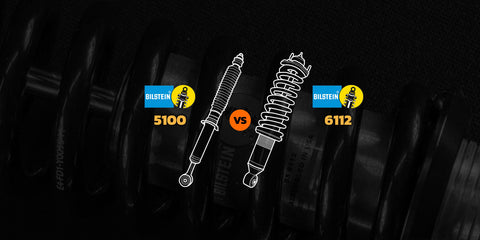
The Bilstein 6112 is the bigger, more capable coilover. It runs a 2.6" body and 60mm piston, versus the 5100's 46mm piston. On an F-150, the 6112 has more heat capacity and better control on big hits. The 5100 is the budget option for light use.
Bilstein 6112 or Eibach Pro-Truck Stage 2R on an F-150?
Bilstein for control, Eibach for comfort. In our 14th-gen F-150 testing, the Bilstein 6112 was more planted at speed and the better value. The Eibach Stage 2R had the best small-bump compliance and lets you adjust height on the truck.
Which rear shock should I pair with the Bilstein 6112 on my F-150?
The Bilstein 5160. Its remote reservoir adds heat capacity for towing and dirt, and it's what we ran with the 6112 on our F-150 test truck. The Bilstein 5100 is the budget alternative for daily drivers.
Is the Bilstein 6112 good for towing with an F-150?
Yes. On our 2023 F-150 PowerBoost with the Max Tow package, the Bilstein 6112 handled a trailer with no wallow and no fade. Digressive valving controls the rebound bounce that makes a loaded truck porpoise.
Buying & Ownership
What's the difference between an assembled Bilstein 6112 and buying the parts separately?
The assembled Bilstein 6112 shows up as one bolt-in unit: shock, spring, and upper mount already built. Buy the parts separately and you'll need a spring compressor and the know-how to assemble a loaded coilover before it goes on your F-150.
How long do Bilstein 6112s last, and can they be rebuilt?
A long time. Nothing lasts like a Bilstein. When your F-150's 6112s do need service, they're rebuildable, so you're refreshing a shock instead of replacing it.
The Bottom Line
If you've got a F-150 built anytime since 2004, the Bilstein 6112 is the coilover we'd put on it. It's planted, it tows, it handles dirt, and it doesn't cost race-shock money. Find your generation, pick your height, and pair it with a 5160 out back.
Not sure which one fits your truck? Call or chat with our team. We've driven them.
Call (213) 433-3616We'll see you out on the trails.