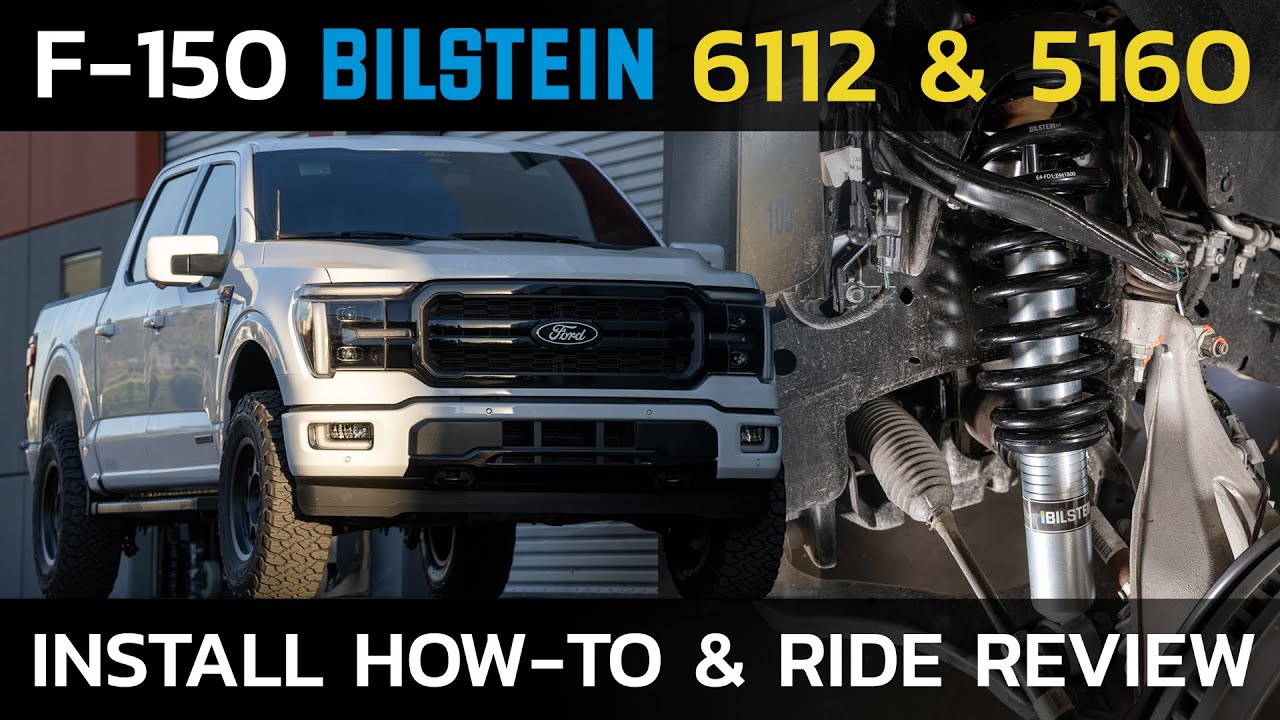
We didn't pick this kit off a spec sheet. We put Bilstein's 6112 fronts and 5160 rears head to head against the Eibach Pro-Truck Stage 2R and the Fox 2.0 Performance Series on our own 14th-gen F-150, a PowerBoost with the Max Tow package. Stock, that truck was underdamped up front: soft at the start of a hit, harsh when it bottomed, lots of body roll, and a bouncy rebound. The 6112 fixed it. The 60mm digressive piston took the edge off small chatter and still caught the big compression and rebound events, the truck stayed planted at speed, and it towed without pogo-ing or fade. It came out as our value champion: 2.6-inch body and support at 2-inch coilover pricing from the competitors.
We take it one step further. The 6112 normally shows up as a box of loose parts: dampers, springs, spring seats, and circlips, with a note that says "spring compressor required." Bilstein's kit also reuses your factory upper mounts. We build them for you, at the height you choose, with new OE-spec upper mounts, so what shows up at your door is two finished coilovers ready to bolt in to your F-150, or save you a couple hours of labor at a shop.
How We Build Them
Every pair is built to order after you pick your engine and lift setting above. Here's what happens on our bench:
- Set the circlips. The 6112 body has a row of numbered grooves, and where the circlip sits decides your ride height. On the F-150, Bilstein uses the same groove on both sides. We set each coilover to the setting you ordered.
- Seat the billet spring perch. The anodized aluminum spring seat sits on the circlip and carries the spring.
- Compress and install the Bilstein spring. We use a mounted, shop-grade strut compressor. This is the step that makes DIYers nervous, for good reason: a coil spring under load stores a lot of energy.
- Install a new OE-spec upper mount. The rubber in your factory mounts has been soaking up every pothole since the truck was new. Reusing tired mounts on fresh coilovers is like putting new tires on bent wheels. New mounts come on every build.
- Torque, check, label. The top nut gets torqued to spec, each coilover is checked and marked driver or passenger, and the pair is boxed together.
Why Buy Them Assembled?
- No spring compressor. Rental "clamshell" compressors are the most dangerous tool most people will ever use in a driveway. You skip that part entirely.
- No mismatched sides. A common 6112 mistake is setting the two sides one groove apart by accident, which leaves the truck leaning. Ours are set and checked as a pair.
- New mounts included. The loose Bilstein kit reuses your factory upper mounts. Ours come with new ones.
- Faster install. Assembly is the slowest part of a coilover job. With that done, the job is removing two struts and bolting in two.
Bilstein doesn't approve every setting on every F-150, so we only build the settings in the dropdown. The same groove lifts each truck differently: the PowerBoost carries extra weight and sits lower on the same spring, and the Tremor starts out taller. The 2.7L EcoBoost has no stock-height setting; its lowest is 0.4".
How to choose: Find your engine first. Then measure from the center of each wheel to the fender lip, front and rear. The difference is your rake. If you want the truck level on the stock rear leaf springs, pick the setting for your truck closest to that number. Adding an add-a-leaf or a new rear leaf pack? Add that rear lift to the rake. Running a steel front bumper or winch? Go one setting higher. Stuck between two? Call us with your measurements and we'll pick it with you: (213) 433-3616.
Matching the Rear: Bilstein 5100 or 5160?
The F-150 rear is a leaf-sprung solid axle, so rear height comes from the leaf pack (or an add-a-leaf), and the shock just has to cover that height. Bilstein builds both a 5100 and a 5160 for it, both rated for stock height up to 2" of rear lift and both fit 2015 and newer F-150 4WD rears. The choice comes down to how hard you work it. Our test truck runs the 5160.
The Bilstein 5100 (33-253190) is the default. It uses a 46mm digressive piston in a zinc-plated monotube body and covers stock height up to 2" of rear lift (28.74" extended, 17.52" compressed, 11.22" of travel). With Bilstein valving at both ends, gone is the feeling that the front doesn't feel sharp while the rear bounces around on tired stock shocks, however you will notice under heavy use that the 5100s will fade faster than the 6112s up front.
The Bilstein 5160 (25-311372) is for loaded or working rears. The remote reservoir adds oil capacity, so it runs cooler and fades less with a trailer behind it or on long washboard roads. Same 0-2" rear lift range. On our PowerBoost with the Max Tow package, the 6112 and 5160 together towed without the wallow or fade the stock setup showed.
Run the 5100 if:
- You're keeping the stock leaf pack, or adding up to 2"
- The truck is mostly pavement and dirt roads, with a trailer now and then
- You want Bilstein control front and rear without spending reservoir money
Run the 5160 if:
- You tow often or carry real weight in the bed
- You spend long stretches on washboard or desert roads, where a shock without a reservoir heats up
When you need something else: More than 2" of rear lift needs a longer shock. Call us and we'll size one to your setup: (213) 433-3616.
Shop the Bilstein 5100 Rear Pair for the F-150 4WD
Shop the Bilstein 5160 Rear Shocks for the F-150 4WD
On the Road
Bilstein tunes for control first, and on this truck it shows. Expect less nose dive when you brake, less body roll on on-ramps, and a front end that settles after a highway dip in one motion instead of bobbing. Our PowerBoost felt planted and confident at speed with or without a trailer. It's firmer than stock and a touch busier over small, sharp bumps than the Eibach Stage 2R, which was the comfort pick in our test. If you want a pillowy ride, this isn't it, and we'd rather tell you now than after the install.
Off the Road
The 2.6-inch body holds more oil than the factory strut and sheds heat better, so damping stays consistent on long washboard roads instead of fading. The digressive piston stays firm on small, quick inputs and opens up on bigger hits, which is why the truck stops crashing into bottom-out on the big ones. We'd skip the Fox 2.0 on this generation: in our test its valving didn't match the truck, it felt underdamped off-road, and it sent small chatter into the cab. Plan on a rear shock to match (see above).
The Honest Trade-Offs
- Not for trucks with Continuously Controlled Damping. Bilstein lists this kit for F-150s without CCD. If you have it, call us.
- Fewer settings on some trucks. The PowerBoost has five settings and tops out at 1.9". The Tremor has four and tops out at 1.5". The 2.7L has no stock-height setting.
- Your height is set when we build it. Changing it later means taking the coilover apart with a strut compressor. If you want height adjustment on the truck, the Eibach Pro-Truck Stage 2R does that; the 6112 doesn't.
- Firmer than stock. See "On the Road" above.
- Built to order. Every pair is assembled for your truck, so it takes longer to ship than a box pulled off a shelf.
- The top settings can run out of alignment. At 2-2.5", the factory upper control arms and ball joints run at steeper angles. If your alignment shop can't bring camber back into spec, aftermarket upper control arms fix it.
- Don't stack a spacer on top. A strut spacer on top of a 6112 pushes the front past what the factory arms and axles are built for.
Install Notes
- Fits 2021-2026 Ford F-150 4WD SuperCab and SuperCrew with the 5.0L V8, 3.5L EcoBoost, 2.7L EcoBoost, 3.5L PowerBoost, or Tremor (5.0L or 3.5L EcoBoost). Choose your truck above; the height settings are different for each.
- Continuously Controlled Damping (CCD): call us before ordering. Bilstein lists this kit for trucks without CCD.
- Regular Cab, 3.3L V6 or 3.0L Power Stroke owners: call us before ordering. Bilstein's chart for this kit doesn't list them.
- Not for the Raptor, the Lightning, or 2WD trucks.
- For a 2015-2020 F-150, see our 2015-2020 F-150 assembled 6112 listing.
- Removing a strut spacer? Leave it off.
- Get an alignment right after install. Any lift changes camber and toe.
- Recheck the front height after the springs settle in over the first few hundred miles.
- Most people with a floor jack, jack stands, and a basic socket set can swap the pair in an afternoon. The heavy lifting is done.
Who Should Buy These
F-150 owners who want the front leveled, a truck that stays planted at speed and under a trailer, and the best performance per dollar we've found on this generation. It's a great fit for tow rigs, daily drivers that see dirt, and weekend trail trucks. If small-bump comfort and on-truck height adjustment matter more to you than control, the Eibach Pro-Truck Stage 2R is the other kit we'd look at.