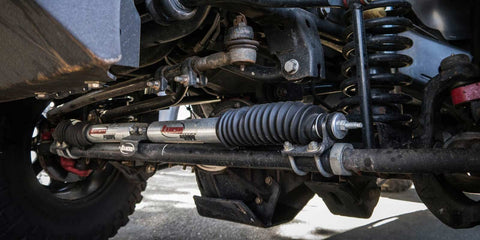
Eibach 2.0 Coilover Lift Test: Can You Really Run 4 Inches of Lift on the Silverado?
Posted by Sean Law-Bowman on
Introduction
In This Article
So, we did what we always do: got a truck in the shop, bolted a set on, and tested the claim ourselves.

Why Coilover Ride Height Actually Matters
Before diving into height settings, it's important to understand how adjusting coilovers affects suspension performance. When you add lift on a threaded-body coilover, you're not adding travel — you're shifting where the suspension operates within its existing travel.
Think of it like this:
- A coilover with 10 inches of travel might sit at 5 inches bump / 5 inches droop at stock height.
- Add 2 inches of lift and now it might sit at 7 inches bump / 3 inches droop.
That reduction in droop travel is where things get sketchy.
Not enough droop means your suspension can top out, basically hitting a hard limit on the rebound stroke. Even with a well-valved shock, topping out will make the ride harsh, noisy, and unpredictable over certain obstacles.
On most IFS trucks, we've found that 3 inches of usable droop travel at the wheel is the minimum for a comfortable, controlled ride. So hearing that these Eibach 2.0s can go to 4 inches of lift had us worried and curious.

Test 1: Out-of-the-Box Height (2 Inches of Lift)
As usual, our first step was installing the coilovers as they come from Eibach, straight out of the box. Most brands ship their coilovers preset to what they believe is the best balance of:
- Up-travel
- Down-travel
- Preload
- Everyday comfort
At this factory preset, we landed at a measured 2.0 inches of lift, dead-on.
And honestly? It feels fantastic.
On-road impressions at 2 inches:
- Smooth ride quality, unmistakably Eibach
- Minimal top-out over speed bumps (stock arms + stock droop stops still in place)
- Great control over both small chatter and bigger hits
- No bottoming out on our driveway test
- Excellent daily-driver manners
For most owners, this out-of-the-box height is going to be the sweet spot. The truck maintains plenty of droop travel, retains predictable handling, and still gets a solid visual lift.
If this were my truck, this is where I'd leave it. And that's exactly what the owner of this test vehicle plans to do, based on the results.

Test 2: Max Height — A Full 4 Inches of Lift
Now for the wild part.
To reach the advertised 4-inch height, we cranked preload up to Eibach's stated maximum of 76mm. Fortunately, their slip-ring design on the steel threaded body means you can make big adjustments without removing the coilover or grabbing a spring compressor.
Right off the rack, the truck had a noticeable Carolina squat (the rear wasn't lifted yet) so we knew weight distribution would work against us.
On-road impressions at 4 inches:
Speed bumps:
- At slow speeds, surprisingly smooth
- At higher speeds, immediate and noticeable top-out
Street driving:
- No weird handling behavior
- Front end feels firmer (less weight over the front because the rear is low)
- Rear shocks (Eibach Stage 2 with reservoirs) feel excellent
Driveway test:
- At 10 mph: big, obvious top-out
- Still not as harsh as expected
- Actually better than some setups we've tested at less lift
Dropping off a ledge:
- Instant top-out — no surprise here
- Would improve noticeably with more load or a matching rear lift
Overall at 4 inches:
Honestly? Not terrible. Not ideal, but absolutely drivable, especially with a matching rear lift.
We lost around 5 mph of comfortable speed over certain obstacles, but the truck still rode better than stock, which is not what we expected going into this test.

So What's the Ideal Lift Height for These Eibach 2.0s?
Based on measurements, motion ratio, and real-world testing:
2 Inches (Out-of-the-Box)
- Best overall ride
- Strong compromise between bump and droop
- Daily-driver friendly
- Our recommended setting for most people
3 to 3.5 Inches
- Still maintains droop close to stock
- Works if you're lifting the rear as well
- Good for a leveled stance or slightly taller build
- The highest we'd personally recommend
4 Inches
- Works, surprisingly
- Reduced droop, noticeable top-out
- Drivable only if you also lift the rear
- A "careful win," but not ideal


Final Thoughts
For most owners, the factory preset 2-inch height is going to deliver the best mix of comfort, control, and real-world usability. If you need a bit more height, and you're also lifting the rear, you can safely push them into the 3-3.5-inch range.
Four inches? Only if you know what you're getting into, and only if the rear is lifted to match.
If you've got questions about these Eibach coilovers, or you want help dialing in your GM truck's suspension setup, hit us up.