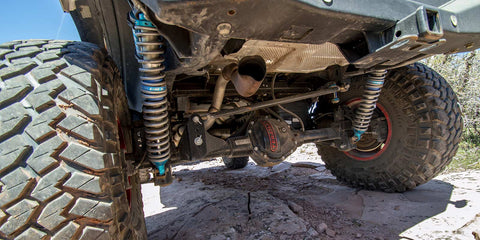
Ford F-150 Suspension Buyer's Guide Part 1: What to Know Before You Lift + The Best Entry-Level Shocks
Posted by Sean Law-Bowman on
This is Part 1 of our F-150 Suspension Buyer's Guide, where we dig into everything we know about the shocks available for your truck, what they mean for tire sizes and lift heights, and what we recommend for different kinds of drivers. Today we're doing the homework every F-150 owner should do before buying anything, then walking through the entry-level options we'd actually run on a daily driver.
In This Article
- Which F-150s This Guide Covers
- Tremor vs. Standard Ride Height
- Curb Weight & Engine Differences
- Rake & How Much Lift Is Realistic
- Do You Need Upper Control Arms?
- CCD & BlueCruise
- Wheel & Tire Fitment
- Why Leveling Spacers Are a Trap
- What to Expect from Entry-Level Shocks
- Bilstein 5100
- Eibach Pro-Truck Sport
- Eibach Stage 1 Pro-Lift Kit
- Eibach Stage 2 & 2R
- Fox 2.0: Our Dishonorable Mention
- Side-by-Side Comparison
- Which One Is Right for You?
- FAQ
- What's Next in the Series
Which F-150s This Guide Covers
This whole series focuses on 2021+ (14th gen) F-150s, but many of the parts we cover fit trucks going back to 2015, and others perform very similarly on them. So if you've got a 2015–2020 13th gen truck, most of what follows still applies to you.
As we always say, you have to know what you've got before you know what to get. Pretty much every package (Raptor aside) comes with stock struts and shocks that are suboptimal, to put it nicely, so it doesn't take much to make a big improvement. But there are still differences in ride height, stiffness, and factory tech from model to model that you'll need to work around.

Tremor vs. Standard Ride Height
Raptors aside, the biggest outlier in the lineup is the Tremor. It sits about 1″ taller in the front and at least 1″ taller in the rear than other F-150s.
The Tremor's rear shocks also have quite a bit more travel than a standard F-150's. That means two things:
- You get less lift over stock in the front from the same coilover, because you're starting higher.
- Not every aftermarket rear shock is even as long as your stock Tremor shock, so you really have to choose carefully.
Curb Weight & Engine Differences
Curb weights vary a lot across the F-150 lineup, and most kits are optimized for 4WD Crew Cab trucks with the 3.5 EcoBoost or 5.0 Coyote. In practice:
- PowerBoost (hybrid): expect less out-of-the-box lift and a lower max lift height on loaded struts and coilovers, since the nose is heavier.
- 2.7 EcoBoost (Nano): expect more lift than advertised, since the nose is lighter.
If you're buying a loaded coilover or strut like the Eibach 2.0 or OME MT64 and you've got a hybrid or a 2.7, plan on adjusting the preload from the factory setting to get the coilover where it performs best.

Rake & How Much Lift Is Realistic
These trucks have more rear-high rake than most, and the max tow package adds even more. Getting truly level can take as much as 3″ of front lift.
Icon is the only brand we've found making a reliable coilover solution for Tremors and base models that rides well at those heights, and "well" is an understatement. For everything else, 2–2.5″ of front lift is the most we recommend, even if the box says more. Most options just don't have the travel to avoid topping out constantly beyond that.
The limiting factor is clearance. There's very little room between the upper control arm or knuckle and the strut, so most coilovers and struts limit travel (and therefore lift) to keep the arm or knuckle from hitting the spring at full extension. Icon is the only one making control arms and knuckles that open up that extra travel. We won't cover Icon's shocks or complete kits today, but keep them in mind for later episodes.
Front Lift Range by Option
Here's how the options in this article stack up against our recommended ceiling.

Do You Need Upper Control Arms?
There are a handful of reasons you'll want aftermarket upper control arms (UCAs) on an F-150:
- Remote reservoir coilovers need them for clearance, period.
- Spacer lifts cause bind. Anything over a 2″ spacer costs you down travel, and past 2.5″ you run into the same clearance problems as reservoir coilovers.
- The stock ball joints and bushings are soft. They deflect and fail easily under anything beyond mild off-road use, or even on the street with tires much bigger than 34″.
- Headlight aim. Ford mounts the leveling hardware for the Dynamic Bending Headlights to the UCA. Even if your coilovers don't need new arms, lots of people upgrade to get their headlights pointing where they should instead of blinding the car in front of them.
As always: if you have to ask, get a set to be safe.
Our UCA Picks
- Icon Delta Joint Pro Tubular: our top pick. Fewest tire and wheel clearance limitations, uniball strength with ball joint longevity, and 90 degrees of articulation.
- OME: the better solution for most people who aren't wheeling hard or running one of Icon's long-travel coilovers.
- SPC: currently on our truck and working great, though on these trucks we think the extra adjustability is unnecessary.

ICON Vehicle Dynamics
Tubular Upper Control Arm Delta Joint Kit
2021+ Ford F-150
Shop All F-150 Upper Control Arms
Not sure which arm works with your wheels and coilovers? Call us at (213) 433-3616.

CCD & BlueCruise
CCD (Continuously Controlled Damping)
Some F-150s come with Ford's electronically controlled suspension, called CCD. If you're upgrading struts and shocks, it has to go.
We're the first to say electronic suspension is the future, and there are some excellent electronically controlled options coming later in this series. But good tech on a weak shock with a weak algorithm still makes for weak performance and ride quality. That doesn't mean you should grab the cheapest parts-store shock you can find, but if you upgrade to anything in this guide, you're not giving up anything CCD was doing for you.
You will need to budget about $400 for a delete kit to keep your dash free of warnings. And if you're still shopping for an F-150 and know you'll upgrade the suspension, skip the CCD-equipped truck. It costs you more up front and more during the upgrade.
BlueCruise
BlueCruise, Ford's hands-free driver assistance system, uses GPS, cameras, and radar to know where you are and where you're going. Lifting the truck moves those sensors and cameras, which can throw the system out of calibration.
Whether people actually have issues is hit or miss, but it seems to happen more often the more level the truck sits. If you want BlueCruise to keep working, it pays to keep some rake.
So if your goal was just to cut down that big rear-high rake, consider a rear spring upgrade as part of the plan. The stock leaf springs are harsh enough that most people benefit anyway, especially from something like the Icon RXT packs that let you pull the stock blocks and run a longer shackle.
Either way, it's not a huge deal to have Ford recalibrate the system. You might just need it done more than once.

Wheel & Tire Fitment
Higher offset is better for tire clearance on these trucks. It minimizes scrub radius and keeps the tire tucked inside the fender line when you bottom out. Two caveats:
- With the max tow package, you may only be able to go to around +35 for rear brake clearance.
- Some upper control arms won't work with more than +30, so check with us before you buy.
With that wheel spec, a 35x12.5 pretty much clears at stock height, at least with the Tremor front bumper and skid plate, and more lift doesn't make much difference. With something like Icon's 3.5–4.5″ kits, we'd guess a narrow 37 is possible without too much work, but we haven't tested it.
Fitting the Tire Is the Easy Part
Controlling it is another story. These trucks typically run a 450–550 lb front spring depending on engine and coilover choice, and that's not a lot to manage the mass of a 35″ or bigger tire. If you plan to run anything larger than a 34″ tire, get a 2.5 shock in the front. 2.0 and smaller shocks struggle with big tires, dribble, top out, and ride harsher than they should.

Why Leveling Spacers Are a Trap
The front suspension on these trucks doesn't leave much room to work with on stock components, and travel is limited to begin with.
With a traditional strut spacer, by the time you're close to level you've lost over 1″ of down travel with the stock arms, leaving you with a measly 6″ or less at the wheel.
Learned it the hard way: on our own truck, a 2.5″ spacer lift sheared the steering stop off our knuckles and killed the stock upper ball joints, which forced an upper control arm upgrade. The UCAs alone cost more than a set of Bilstein 5100s or Eibach Pro-Truck Sports, which would have added a little travel, improved the ride, and worked with every stock component without breaking anything.
Preload collar lifts aren't viable either. The stock struts have only about 7″ of total travel and too little rebound control to begin with. Adding spring force while taking away down travel gives you a truck that tops out constantly and rides terribly, whatever the Facebook groups say.
Lift Methods Compared
| Method | Effect on down travel | Hidden costs | Ride quality | Our take |
|---|---|---|---|---|
| Strut spacer | Loses 1″+ near level; ~6″ or less at the wheel | Bind, broken steering stops, dead ball joints, UCAs | Same weak stock damping, less travel | Not worth it |
| Preload collar | Takes travel away from a ~7″ strut | Constant top-out | Worse than stock | Not viable |
| Adjustable strut w/ stock springs (5100, PTS) | Small gain over stock | Spring compressor / labor | Better than stock | Smart budget pick |
| Loaded threaded-body coilover (Eibach 2.0) | A touch more travel; better tune | None for most trucks | Best in this tier | Sweet spot |

What to Expect from Entry-Level Shocks
As you can tell, the cheap-and-cheerful route on these trucks is neither cheap nor cheerful. Buying once and crying once with a good set of struts or coilovers is the right move, especially since these trucks need better dampers right out of the gate anyway.
We call the options below "entry level" because of their intended use and outright performance, not their price, though they happen to be reasonably priced too. Many cost less than the parts and repairs that come with a spacer lift, so you get the stance you want for less and a better ride on top of it.
Who this tier is for: everything here is daily-driver focused. These shocks make the truck a bit more stable, take some of the jolt out of your commute, and make it actually functional off-road. They are not a complete transformation, they won't be happy with a big set of 35s, and they won't do Raptor things. If your needs look more like the average driver's than the average enthusiast's, you're in the right place.

Bilstein 5100
You can't talk entry-level shocks without the granddaddy of them all.
Fitment & Lift
- Front: reuses your stock springs, top hats, and hardware, with six ride height settings from stock to about 2.5″, roughly ½″ apart.
- Rear: available for 0–1″, 2″, and 4″ of lift, so they work with a wide range of 4–6″ spacer-style lift kits and give you room to upgrade those rough-riding rear springs.
- Extra parts: none if you're using them as a leveling kit. You can keep the stock control arms.
The catch: you'll have to pull your stock struts, put them on a spring compressor, and transfer the parts over. What you pay in labor, you save on the parts.
Ride & Performance
With true double-digressive valving, the 5100 is arguably the stiffest-riding option here, especially over small bumps and washboard at lower speeds. Still, most people prefer it to stock, and they really like how much better the truck handles and how much more stable it is under a load.
As a 2″-body shock it gets overwhelmed easily. It softens up as speed increases, but its limit is low and its happy range in the dirt is limited. It's just enough to make the truck genuinely drivable off pavement, which doesn't sound like a compliment until you've found out how bad the stock stuff is.
Bottom line: if this is as far as your budget stretches and you've got the occasional load or twisty road to deal with, these are the shocks to buy.

Bilstein
5100 Series
2021+ Ford F-150
Questions on ride height settings or rear lengths? Call (213) 433-3616.

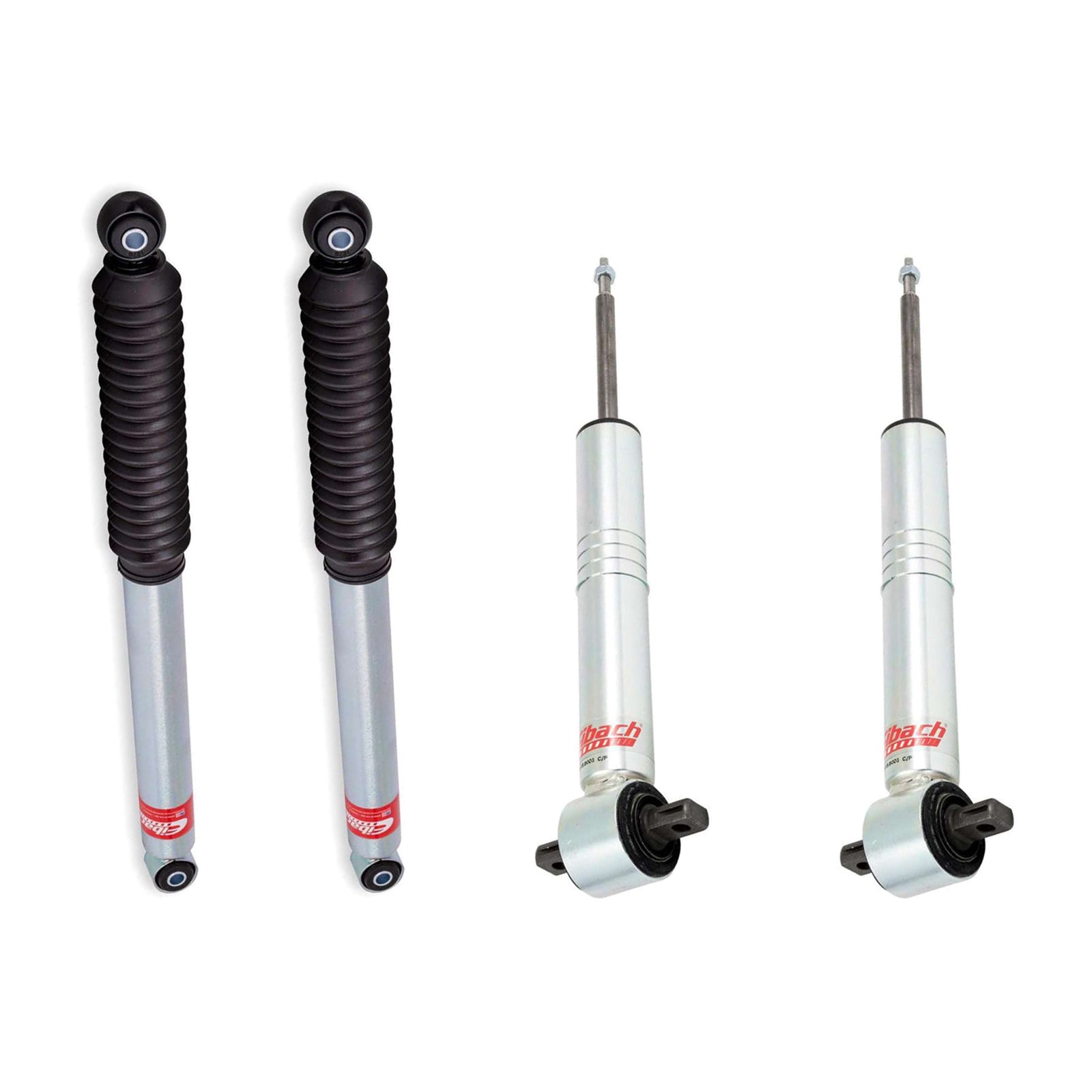
Eibach Pro-Truck Sport
If the firmer feel of the 5100 is a red flag but your budget won't stretch further, the Eibach Pro-Truck Sport (PTS) is your answer. It's about as close to a carbon copy of the Bilstein as you can get, right down to the price. The big difference is a softer tune.
Eibach isn't locked into digressive or linear valving the way many brands (Bilstein included) are. They'll mix the two, often front to rear, to match what the vehicle needs. On the F-150 that means mostly linear valving up front for better small-bump compliance, and digressive valving in the rear to help a bit when towing or hauling.
We call it an OEM+ setup: it keeps the stock-like ride where the stock parts do well and improves the areas where they fall short. Expect:
- A little less body roll and brake dive
- Fewer second bounces after a bump, at least on the road
- Less jarring feel on washboard
- Slightly better stability under a load
It doesn't match the 5100's overall stability, loaded or not, but it's softer where the Bilstein is at its worst. You could argue the 5100 is slightly better off-road, and we'd like to see longer rear options than the 0–1″ shock Eibach offers. But if you're shopping this tier, that extra off-road performance probably doesn't matter, and if you have a big lift that needs longer rear shocks, you likely have tires big enough to overwhelm any 2″-body option anyway.
Eibach
Pro-Truck Sport
2015+ Ford F-150
Call (213) 433-3616 with any fitment questions.

Eibach Stage 1 Pro-Lift Kit
We have to at least mention the Stage 1 kit, even though we don't think it's the move for most people.
The only difference from the Pro-Truck Sport is a set of Pro-Lift springs that give about 3″ of lift on most trucks at the lowest circlip setting. The next two settings let you recover height lost to a bumper, winch, skid plates, or other heavy front-end additions.
That's a great idea on paper, and something we love in higher-end kits. The problem is that 3″ is simply too much for the included struts. They're the same PTS struts you can buy on their own, designed to work with stock springs at stock height, so they only gain a little travel over stock. They certainly don't gain 3 full inches.
The result: total travel goes up, but down travel goes way down. They top out constantly and ride harshly, with no way to run less lift.
Our recommendation: skip the Stage 1 unless you already have, or will soon add, at least 100 lb of constant load over the front end. Without that weight, it rides worse than a Pro-Truck Sport at around 2″ on stock springs, and costs more.

Eibach
Pro-Truck Stage 1 Kit
2021+ Ford F-150

Eibach Stage 2 & 2R
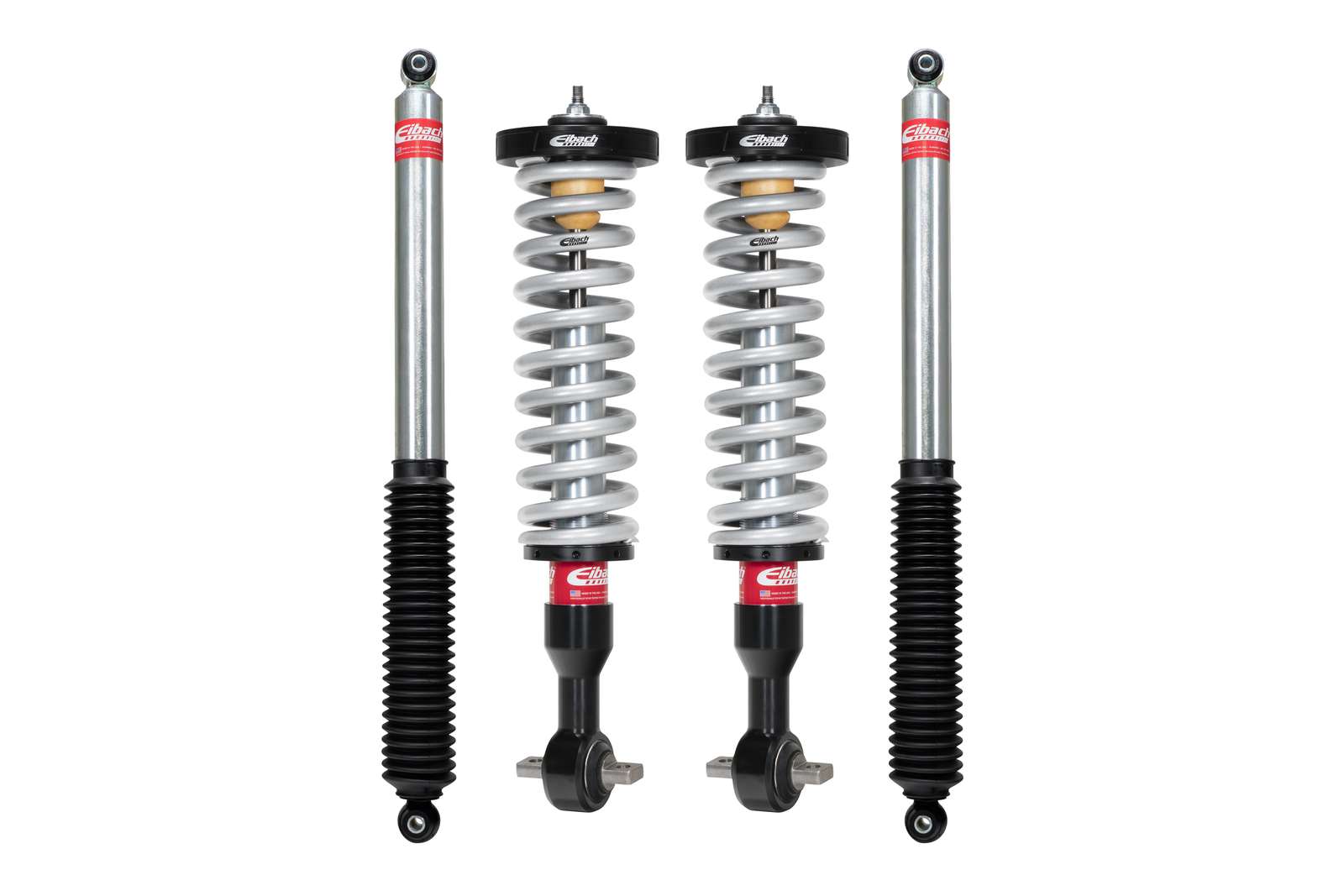
If you've got a little extra to spend, the sweet spot in Eibach's catalog, and in this whole article, is the Stage 2 kit. It swaps the Pro-Truck Sport front struts for Eibach's loaded, threaded-body 2.0 coilovers.
We get it: paying double the PTS price, and close to $400 more than the Stage 1 for less lift, doesn't look great on paper. But most people who buy the lesser kits end up upgrading to the 2.0 coilovers up front and never looking back. That tells you everything.
Why It's Better
- Better tune and a bit more travel. With control over the whole assembly, damper and spring, Eibach isn't stuck with the constraints of the stock-spring parts.
- Comes loaded. About 2″ of lift out of the box on most Coyote and 3.5 EcoBoost trucks, so there's nothing to assemble.
- No spring compressor for adjustments. Each full turn of the collar is about ⅛″ of ride height, and in our testing that's spot on.
- Flat-ground universal springs. Adjustment runs from about 0.5–2.3″, with threads to spare above the recommended max. If you run out of adjustment after adding a bumper or winch, you have spring options, which you can't say about anything that uses factory or factory-style tapered springs.
Tip: the included adjustment tool is a little weak, so take your time with it. If you see a lot of preload changes in your future, spring for the heavy-duty tool.
The rear rides the same as the other Eibach kits since the rear shock is unchanged, but the front's added comfort, easy install, and adjustability put this kit in a different league. At nearly $1,300 , it's close to a no-brainer: more comfortable, more stable, more usable, and better than the Stage 1 at the one thing the Stage 1 does well.
It's also the one kit in this article we'd call somewhat viable for regular off-road use, as long as you keep speeds and trail difficulty reasonable.
What About the Stage 2R?
The Stage 2R swaps the rear Pro-Truck Sport shocks for Pro-Truck Reservoir shocks with an external reservoir for better heat dissipation. They do that job, but it's a wasted benefit on these trucks. The front end is far heavier than the rear, and the independent front suspension makes the struts mechanically less efficient. The rear shocks were never the problem.
In our head-to-head between the Stage 2R and the Bilstein 6112/5160 , the front coilovers failed long before the rear shocks even got warm. If you think you need a rear reservoir, you need something much bigger than a 2.0 coilover up front: think Eibach Stage 3R, Bilstein 6112/5160 or 8100, or the bigger-bodied options coming in the next episode.
Eibach
Pro-Truck Stage 2 Kit
2015+ Ford F-150
Shop Eibach Stage 2R for F-150
Want help setting preload for a PowerBoost or 2.7? Call (213) 433-3616.

Fox 2.0
A lot of you have probably been researching the Fox 2.0s, and fairly so. But we wouldn't be doing our job if we didn't save you from them on this truck.
For context, I'm a big Fox guy. It's all I run on my mountain bikes, it's what I'd buy for my own rigs, and I've been accused of bias in their favor before. On most vehicles the 2.0s are among the more comfortable things you can buy. So believe me when I say this isn't fun to write.
- 2021+ trucks: they just don't ride or perform well. We checked everything and tried every fix we could think of. Nothing worked.
- 2015–2020 trucks: comfortable, but no more so than the Eibach 2.0, which costs less and has a longer service life.
As the most expensive option on this list, they're the one thing here we recommend avoiding.
That's not a knock on Fox as a whole. Their new 2.5 Performance Series coilovers and shocks have become one of our most frequently recommended packages, they couldn't be more different from the 2.0s, and we'd argue they're the real sweet spot in the Fox catalog. If you love Fox, start there. If it's the feel people get from Fox 2.0s on other trucks you're after, the Eibachs aren't just a suitable alternative; they're the better value.

Fox
2.0 Performance
2021+ Ford F-150
Side-by-Side Comparison
| Option | Front design | Front lift | Rear lengths | Ride feel | Install | Best for | Verdict |
|---|---|---|---|---|---|---|---|
| Bilstein 5100 | 2″ strut, reuses stock springs | Stock–2.5″ (6 settings) | 0–1″, 2″, 4″ | Firmest; stable under load | Spring compressor required | Towing, hauling, twisty roads on a budget | Best budget all-rounder |
| Eibach Pro-Truck Sport | 2″ strut, reuses stock springs | Stock–~2.7″ | 0–1″ | Softer, OEM+ | Spring compressor required | Comfort-first commuters | Best budget comfort |
| Eibach Stage 1 | PTS strut + Pro-Lift springs | ~3″+ | 0–1″ | Harsh, frequent top-out | Spring compressor required | Trucks with 100+ lb constant front load | Skip for most |
| Eibach Stage 2 | Loaded 2.0 threaded-body coilover | 0.5–2.3″ (~1/8″ per turn) | 0–1″ | Most comfortable in this tier | Bolt-in, no compressor | Daily drivers with light-moderate off-road | Sweet spot |
| Fox 2.0 | 2.0 coilover | — | — | Poor on 2021+; comfy on 2015–20 | — | Nobody, on this truck | Avoid |

Which One Is Right for You?
- Tightest budget, tow or haul occasionally: Bilstein 5100.
- Tightest budget, want to keep a stock-like ride: Eibach Pro-Truck Sport.
- Can stretch the budget for the best daily-driver setup: Eibach Stage 2. This is our pick for most people in this tier.
- Heavy bumper and winch already on the truck: Eibach Stage 1 becomes reasonable, though the Stage 2's adjustable coilover still handles it better.
- Running 35s, wheeling regularly, or wanting a rear reservoir: you've outgrown this tier. Look at Part 2.
- Thinking about a spacer: don't. Put that money toward one of the options above.
Shop All F-150 Lift & Leveling Kits
Still deciding? Call (213) 433-3616 and we'll help you pick.
Frequently Asked Questions
Not really. Once a strut spacer gets you close to level, you've lost more than an inch of down travel with the stock arms, leaving roughly 6″ or less at the wheel. Spacers over 2″ cause control arm bind, and on our own truck a 2.5″ spacer sheared the steering stop off the knuckle and killed the upper ball joints. The upper control arm we needed afterward cost more than a set of Bilstein 5100s or Eibach Pro-Truck Sports, which work with all your stock parts and improve the ride.
For most coilovers and struts we recommend 2–2.5″ of front lift at most, even if the manufacturer says you can go higher. Past that, most options don't have the travel to avoid topping out constantly. Getting truly level can take up to 3″ of front lift because of the factory rake, and Icon is the only brand we've found with a coilover solution that rides well at that height on Tremors and base models.
You do if you run a coilover with a remote reservoir (for clearance), a spacer lift over about 2.5″, or tires much bigger than 34″. The stock ball joints and bushings are soft and fail easily. Ford also mounts the headlight leveling hardware for the Dynamic Bending Headlights to the upper control arm, so many people upgrade to get their headlight aim back after lifting. If you have to ask, get a set to be safe. Our top pick is the Icon Delta Joint Pro tubular arm; for most people who aren't wheeling hard, the OME arms are the better fit.
No. CCD has to go when you upgrade the struts and shocks, and you should budget about $400 for a delete kit so your dash stays warning-free. You won't be giving up anything that was doing you favors. If you're shopping for an F-150 and know you'll upgrade the suspension, skip the CCD-equipped truck: it costs more up front and more during the upgrade.
It can. Lifting moves the external sensors and cameras, which can knock the system out of calibration. It's hit or miss, but problems seem more common the more level the truck sits, so keeping some rake helps. A rear spring upgrade, such as the Icon RXT leaf packs that let you remove the stock blocks and run a longer shackle, can help balance the stance. Ford can recalibrate the system, though you may need it done more than once.
The ideal wheel is 8–8.5″ wide with a +20 to +38 offset. With the max tow package, you may be limited to around +35 for rear brake clearance, and some upper control arms won't work with more than +30, so check with us before buying. That setup lets a 35x12.5 tire mostly clear at stock height, at least with the Tremor front bumper and skid plate. If you plan on running anything bigger than a 34″ tire, you'll want a 2.5 shock up front.
They're close to carbon copies, down to the price. The Bilstein 5100 is firmer, especially over small bumps and washboard at low speeds, but more stable under a load and slightly more capable off-road. It also comes in more rear shock lengths. The Eibach Pro-Truck Sport is tuned softer, with mostly linear valving up front and digressive valving in the rear, for an OEM-plus feel. Choose the 5100 for towing, hauling, and twisty roads; choose the Pro-Truck Sport if comfort matters more.
For most people, yes. The Stage 1's Pro-Lift springs give about 3″ of lift on the lowest setting, which is too much for the included struts, so they top out and ride harshly unless you have at least 100 extra pounds of constant load up front. The Stage 2 swaps in Eibach's loaded, threaded-body 2.0 coilovers with roughly 0.5–2.3″ of adjustable lift, a better tune, and no spring compressor needed. Most people who buy the lesser kits end up upgrading to the 2.0 coilovers anyway.
Not in our testing. They didn't ride or perform well on 2021+ trucks, and nothing we tried improved them. On 2015–2020 trucks they're comfortable, but no more so than the Eibach 2.0s, which cost less and last longer. If you want Fox, the Fox 2.5 Performance Series is the one to look at, and it's covered in Part 2.
Largely, yes. We focus on 2021+ (14th gen) trucks, but many of the parts covered fit back to 2015, and others perform very similarly on the 13th gen trucks. The Fox 2.0 is the notable exception: it behaves quite differently between the two generations.

What's Next in the Series
Those Fox 2.5 Performance Series coilovers and shocks kick off Part 2, where we get into the intermediate, more enthusiast-oriented options. For most people looking for a noticeable upgrade across the board, and especially off-road, that's the real sweet spot in the market.
In the meantime, we've got plenty of in-depth F-150 suspension reviews to keep you busy.
Series so far:
- Part 1: Before You Lift + Entry-Level Shocks (you are here)
- Part 2: Intermediate Shocks (coming soon)
Ready to Upgrade Your F-150?
Interested in anything we covered today for your F-150, or whatever else you're whipping? Shock Surplus is your one-stop shop.
Shop All F-150 Lift & Leveling Kits
Phone: (213) 433-3616
We'll see you out on the trails.