How to Adjust Preload and Ride Height on Threaded-Body Coilovers
Posted by Sean Law-Bowman on

What Is Preload?
Preload is how much the spring is compressed in the assembly compared to its free, fully extended length.
The more you compress the spring, the more preload you have, and the more the spring pushes to extend the coilover or strut, raising the vehicle. The less you compress it, the lower the vehicle sits.
That can feel counterintuitive, so here's the one rule to remember for the rest of this article:

Two Styles of Preload Adjustment
Preload adjustment is preload adjustment. No matter how you get there, the end result is the same, but there's more than one way to get it done.
Circlip Adjustment
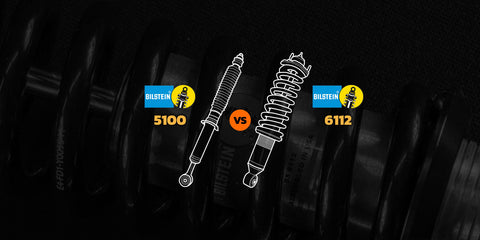
Many entry-level and mid-tier struts, like the Bilstein 6112, use circlip adjustment. The strut body has a few preset grooves, and the spring seat is held in one of those grooves by a circlip or snap ring. You get a handful of fixed ride height settings to choose from.
Threaded-Body Adjustment
Then there are threaded-body coilovers, like the Eibach Stage 3R 2.5″ coilovers we're running on our Ford F-150. You're still moving the spring seat up and down, but the threaded body gives you near-infinite adjustment within a set range.

Do You Need a Spring Compressor?
Circlip-Style Struts: Yes
On any circlip-style strut, you won't be able to move the clip while spring force is holding the seat in place. Unless you're a magician, you'll need to mount the strut in a spring compressor and compress the spring until there's no load on the spring seats. From there, you can move the seat wherever you need it.
Threaded Coilovers: It Depends on the Body
On threaded-body coilovers, it comes down to what the body is made of.
Aluminum-body coilovers require a spring compressor. That includes select Bilstein 8112 models and the Fox 2.0 and 2.5 Performance Series and Performance Elite. Aluminum threads can't handle the full spring load during adjustment. We've tried it, and you'll damage the threads.
Steel-body coilovers are a different story. Steel is strong enough to handle the spring force during adjustment, and many, including Eibach's 2.0 and 2.5 series, include a slip washer between the spring and the seat. That lets the spring rotate freely, so the pigtail doesn't bind against the seat or the adjustment collar.
The result: you can adjust these with the coilovers installed on the vehicle. Just get the front end up on jack stands, like we have with our F-150, so you're not fighting the weight of the truck. And a nice bonus with Eibach: they include a spanner wrench in the box.
Preload adjustment by coilover and strut type
| Type | How It Adjusts | Spring Compressor? | Examples |
|---|---|---|---|
| Circlip strut | Seat moves between a few preset grooves, held by a circlip or snap ring | Required | Bilstein 6112 |
| Threaded aluminum body | Near-infinite adjustment within a set range | Required, or you risk damaging the threads | Select Bilstein 8112 models; Fox 2.0 & 2.5 Performance Series and Performance Elite |
| Threaded steel body | Near-infinite adjustment within a set range; slip washer lets the spring rotate | Usually not; adjust on the vehicle with the front end on jack stands | Eibach 2.0 & 2.5 series |

Which Direction to Adjust
The Eibachs on our F-150 are a standard-orientation coilover, meaning the body is on the bottom and the shaft is on top. To raise the truck, move the spring seat up. To lower it, move the seat down.
Many high-end coilovers use an inverted design, with the body on top and the shaft on the bottom. The principle is identical; you're just moving the seat in the opposite direction.
Spring seat direction by coilover orientation
| Orientation | To Raise the Vehicle | To Lower the Vehicle |
|---|---|---|
| Standard (body on bottom, shaft on top) | Move the seat up | Move the seat down |
| Inverted (body on top, shaft on bottom) | Move the seat down | Move the seat up |
| Either one | Compress the spring | Back off the spring |
That's why we stick with the simple rule: compress the spring to go taller, back off the spring to go lower. It works no matter which way your coilover is mounted.

How Much to Adjust
Knowing how much to adjust depends on the manufacturer.
Eibach: Turns per Inch
Eibach makes it easy. They give you a baseline for where the vehicle will sit out of the box, and they tell you exactly how much ride height change each turn produces. On our F-150 kit, one full turn of the spring seat equals about 1/8″ of ride height. Across multiple sets of Eibach 2.0 and 2.5 coilovers, we've found that to be very accurate.
Bilstein: Reference Measurements
Bilstein takes a different approach. They provide a measurement, typically from the bottom of the spring seat or the top of the top hat to a reference point, along with several recommended settings, so you can estimate where the vehicle will sit.
No Guidance? Use Your Motion Ratio
Without that kind of guidance, the easiest method is to calculate your motion ratio. It's what I rely on most of the time.
Calculating Your Motion Ratio
On an independent front suspension:
- Measure A: the lower control arm, from the center of the inner pivot bolt at the frame to the center of the ball joint.
- Measure B: from that same inner pivot to the coilover or strut mount.
- Divide A by B. That's your motion ratio.
- Divide your desired ride height change by the motion ratio. That's your starting preload adjustment.
It won't be perfect every time, but it's a solid starting point, and the goal is to get you close.

Tools for the Job
Spanner Wrench or Punch
An included spanner wrench is mostly an Eibach thing. Few brands outside of Eibach and Dobinsons include preload adjusters with their coilovers. Without one, you can usually use a punch in the slots of the spring seat or lock collar to make your adjustments.
We've been using the same Harbor Freight punch set since Shock Surplus started. They're a little bent at this point, but they still get the job done.
Jack Stands and a Spring Compressor
Even on coilovers like the Eibachs that can be adjusted on the vehicle, taking some load off the spring makes the job easier. If you find yourself fighting it the entire time, don't try to prove anything. Grab a spring compressor and avoid damaging your parts.
- Spanner wrench (included with Eibach) or a punch for the seat and lock collar slots
- Jack stands to get the weight off the front end for on-vehicle adjustment
- Spring compressor for circlip struts, aluminum-body coilovers, or any spring that's fighting you
- Tape measure for motion ratio and before-and-after ride height
Frequently Asked Questions
Preload is how much the spring is compressed in the assembly compared to its free, fully extended length. The more you compress the spring, the more preload you have, and the more the spring pushes to extend the coilover or strut, which raises the vehicle.
Adding preload raises the vehicle. The simple rule is: compress the spring to go taller, back off the spring to go lower. That holds true for standard and inverted coilovers alike.
Adding preload doesn't change the spring rate, so it doesn't make the spring itself stiffer. It changes where the vehicle sits. Raising the vehicle does shift how the suspension travel is split between compression and droop, which can change how the vehicle feels.
On circlip-style struts, yes. You can't move the clip while the spring is loading the seat, so the strut has to be compressed until there's no load on the spring seats. On threaded aluminum-body coilovers, also yes, because aluminum threads can be damaged under full spring load. Many steel-body coilovers, like Eibach's 2.0 and 2.5 series, can be adjusted on the vehicle with the front end on jack stands.
Not the aluminum-body Fox 2.0 and 2.5 Performance Series and Performance Elite coilovers. Aluminum threads can't handle the full spring load during adjustment, and we've damaged threads trying. Use a spring compressor to take the load off before adjusting.
On a standard coilover, with the body on the bottom and the shaft on top, move the spring seat up to raise the vehicle and down to lower it. An inverted coilover has the body on top, so you move the seat in the opposite direction. Either way, compressing the spring raises the vehicle and backing it off lowers it.
It depends on the manufacturer and vehicle. On the Eibach kit we tested on our F-150, one full turn of the spring seat equals about 1/8″ of ride height, and we've found that to be very accurate across multiple sets of Eibach 2.0 and 2.5 coilovers. Other brands, like Bilstein, provide reference measurements and recommended settings instead.
On an independent front suspension, measure the lower control arm from the center of the inner pivot bolt to the center of the ball joint, then from the same inner pivot to the coilover or strut mount. Divide the first measurement by the second to get your motion ratio. Then divide your desired ride height change by the motion ratio to get a starting preload adjustment. With a 2:1 ratio, 1″ of ride height change takes about ½″ of preload adjustment.
A spanner wrench is ideal, and Eibach includes one with its coilovers. Few brands outside of Eibach and Dobinsons include preload adjusters, so without one you can usually use a punch in the slots of the spring seat or lock collar. You'll also want jack stands, and a spring compressor for circlip struts, aluminum-body coilovers, or any time you find yourself fighting the spring.
What's Next
As many of you have noticed, our F-150 has been running the Eibach Stage 3R kit for a while now, and we've finally received the updated production parts. That means we'll be back out testing soon, so keep an eye out for the full review.
In the meantime, subscribe on YouTube so you don't miss that one or any of the other reviews we have coming.
Ready to Dial In Your Ride Height?
Whether you're shopping for ride height adjustable coilovers or trying to figure out how to adjust the ones you've got, Shock Surplus is your one-stop shop.
Have questions? Give us a call: (213) 433-3616