The Ultimate Ford Bronco Suspension Guide - Part 1
Posted by Sean Law-Bowman on
- Introduction
- Keep It Simple: Define Your Goals First
- Factory Heights & How They Affect Your Lift
- Upper Control Arms
- Rear Track Bar
- Trailing Arms & Rear Links
- Understanding Your Factory Suspension
- HOSS 1.0
- HOSS 2.0
- HOSS 3.0
- Tire Clearance
- Lift Without New Coilovers
- Strut Spacers
- Preload / Perch Collar Lifts
- Spring Lifts
Introduction
At Shock Surplus, we test everything we carry on our own vehicles so we can give you real-world feedback on what suspension package is right for you. We make the mistakes so you don't have to — and when it came to Sean's two-door Bronco, he made sure to make all of them.
This is Part 1 of our multipart Ford Bronco Suspension Buyer's Guide series. Today's installment covers the foundational knowledge you need to avoid the most common and costly missteps: factory heights, when you need UCAs, what's going on with your rear end, how to read your OE suspension, tire clearance, and the lift alternatives that are worth considering (and the ones that aren't). Future installments will cover entry-level, intermediate, and high-end shock options in detail.

Keep It Simple: Define Your Goals First
The best advice we can give before you spend a dime is this: define your end goals, plan accordingly, and until you're ready to execute that plan properly, follow the KISS method — Keep It Simple, Stupid.
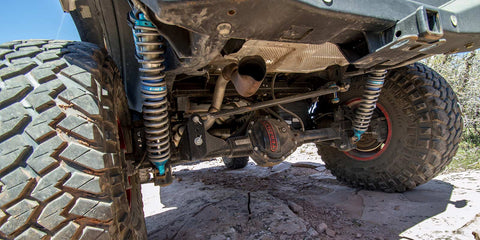
A lot of people assume Sean's two-door was heavily built. It wasn't. Good coilovers, upper control arms, wheel spacers, Ford Performance beadlock rings on the stock Sasquatch wheels, 37s (eventually 38s), and a set of $50 JKS tie rod sleeves. That's most of it. Pull the front bumper wings and fender flares, and let her eat.
You'd be surprised how far the stock components will take you if you know what you're doing. That means you can often afford to spend a little more on the shocks themselves for a better ride, since almost everything else can stay stock — especially on Badlands or Sasquatch-equipped models.

Factory Heights and How They Affect Your Lift
Outside of the Raptor variants, these Broncos come from the factory at essentially three different ride heights, and understanding which one you have makes a real difference in planning your build.
- Base models — includes Base, Outer Banks, Big Bend, and Black Diamond without the Sasquatch package
- Badlands (without Sasquatch) — sits approximately ½" above base models
- Sasquatch-equipped models — sits approximately 1" above base models
That height difference flows directly into how much lift you're actually gaining from a coilover upgrade. Final ride heights will be the same across all three platforms with comparable setups, but what reads as a 3" lift on a base model is only 2.5" on a Badlands and 2" on a Sasquatch. Keep that math in mind when reading any lift spec.

Front Upper Control Arms (UCAs)
UCAs are probably the component most people ask about, and the short answer is: you're generally fine to around 2.5" of lift on base models, 2" on Badlands, and 1.5" on Sasquatch before geometry starts to get funky. We've seen people push it a little further, but consider those numbers the practical limit before alignment becomes a problem.
Lift height isn't the only trigger, though. Many coilovers will require UCA upgrades regardless of how much lift you run. As a reliable rule of thumb: if a coilover uses 3" or larger ID springs, has a 2.5" or larger body capable of more than 1.5" over stock Sasquatch height, or comes with remote reservoirs — plan on upgrading the UCAs for clearance, even at stock height.
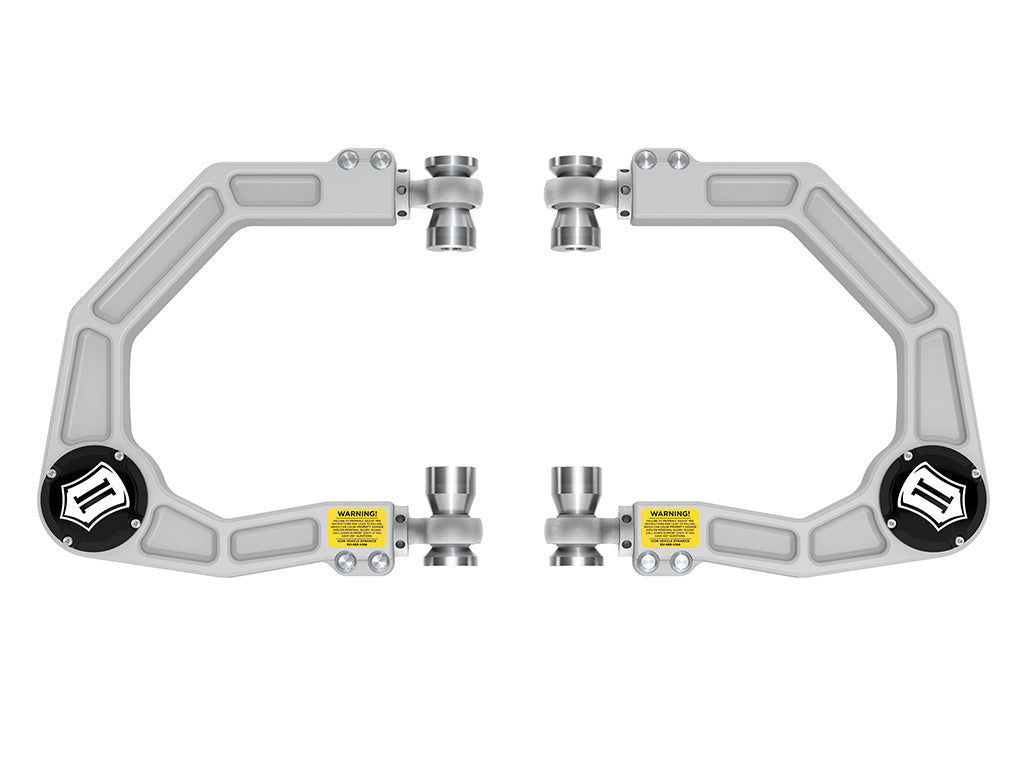
The stock UCAs on these Broncos are also fairly short relative to the lower control arm, which means the upper ball joint sees some extreme angles under articulation. When shopping for replacements, avoid anything with less than a 1.25" uniball or equivalent cup — 1" joints have shown a consistent pattern of bind across the board.
Icon Vehicle Dynamics
Billet Upper Control Arm Delta Joint Pro
2021+ Ford Bronco
We don't usually play favorites on specific parts, but Icon's UCAs deserve a callout here. Their Delta Joint Pro ball joints offer 90 degrees of articulation with the smoothness and strength of a same-size uniball, and they're sealed and greaseable for longevity. In our testing they showed the least bind of any arm we've run, and Sean put around 40,000 miles on a set. If they can survive his driving, they can survive yours.
One more thing to be aware of: billet UCAs frequently cause clearance headaches with remote reservoir hoses. They tend to leave less room than tubular, plate, or cast arms. Icon's billet arms are the only ones we haven't had to grind on, clearance, or relocate reservoirs for — but if you're going with any other billet arm alongside reservoir coilovers, check with us first.

Rear Track Bar
Here's something worth knowing: the rear axle doesn't actually wander too far off center as you add lift. Sean ran as high as 2" over stock Sasquatch height without it being a centering problem. What you do notice is yaw, wiggle, general instability, and an unpredictable feel out of the back — and almost all of that comes from excessive track bar angle.
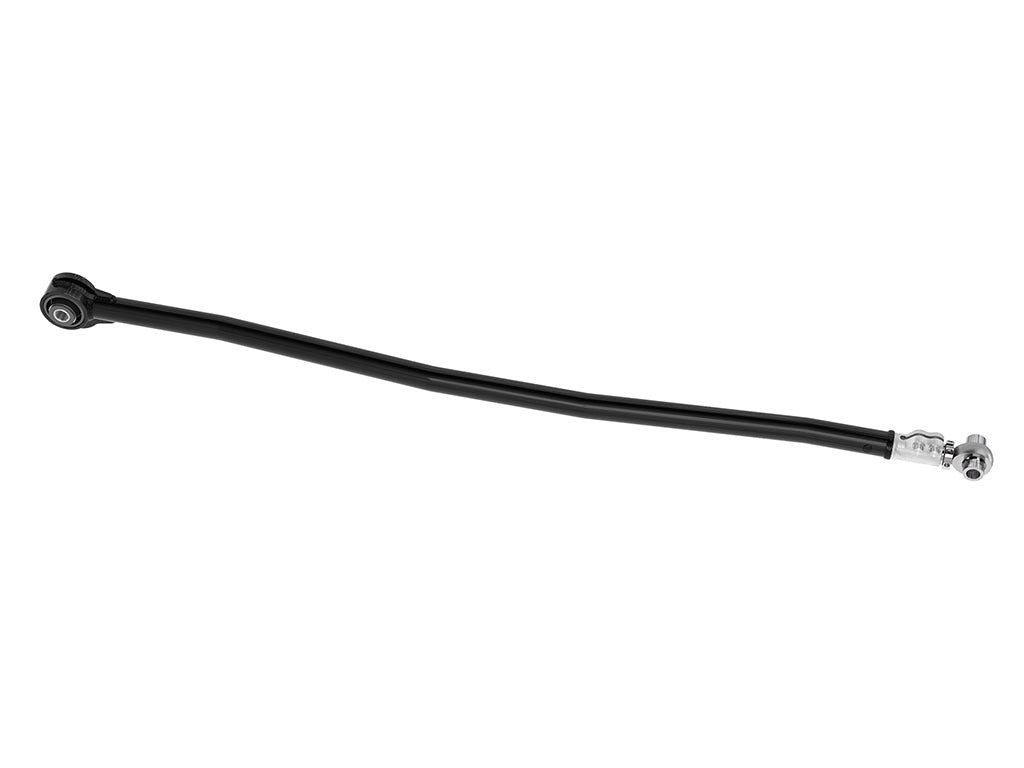
When the track bar angle gets too steep, forces that should travel through the suspension are instead transferred diagonally into the chassis. If you find yourself correcting the Bronco's direction after every significant bump, odds are the track bar is a major contributor. Brands like Rock Jock offer bolt-on track bar relocations that raise the axle-side mounting point, flattening the angle and restoring proper geometry. This also corrects roll center and center of gravity to reduce sway — something that borders on necessary if your Bronco didn't come with a rear sway bar and you're running a soft-riding setup like the Eibach Stage 2 kits.
Icon Vehicle Dynamics
Rear Adjustable Track Bar Kit
2021+ Ford Bronco
One caveat on bolt-on relocations: since the rear uses coilovers (infinitely height-adjustable within a range), a fixed-position relocation bracket may not perfectly center your axle at every ride height. That's why we still recommend pairing any relocation with an adjustable rear track bar — one with a stiffer joint than the stock unit, which is notoriously soft and prone to deflection. The side-to-side wiggle on Sean's Bronco footage? That's the stock track bar bushings doing the happy dance.
In terms of where the track bar becomes a priority: 1.5" over Sasquatch height is generally the threshold. On Broncos without rear sway bars running very compliant setups, you may benefit from addressing the track bar even at lower lift heights.

Trailing Arms and Rear Links
Sean never touched the rear links on his Bronco in 40,000 miles of serious use, and he can honestly say it was "fine" — so let's talk about what "fine" actually means.
Icon Vehicle Dynamics
Tubular Rear Upper Link Kit
2021+ Ford Bronco
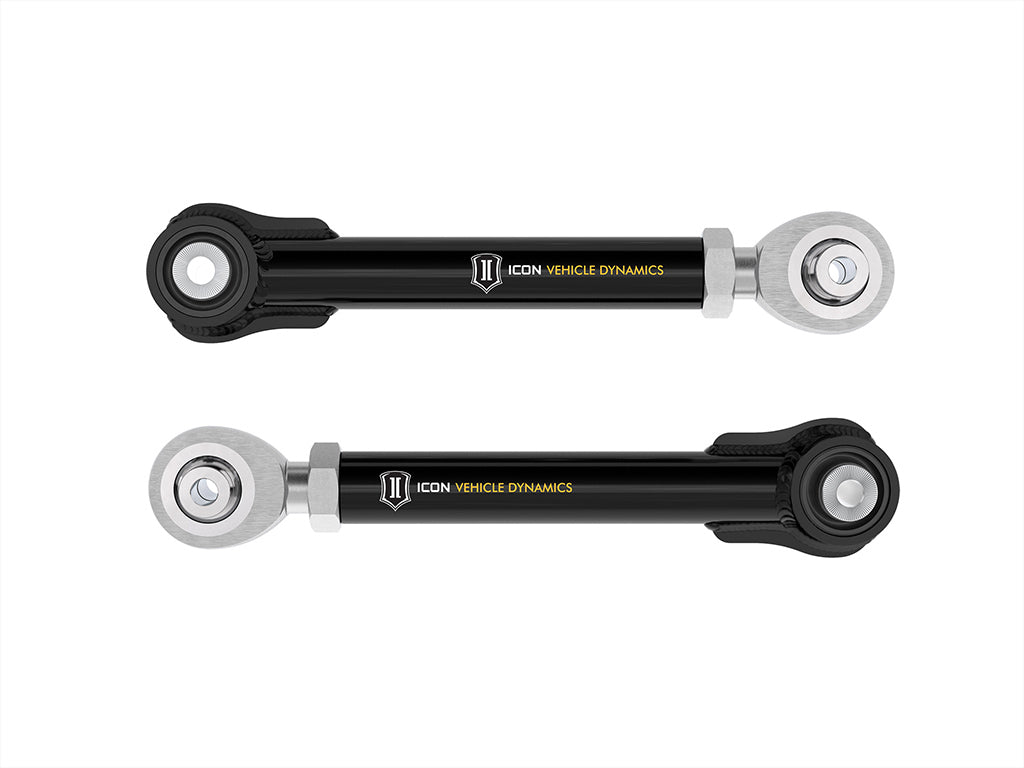
The longest-travel rear coilovers available for these Broncos are the Icon units with approximately 14" of travel. During installation testing, the stock links only showed bind through the last inch of droop — both sides simultaneously — so they're not a meaningful limiter on travel. The stock bushings do show bind under articulation and independent wheel movement, but nothing catastrophic. After 40,000 hard miles, the bushings still looked nearly new.
The behaviors that could be corrected with adjustable links are: wheel hop in reverse when spinning the tires, and some rear-end deflection and wiggle. Avoiding reverse burnouts is easy enough, and the deflection is drivable. If upgrading your links would mean spending less on coilovers, put that money into the shocks.
Bottom line: rear links are the component you can most safely defer. Save the budget for where it matters more.
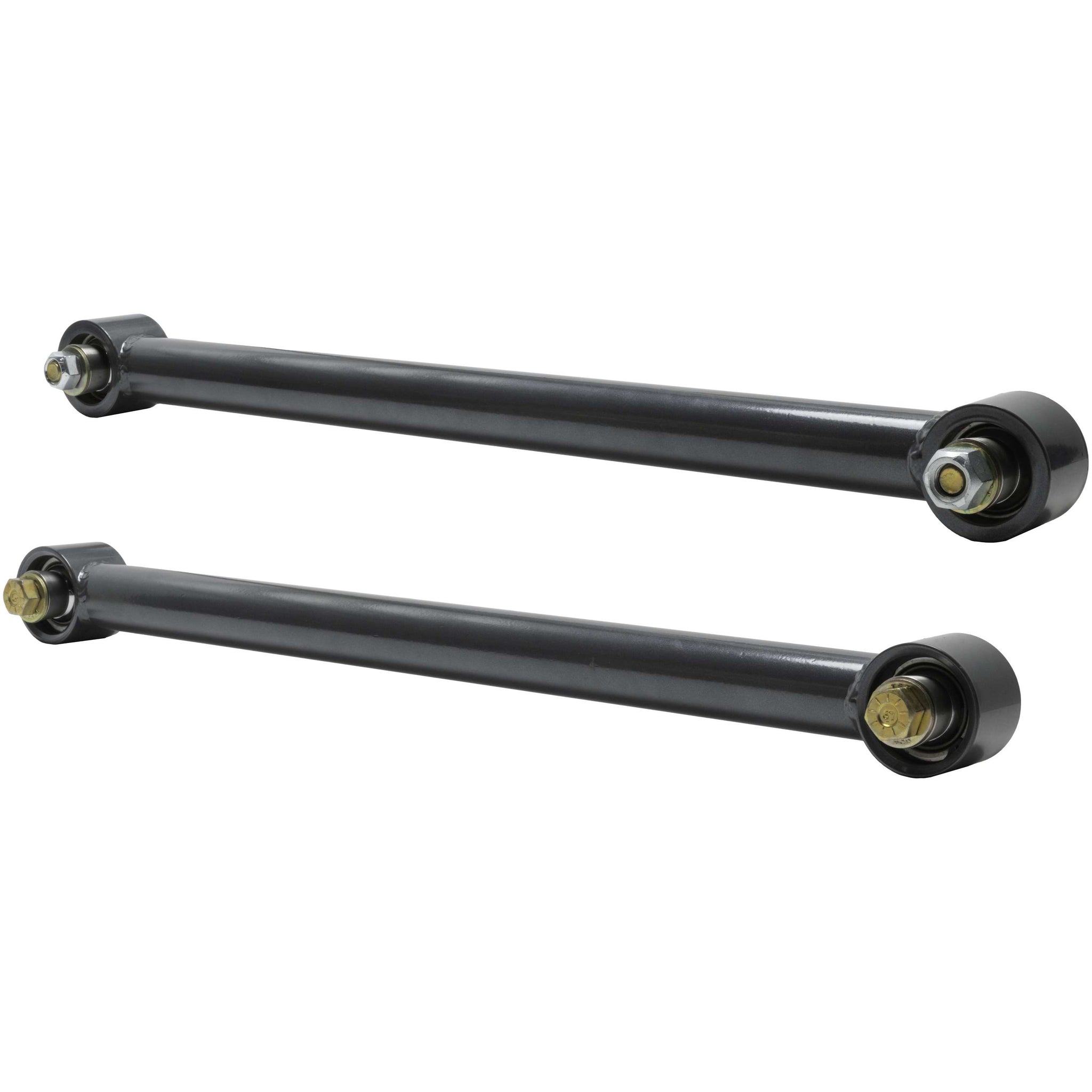
Icon Vehicle Dynamics
Rear Tube Lower Trailing Arm Kit
2021+ Ford Bronco
Understanding Your Factory Suspension
Just as these Broncos come at three different heights by trim, they also come with three (technically four) different factory suspension systems — and knowing which one you have is critical, because a couple of them are genuinely good. An upgrade should actually be an upgrade.

HOSS 1.0 — Base Model Shocks
Base models without the Sasquatch package come with black twin-tube shocks Ford calls the HOSS 1.0, manufactured by Hitachi. They're typical OE dampers: a little harsh over chatter, easily overwhelmed by anything but the smallest bumps. If this is what you have, almost any aftermarket upgrade is going to be a noticeable improvement. Buy with confidence knowing you're starting from the bottom.

HOSS 2.0 — Bilstein ESCV
Badlands and most Sasquatch models get the HOSS 2.0 package: yellow Bilstein End Stop Control Valve (ESCV) shocks in a 2" monotube body with internal bump stops on both ends and piggyback reservoirs. We call them "Dollar Store 8112s" — they function on a similar principle to Bilstein's flagship, just with smaller pistons and a less refined bump stop system.
These surprised us at speed. Small-bump compliance is rough, and the compression end stop control valves can engage abruptly — especially in the rear, where they can make the back end buck over big hits. But for the price tier and the fact they're factory equipment, their high-speed off-road capability is genuinely impressive.
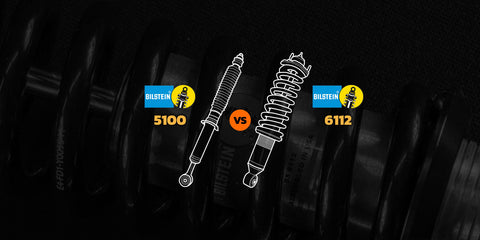
This is the level where you need to think carefully about what you're upgrading to. Almost anything will be more comfortable, but lesser options like the Bilstein 5100 will be a meaningful step backward for off-road performance. If you spend time on tough trails, at higher speeds, or you just like to push the Bronco, stick to 2.5" or larger body coilovers. Options like the Bilstein 6100s, Icon 2.5 EXPs, and Fox 2.5 HTOs can all run with your stock springs and still accommodate a healthy amount of lift.
Also worth noting: the ESCV shocks have had a well-documented reliability record. There's a high probability yours will need replacement sooner than later regardless. Better to be ready with a plan.

HOSS 3.0 — Fox Internal Bypass
The HOSS 3.0 is the top-tier factory option, available on Wildtraks starting in 2022–23 and now on Badlands models with the Sasquatch package. These are 2.5" body Fox internal bypass shocks — the same basic technology found on first-gen Raptors, TRD Pros, and Gladiator Moabs.
They offer far superior small-bump compliance, similar big-bump support, and a much smoother transition through their ride zones compared to the HOSS 2.0. These are genuinely good shocks, and many owners of lesser trims go out of their way to swap them in. If you're shopping for an upgrade from this starting point, look toward position-sensitive options like the Bilstein 8112 or Fox 3.0 Factory Race, electronically controlled setups like the Icon CDEVs or an SDI conversion, or the Fox 3.2 Live Valves if you want both.

Tire Clearance: What Actually Matters
One of the coolest things about these Broncos is how much tire you can stuff underneath them without a ton of fabrication. But the way most people think about tire fitment is incomplete.
It's not the lift that lets you run bigger tires — it's limiting upward travel enough to keep those tires out of the fender. What the lift does is preserve that bump travel, so you're not worse off than stock after you install the larger rubber.
For example: clearing a 37" tire requires limiting upward travel to approximately 1" less than a stock Sasquatch setup. Raise the suspension by that same 1" or more, and you guarantee you still have equivalent or better bump travel compared to stock — and with good coilovers, you'll often gain droop as well.
Some coilovers we can confirm clear 37s without modification include the Fox 2.5 Performance Elites, 3.0 Factory Race Series, and 3.2 Live Valves. Most others will need a bump stop spacer to avoid trimming. Icon handles this particularly well — they offer the most travel on the market and include a purpose-built bump stop spacer for 35"+ tire setups. Sean ran them without the spacer after removing his flares, and rubbing was minimal.
For wheel specs, the sweet spot for clearance is an 8.5" wide wheel with roughly ET0 to +25 offset, with required offset decreasing as tire diameter grows.
For 37s specifically, the most you'll likely need to do is cut the crash bar mounts and pin back the liners — the JKS Max Tire Clearance kit handles both. And for the record: those crash bars are designed to prevent tire intrusion in a collision. A 37" or larger tire isn't going to be crushing your toes in a fender buckle scenario.
Lift Without New Coilovers: Know What You're Getting Into
We've said it before: lifting without new coilovers that add travel is generally a bad idea. The Bronco is one of the rare platforms where you can sometimes get away with one of the three alternatives — but only one is really worth considering, so let's break them all down.

Strut Spacers
True spacer lifts — where a spacer is installed above or below the strut assembly to increase overall length and therefore ride height — are the cheapest option upfront and potentially the most expensive option long-term.
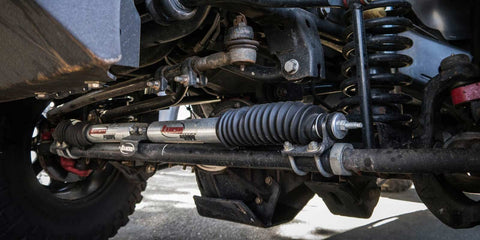
These Broncos are known for steering and axle issues to begin with, and strut spacers compound both problems. Because the complete assembly ends up longer than any comparable lift, the axles can run out of splines and fail quickly. The added extension also creates bind at the tie rods, which will almost certainly cause a failure even with modest tire sizes. Hard pass.

Preload / Perch Collar Lifts
Preload spacers or perch collar lifts work by adding a spacer under the spring seat, increasing spring preload, which extends the strut further and generates lift. The good news and the bad news are the same: because you're not increasing the overall strut length, you won't over-extend the axles or bind the steering — but because the struts end up further extended, you lose droop travel and the ride suffers.
Added spring preload means a harsher ride, and less droop travel means more frequent and more violent top-outs. Base-model Hitachis don't have the rebound damping to control the situation. The Bilsteins are already stiff and only get stiffer. The factory Fox shocks have ride zones so closely spaced that any meaningful ride height change compromises their performance significantly.
That said, there's one scenario where preload collars actually make a lot of sense: if you have the factory Fox HOSS 3.0 shocks and you've added weight to the vehicle (overland gear, bumpers, armor) that's dropping you out of their ideal ride zone, a small preload adjustment to recover that height while you save for a proper upgrade is a genuinely smart move. It's not a long-term solution, but it's a legitimate bridge.

Spring Lifts
The best of the lift-without-new-coilovers options is a proper spring lift — like what Eibach offers for HOSS 2.0 and 3.0 models. These kits use a longer, softer spring in place of the stock unit, which generates lift without the same spring-force penalty you get from a perch collar approach.
The result is less severe top-outs, better small-bump compliance, and — in the case of the Fox HOSS 3.0 — a partial mitigation of the ride zone compromise. For the Bilstein ESCV shocks, a softer spring actually helps by reducing how often the compression end stop valves engage, and the lower rate improves washboard performance at speed.
If a spring upgrade is what gets you out on trail while you're saving up to do it right with a proper set of coilovers, we're for it. Just make sure the plan is to eventually do it right.
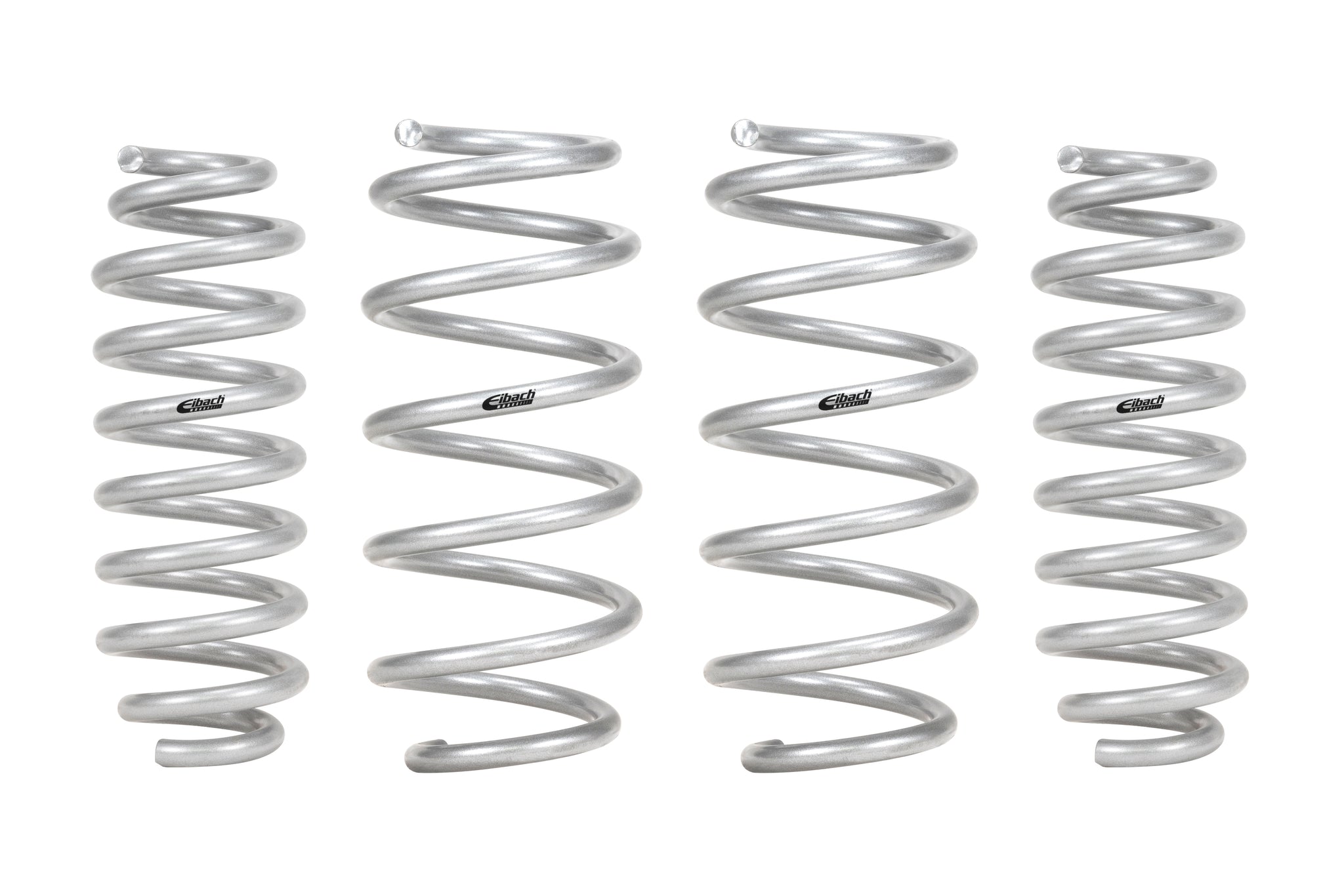
Eibach
Pro-Lift-Kit 2.3" Lift Springs
2021+ Ford Bronco
Ready to go further? Browse all Ford Bronco lift and coilover options at ShockSurplus.com, or give us a call at 213-433-3616 and talk to someone who's actually driven the thing.