Bilstein 6112 Vs Eibach Pro Truck vs Fox 2.0 - Ford F150 Edition
Posted by Sean Reyes on

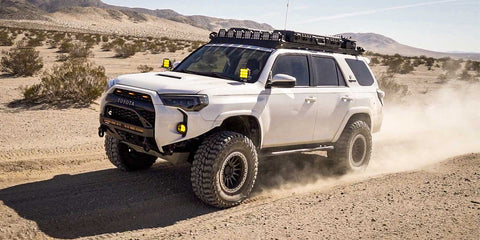
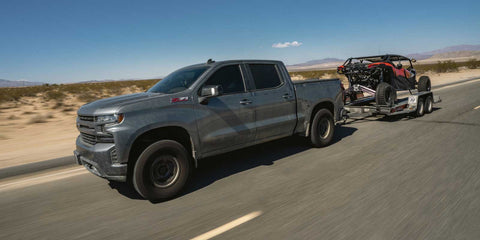
Most F150 owners are daily commuting, with the occassional adventure in the dirt, or throwing on a trailer for the weekend. For most owners, the stock shocks do fine as most owners never need more than good pavement manners, but if you're trying to do 'truck-stuff' you'll quickly feel the limits. The front end chatters, the rear bounces back up a second time after every dip, and anything over 25 mph in the dirt it starts to feel like the truck is running the show instead of you. That's the F150 we started with, and it's why we bolted three different coilover setups onto it.
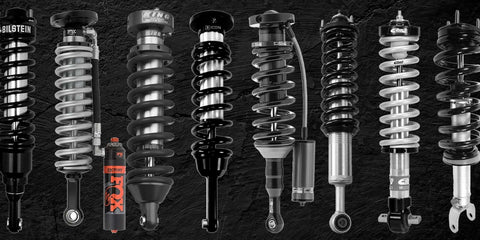
We ran all three on the latest F150s: the Eibach Pro-Truck Stage 2R, and the Fox 2.0 Performance Series, and the Bilstein 6112 package. Each one got real miles, real terrain, and the same test loop out in the Gorman OHV area of Southern California. Here's how they actually compared. Want to see every option we've tested on this truck, not just these three? Start with The Best Shocks for the 2021-2026 Ford F-150.
Bilstein for value and control. Eibach for daily comfort and adjustability. The Bilstein 6112 is the most shock for the money and the one we'd pick for off-road and towing. The Eibach Pro-Truck Stage 2R is the "Goldilocks" daily driver with on-truck height adjustment, and a great balance of comfort and handling. On 2021+ F-150s, we're apprehensive about recommending the Fox 2.0 when there are other options at a similar or lower price. It rode harsh and underdamped on this platform and costs more than both.
Side-by-Side Comparison
| Spec | Bilstein 6112 + 5160 | Eibach Pro-Truck Stage 2R | Fox 2.0 Performance Series |
|---|---|---|---|
| Shock Body | 2.6" IFP Monotube | 2.0" IFP Monotube | 2.0" IFP Monotube |
| Body Material | Steel (zinc plated) | Steel threaded body, aluminum mounts | 6061-T6 Aluminum |
| Piston Design | 60mm Digressive | 46mm Variable Force | High-Flow Linear (IFP) |
| Front Lift Range | 0–2.5" | 0.5–2.5" | 0–2" |
| Rear Shock | 5160 Remote Reservoir | Reservoir Sport (2R) or IFP Sport (Stage 2) | 2.0 IFP Smooth Body |
| On-Vehicle Height Adjust | No — requires spring compressor | Yes — spanner wrench included | No — requires spring compressor |
| Ride Character | Firm, controlled, precise | Balanced — OEM+ comfort with composure | Harsh + underdamped on 14th-gen F-150 |
| Small Bump Compliance | Good — improved over stock | Best of the three | Poor — chatter transmitted to cab |
| Off-Road Feel | Planted, confident at speed | Capable for mild-moderate trails | Underdamped — lacks control |
| Warranty | Limited Lifetime | Million-Mile (shocks) / 12-mo (coilovers) | 1 Year |
| Rebuildable | No | No | Yes |
| Approx. Kit Price | ~$1,100–$1,300 | ~$1,400–$1,600 | ~$1,700 |
| Value Rating | ★★★★★ | ★★★★☆ | ★★☆☆☆ |
Prices are approximate at time of writing. Check each product page for current pricing.
↑ Back to TopThe Stock Baseline
Before we bolted up anything aftermarket, we drove the factory suspension on the same loop to set a baseline. Our truck is a PowerBoost with the Max Tow Package, and the stock setup showed its limits fast:
- Underdamped front end, most noticeable over repetitive bumps and washboard
- Rear end that leaned on the overload springs too easily
- Soft initial compression, then a harsh bottom-out on bigger hits
- Excessive body roll in corners
- Bouncy rebound that kept the truck moving after the bump was gone
The stock twin-tube shocks do the baseline job of a shock: they keep the springs from bouncing uncontrolled. But they left a lot on the table for both comfort and control. This is the truck all three setups were tested on, back-to-back.

Bilstein 6112 & 5160: The Value Champion
The Bilstein 6112 front coilovers and 5160 reservoir rears transformed how our 2023 F-150 rides and handles. Even with a digressive valving design, which usually reads firm on paper, this setup actually improved small-bump compliance while doing a much better job controlling the big hits. (Full install steps and our stock-vs-Bilstein notes are in our Bilstein 6112 & 5160 F-150 review and install guide.)
We set the 6112 fronts for roughly 2 inches of lift on our PowerBoost. EcoBoost and Coyote trucks may see closer to 2.5 inches because of their lighter front ends.
A 60mm digressive piston inside a 2.6-inch body means more oil, more cooling, and more control over rough terrain without giving up comfort. In our testing, this kit rivals 2.5-inch race-series coilovers from the competition at a 2.0-inch price.
Key Takeaways: Bilstein 6112
- The bang-for-your-buck factor is a no-brainer: a 2.6-inch body shock priced like the 2.0-inch shocks in this test.
- The balance between comfort and control makes it a strong pick for daily drivers and work trucks alike.
- Some drivers shy away from Bilstein's firmer tune. The precision you get behind the wheel is worth far more than the "comfort" of boat-like stock shocks.
- Monotube design keeps damping consistent and fade-free when the shocks get hot.
- Backed by Bilstein's limited lifetime warranty, though we see very few failures or warranty claims on Bilstein to begin with.
Worried the setup is too firm for your F-150? Don't be. These are surprisingly plush for a Bilstein. The big piston makes everyday bumps and chatter effortless, then soaks up the bigger hits and recovers cleanly, which is exactly where stock shocks fall apart.
Whether you want to level the truck, ride better, or drive harder off-road, this Bilstein package delivers across the board. Height adjustment, Bilstein durability, and big-body damping, for less money than the competition. Confidence through Control.
Want the deep dive? Read our full Bilstein 6112 & 5160 review on the F-150.
↑ Back to Top
Eibach Pro-Truck Stage 2R: The Goldilocks Shock
The Eibach Stage 2 and 2R kits have taken off with F-150 owners lately. We installed the Stage 2R on Steve's brand-new 2023 F-150, a truck that handles daily commuting, cross-country family road trips, and regular towing. (Read the full story in our Eibach Stage 2R F-150 review.)
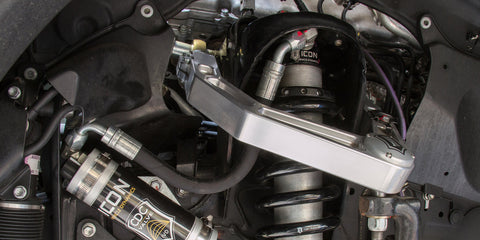
Stage 2R pairs Eibach's 2.0 coilovers with reservoir rear shocks. The "R" means reservoir rears, which shed heat better and recover faster than non-reservoir shocks.
Eibach's 2.0 coilovers let you adjust ride height on the truck. Steel threaded bodies and slip washers prevent coil bind, and the included spanner wrenches make adjustments straightforward. Most other brands require pulling the coilover and using a spring compressor.
Key Takeaways: Eibach Pro-Truck
- The Eibachs feel like an OEM+ package: better than stock without asking you to give anything up.
- More small-bump compliance than Bilstein, a tighter, more composed feel than Fox. The "tweener" shock for daily drivers.
- Eibach valves some applications with a mild digressive tune. Not as aggressive as Bilstein, but noticeably firmer than the Fox 2.0.
- Out-of-the-box lift varies by engine: about 3" on 2.7 EcoBoost trucks, 2" on PowerBoost, and roughly 2.5" on Coyote or 3.5 EcoBoost.
- Usable wheel travel went from 7⅛" stock to just under 8½", even with stock control arms.
- Eibach's million-mile warranty on the shocks is tougher to beat than most competitors'.
We pushed these coilovers past their limit. They took the lap violently bottoming and topping out until the seal heads (where the shock tops out at full extension) gave up the ghost. That's well out of their pay grade, and if you drive like that, the Eibach probably isn't your shock. But they suit how most people actually use an F-150.
Steve calls them the "Goldilocks Shocks." They're not for the roughest trails or desert running. For daily driving, road trips, and mild to moderate off-road use, this is where we'd steer most buyers who want better control, better comfort, and on-truck height adjustment.
Want the deep dive? Read our full Eibach Stage 2R review on the F-150.
↑ Back to Top
Fox 2.0 Performance Series: So What's the Catch?
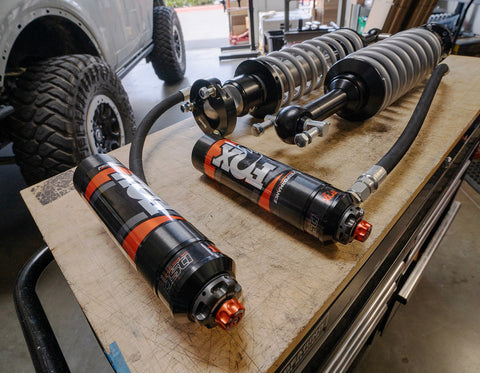
Fox 2.0 coilovers and shocks have long been the go-to F-150 upgrade for a plush ride, level stance, and more off-road confidence. On older trucks, they still earn that reputation.
But with this many strong competitors at similar or lower prices, we had to find out whether they hold up on the current-generation F-150. (Our standalone Fox 2.0 review on the 2021+ F-150 goes deeper on the setup and spring rates.)
Somehow these shocks felt both harsh and underdamped off-road. Small chatter rattled the cab, and bigger hits were downright punishing. We checked everything: the 35" F-load tires, the max payload leafs, even nitrogen pressure. No change. Everything pointed to a valving mismatch on this specific F-150 platform.
Key Takeaways: Fox 2.0
- It's rare we call out Fox this directly, but the 2.0s rode harsher than the Bilsteins off-road, felt less controlled than the Eibachs, and cost more than both.
- In isolation they'd be "fine." With competition this strong, "fine" doesn't cut it.
- To be fair to the Fox: the aluminum body sheds heat to outside air faster than steel, which helps fight cavitation in heat and dirt.
- Fox 2.0s can be serviced and rebuilt like new, a real plus for long-term owners.
- Fox's 1-year warranty is much shorter than Bilstein's or Eibach's.
On 2021 and newer F-150s, we're apprehensive about recommending the Fox 2.0 when there are other options at a similar or lower price. Bilstein and Eibach both beat it in nearly every category for less money. That doesn't mean Fox makes bad shocks. It means this application didn't get the valving attention it needed for the 14th-gen platform.
It lacks the ride quality, balance, and refinement we expect from Fox. If you're shopping for a late-model F-150, look at the Bilstein 6112 and Eibach Pro-Truck first. Both deliver more for less.
Want the deep dive? Read our full Fox 2.0 review on the F-150.
↑ Back to Top
Who Should Buy What
We're not here to tell you what to run. We're here to help you figure out what fits how you drive, and sometimes that means talking you into less shock, not more. Want more entry-level options than these three? Part 1 of our F-150 Buyer's Guide covers the Bilstein 5100, Eibach Pro-Truck Sport and more. For the full field, see every shock we've rated on the 2021–2026 F-150.
Go with the Bilstein 6112 if you:
- Want the most shock for your money. Nothing else in this group comes close on value.
- Get off-road regularly and want a truck that stays planted and confident at speed.
- Tow, and need a setup that handles the extra weight without wallow or fade.
- Are fine setting your lift height once and leaving it.
Go with the Eibach Pro-Truck Stage 2R if you:
- Want better control and comfort without giving up daily-driver refinement.
- Care about on-truck height adjustment, whether for dialing in stance or compensating for gear weight.
- Put on long highway miles with the family and want the best small-bump compliance of the group.
- Want a strong warranty for peace of mind.
Only look at the Fox 2.0 if you:
- Run an older F-150 (pre-2021), where the 2.0 still earns its reputation as plush and reliable.
- Specifically want a rebuildable shock for long-term ownership.
- Value the aluminum body for corrosion resistance in wet or salty climates.
On the 2023 F-150, two of these three setups flat-out impressed us. The Bilstein 6112 delivered the best overall value: a lot of shock for the cost. The Eibach Pro-Truck earned its "Goldilocks" reputation with a refined balance of comfort, control, and adjustability. The Fox 2.0, despite a stellar track record on other platforms, showed us that a valving mismatch can undo a great reputation.
Key Terms
- Digressive Damping
- Valving that firms up quickly on small, slow movements, then flattens out on big, fast hits. Feels sporty and controlled. Bilstein's signature.
- Linear Damping
- Damping force that rises evenly with shaft speed. More compliant over small bumps, but with less baseline control, so it can bottom more on hard hits.
- Monotube vs. Twin-Tube
- A monotube has a single body with more oil and better cooling. A twin-tube (like most factory shocks) nests one tube inside another, which costs it heat capacity and consistency.
- IFP (Internal Floating Piston)
- A piston that separates the shock oil from a nitrogen charge so the oil doesn't foam up under hard use.
- Reservoir Shock
- A shock with an external canister holding extra oil and nitrogen. More oil means more heat capacity and faster recovery. The "R" in Stage 2R.
- Cavitation / Fade
- When shock oil overheats and aerates, causing a temporary loss of damping. Bigger bodies, reservoirs, and aluminum bodies all help hold it off.
- Coil Bind
- When a coil spring compresses until the coils touch each other. Eibach's slip washers help prevent it during height adjustment.
- Overload Springs
- The extra leaf (or leaves) on the F-150's rear pack that engages under heavy load. A soft rear shock lets the truck lean on them too early.
F-150 Shock FAQ
Is the Bilstein 6112 too stiff for a daily-driven F-150?
No. In our testing on a 2023 F-150 PowerBoost, the Bilstein 6112 and 5160 setup was surprisingly plush for a Bilstein and actually improved small-bump compliance over the factory shocks. It rides firmer than the Eibach Pro-Truck, but in exchange you get noticeably better control on rough roads and off-road.
How much lift does the Bilstein 6112 give a 2021+ F-150?
Up to about 2.5 inches. The Bilstein 6112 front coilovers adjust from 0 to 2.5 inches on the 14th-gen F-150. We set ours for roughly 2 inches on a PowerBoost truck; lighter EcoBoost and Coyote trucks may see closer to 2.5 inches at the same setting.
Can you adjust Eibach Pro-Truck coilover height without removing them from the F-150?
Yes. Eibach Pro-Truck 2.0 coilovers use steel threaded bodies and include spanner wrenches, so you can adjust ride height on the truck. The Bilstein 6112 and Fox 2.0 both require removing the coilover and using a spring compressor.
Are Fox 2.0 coilovers good on a 2021+ F-150?
We're apprehensive about recommending them on newer trucks. On our 2023 F-150, the Fox 2.0 Performance Series felt both harsh and underdamped off-road, and we traced it to a valving mismatch for the 14th-gen platform. The Fox 2.0 still works well on pre-2021 F-150s, but on newer trucks the Bilstein 6112 and Eibach Pro-Truck both performed better for less money.
Which shock is best for towing with a 2021+ F-150?
The Bilstein 6112 and 5160 combo. On our F-150, it handled added weight without wallow or fade and recovered cleanly after big hits. The Eibach Pro-Truck Stage 2R is a solid alternative if you also want on-truck height adjustment to compensate for load.
What's the difference between Eibach Stage 2 and Stage 2R on the F-150?
Reservoir rear shocks. Both Eibach kits use the same Pro-Truck 2.0 front coilovers, but Stage 2R swaps in reservoir rear shocks for better heat management and faster recovery, which matters most if you tow or drive dirt roads hard.
Shop by Fitment
| Vehicle Make and Model | Year Range | Setup | Shop Now |
|---|---|---|---|
| Ford F-150 4WD | 2021+ | Bilstein 6112 Assembled Front Coilovers |
Shop Now |
| Ford F-150 4WD | 2015+ | Bilstein 5160 Rear Reservoir Shocks |
Shop Now |
| Ford F-150 4WD | 2015+ | Eibach Pro-Truck Stage 2R |
Shop Now |
| Ford F-150 4WD | 2015+ | Eibach Pro-Truck Stage 2 |
Shop Now |
| Ford F-150 | 2021+ | Fox 2.0 Performance Series Set |
Shop Now |
Not sure which one fits your truck? Call or chat with our team. We've driven them.
Phone: (213) 433-3616
We'll see you out on the trails.