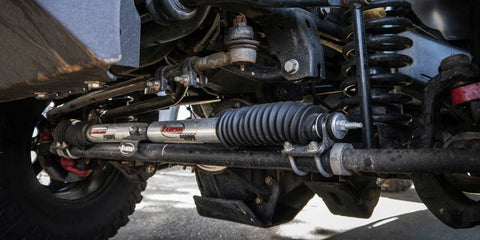
Bilstein 8112, Zero Compromises
Posted by Sean Reyes on
Introduction
In This Article
But forget daily driven comfort, these shocks are purpose-built for off-road performance.
Now, I've had the chance to test most of the available brands over the past 12 years on my own Tacoma, and most of those reviews are live on our channel as proof.
I’m sure a lot of you are debating the best shock to go with for your Tacoma build, and whether or not these fancy new shocks from Bilstein should earn consideration. We’re going to answer that from a perspective of having driven various Fox, King, Icon, and many others over the years.
We’ve had these shocks since the end of 2023, and have put on thousands of miles of desert and mountain terrain. During that training day we specifically got into how the adjusters affected ride quality at different speeds.


Design & Technology
If you haven’t already seen our unboxing and overview of the 8112 DSA, subscribe and check that video out so you have an understanding of what all these features mean.
Before we get into the review, we want to make sure everyone understands the terms we're mentioning going forward.
Performance is keeping the vehicle stable and predictable in critical situations or high speed environments like the desert. This can also mean handling extraordinary loads in the mountains, for you adventurers or overlanders carrying a thousand pounds in the bed.
When we talk High Speed and Low Speed, that specifically means shaft speeds. High shaft speed is when that piston moves through its stroke very fast, really hard hit. Lower speeds is when you're on pavement, and the shock isn't working very hard, think turning, nose dive under braking.

High speed compression adjuster will affect how fast the piston moves in a sudden compression event - such as whoops off-road, curbs, big rocks, anything that jacks the suspension into the bumpstops hard. Firmer settings means less chance of hitting your bumpstops on hard hits.
Low speed compression adjuster will affect how fast the piston moves during driver inputs such as turns, braking, squat under acceleration. Firmer settings means the vehicle’s body roll is less.
The jounce cutoff is a mini-shock in the bumpzone of the main body. With the JCO adjuster, you can now adjust how firm that mini-shock responds, similar to the HSC adjuster and the shock as a whole. I know, very META.
From a materials standpoint, Bilstein spared no expense to solidify their position in the OE off-road market, one of our favorite features of these shocks is the military-grade seal package that not only keeps dirt out, but aims to last over 100k miles before needing service. Cant say the same for many others!

Performance Review
On-Road Handling: Ride comfort, stability, and cornering.
Most Tacoma owners have the benefit of the front sway bar providing most of the handling performance for the truck. In our case, we’ve been without a sway bar for many years, as we drank the koolaid and lean towards off-road performance over on-road handling.
With that said, you can make this Tacoma dip really aggressively on the lowest LSC setting, these shocks can get pretty soft.
Fully tightening up the LSC adjuster ramps up the feel of the road, increasing feedback, and doing a minor role in reducing body roll. Fully closed, highest settings, are going to produce the tightest handling truck, reducing body roll and nose dive the most.
Another benefit to the LSC is handling extra loads, whether hauling furniture, towing a trailer, or loading up the bed with a GFC or other adventure-related gear, which can easily exceed 800-1000lbs.
If you are going the route of overlanding, also make sure to budget an upgraded leaf pack, it’ll make a world of difference if that weight is sitting on a progressive leaf pack from Icon or Deaver, compared to the weak 3-leaf pack from factory.

Off-Road Capabilities: Suspension articulation, shock absorption on rugged terrain.
The 8112s subdue some of that chatter, while remaining in control on the larger bumps, without bouncing off your bumpstops. I may be overstating the benefits, but its pretty cut and dry when you used to hit your bumpstops a lot vs virtually never.
After hanging out with tons of our customers and people on the trail, we understand our definition of off-road performance isn’t widely shared or understood. When we test shocks at high speeds, we mean 40+ through open desert terrain that we’ve generally scouted. We scout out the terrain and path of travel in search of the biggest bumps that the truck can take on whichever suspension we’re testing.
This terrain is where the High Speed Compression adjusters play a role.


To be redundant on definitions - A high speed compression event is related to the speed of the shaft, not how fast the vehicle is going. So when there’s a huge bump off-road that forces the suspension to compress through a lot of its available travel, in a short period of time, the HSC adjuster affects how slow or fast that action occurs. More HSC damping will slow down that piston and shaft.
On top of that the 8112 have a new feature that only Bilstein would dare create, which is an adjuster for the internal jounce cut-off (JCO).
The Jounce Cut-Off (JCO) is a hydraulic shock inside the bumpzone of the primary body, that the piston will run into at full compression.
This 8112 shock is the only one I know of that features this, and with the DSA+ option, the JCO is now adjustable just like the compression settings. INSANE. But is it overkill?
So on those really hard hits, the JCO further slows down the shaft to produce one of the smoothest responses we’ve ever felt.
Having both the HSC and JCO being adjustable creates a lot of opportunity to dial in the kind of ride you like.
We’ll be the first to admit that we thought an adjustable JCO was going too far, especially for an OEM application in a factory length package.
I’m really hoping Bilstein delivers these same features in a universal coilover package long travel kits.


Pros & Cons
Pros
- Best of the best, but also priced that way, $4500 for a full set of DSA & adjustable rears.
- Adjustable for all sorts of driver requirements, not just high speed off-road.
- That "bottomless" suspension feel over more terrain.
- Will last a really long time in terms of miles, if we are to trust Bilstein (we do!)
Cons
- Price, these shocks are purpose built for high speed off-road. They surely have other benefits, and they can do everything, but unless you’re fully sending it; these are overkill.
- The HSC adjuster can sometimes get stuck, but we found that by jacking up that corner, it relieves pressure to the adjuster, and you can gain back the full range of settings.
- So many knobs, you may be overwhelmed trying to find the sweet spot.
- If you’re going for a lot of lift in the rear (2.5-3in), then these options may be a bit short for high speed use, droop travel is compromised. Overlanding or slow trail crawling will be fine though.


Comparison to Competitors
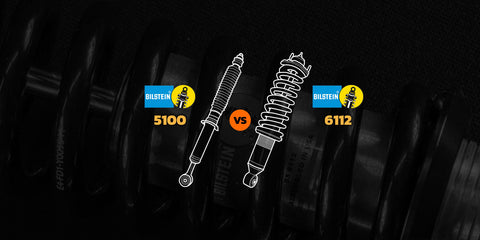
- Bilstein 5100 - no comparison, if you’re debating between 5100s and 8112s, you should check out the rest of our channel to get up to speed on the range of Bilstein shocks.
- Bilstein 6112 - get closer to the 8112, but are still an order of magnitude off. They have the same piston, but still missing 3 other zones of damping, and missing a reservoir.
- Fox 2.0 - There is surprisingly one similarity between the Fox 2.0 and the 8112, and that’s how supple they feel under a loaded Tacoma, really soft and comfortable.
- Fox 2.5 - Since there are now 2 versions of the Fox 2.5 shock, and a 3.0 shock for the Tacoma, its hard to make comparisons here. Especially because of everyone that will lament “but but custom tunes!” Out of the box the 8112 are noticeably softer than the 2.5 factory series and performance elite, but as far as we know, the 2.5 factory series tune is notoriously firm. We did a before and after on Jeff’s Tacoma, and we weren’t impressed when we hit the trails immediately after the install.
- Rancho - comparing against anything Rancho offers would frankly be insulting to Bilstein.
- Eibach Pro-Truck is similar to the Fox 2.0 comparison, really comfortable on-road, but still a basic 2 inch body shock.
- King Shocks - off-road enthusiasts that build vehicles will live and die by their King Shocks, we don't blame em! Bilstein has similar universal products to King, but this comparison is specifically about their OE-replacement offerings. The 2.5 shock package can be tuned to feel similar or the same as the on-road feel of the 8112s, but in order to do that, you’ll have to pull off some magic to ALSO get the same high speed performance. Even if you do pull that off, you’re still going to need an external bumpstop that can do serious work in order to feel as buttery and bottomless as the 8112s. The internal telescoping jounce system really dampens those hard hits when the main piston itself is overwhelmed.
- King’s 3.0 IBP shock - for the Toyota platforms get closer with on-road comfort mixed with position sensitive valving to address higher shaft speeds. But there’s a packaging issue at play here with 3.0 shocks, which require 3.5 ID springs, and this starts to affect total travel and how much the suspension can cycle without coming into contact with other OE components on the Tacoma / Tundra suspension. Its why the 3.0 IBP shocks actually cycle slightly less travel than the 2.5.
- Icon 2.5 Internal Reservoir - Icons are closer to what a bilstein 6112 feels like, sporty and firmer on the daily drive, but really loosens up in the higher speed environments. Adding adjustability to Icons through their CDCV or CDEV options creates a bit more comfort in the ride zone, which is sometimes missing for some people when they get into an Icon suspension package. We’re fans of Icon’s and the way they tune their shocks, specifically because we lean into performance over comfort for most of our vehicle builds. Icon’s CDEV would be the closest competitor to the Bilstein 8112, we say this because the electronic valves of the CDEV is what can deliver that bottomless feel in most scenarios, where the CDCV manual adjusters have a little less range of damping ability when compared to the electronic valves.
- SDI EClik - we would say these are the closest competitor to the 8112 in terms of mixing on-road comfort with high speed off-road performance. Being able to adjust on the fly and in the cab gives a big advantage to SDI over the 8112 Bilstein package.


Frequently Asked Questions
Any additional parts required?
New upper control arms aren’t technically required, but we aren’t selling these without them..basically. If you run these at factory height with no additional lift over factory height, then you can get away without new UCAs. But if you’re after the most performance possible with these shocks, grab new UCAs.
What’s the maintenance schedule for the Bilstein 8112 / DSA+?
Bilstein has designed these in a way to not need servicing for a very long time, far more than the typical 30-50k miles you see with other brands. They achieve this through a start of the art seal package, meaning their materials and processes keep debris and dirt out of the shock extremely well, along with other military level materials and processes to minimize failure and see far more heat cycles to the seals than competitor brands.
What platforms are the 8112 available for?
Right now, the 8112 are available for the 2nd and 3rd gen Tacoma, 2nd gen Tundra, 4th and 5th 4Runner, FJ Cruiser, and GX platforms. The DSA+ are available for the 2nd and 3rd gen Tacoma and 2nd Tundra. 4Runner and 3rd gen Tundra are coming soon.
We’re not sure what happened with the F150 8112s that were available briefly, or talks of the GM 1500 platform. I think volume was a concern there. But being a huge retailer of Bilstein, we’ve seen struggles with 8112 production on limited applications, so we can see the hesitancy on expanding the offering right now.
They are not available for the 2024 Tacoma yet.
Are the Bilstein 8112 shocks worth it over Fox or King?
Anything you can do, I can do better...
At the time of this review, Fox has just come out with their 3.0 internal bypass shock, which is probably the closest competitor in ride quality and performance. The 8112 is leagues ahead of anything King has to offer in terms of materials, longevity, and the comfort/performance mix.
King’s 3.0 IBP option for the Tacoma is shorter in length then their normal offerings because of the size of the shock tower, which causes clearance issues against the UCA. King’s 2.5 option does not have internal bumpstops or rebound stops either.
Bilstein 8112 is designed and built to get 2-3x the miles over a similar Fox or King product, through a unique sealing system that Bilstein has pioneered for military applications.