Radflo 500R 2.0 Lift Kit on the 2025+ Toyota 4Runner: First Impressions, Tech Breakdown, and What to Expect Off-Road
Posted by Sean Law-Bowman on
Introduction
In This Article
To celebrate adding Radflo's full catalog to Shock Surplus, we cracked open their newest product line—the 500R Sport 2.0 coilovers and shocks—and put them to the test. This marks the very first part of a multi-video, multi-blog series where we'll unbox, install, measure, and ultimately thrash these shocks off-road to see how they really perform.
Let's dive into who Radflo is, what makes the 500R line special, and why this kit could become a serious contender for daily drivers and light-trail warriors.


What Are the Radflo 500R Sport 2.0s?
Radflo is best known for their performance-oriented 2.5" and 3.0" shocks built for extreme use. But that's not the market most 4Runner and Tacoma owners live in.
The 500R Sport 2.0 line was built specifically for:
- Daily drivers
- Weekend trails
- Mild lifts
- OEM+ ride quality
- Improved comfort and composure
The Basics
- 2.0" monotube body
- Available with or without reservoirs
- Offered in standard travel (0–2" lift) and extended travel (0–2.5" lift)
- Designed around OEM-style durability and comfort
- Fully serviceable and rebuildable
We chose the non-reservoir, standard-travel version for this first round of testing—what we expect most 4Runner owners to buy.
OEM-Inspired Comfort Features
What really caught our eye is how Radflo rethought this kit:
- Natural rubber OEM-style bushings for longevity and better NVH control
- OE-style top mount and insulator on coilovers
- A new seal pack designed for longevity rather than high-temp racing abuse
- Steel threaded bodies
- Likely capable of minor on-vehicle adjustments (we'll test that later)
This is clearly a shift toward an OEM+ feel, not hardcore desert racing—and that's a very good thing on a modern SUV platform like the 6th Gen 4Runner.


The Game-Changer: Secondary Rebound Pistons
Here's where things get interesting.
Most 2.0" coilovers in this price range are pretty straightforward. But the 500R Sport 2.0s feature a secondary rebound piston that adds progressive resistance near the top of the stroke.
What does that mean?
- It helps reduce harsh top-outs (a huge issue when lift reduces down travel)
- Gives the suspension a more controlled, composed rebound
- Makes the coilover feel more stable at full extension
- Works similarly to what we've seen in:
- Fox 2.5 HTO
- Old Man Emu MT64
This is the kind of feature normally reserved for higher-end shocks, and it could dramatically improve comfort and control in the real world—especially on a vehicle as light as the 4Runner.


Travel Expectations
The standard-travel 500R coilovers:
- Support 0–2" of lift
- Work with factory upper control arms
- Offer limited extended length to maintain OEM component compatibility
The extended-travel version adds:
- Up to 2.5" of lift
- More droop
- Better terrain tracking
- A need for aftermarket UCAs
In the rear:
- 0–2" shocks work with factory springs
- Long-travel shocks are available for 2"+ lifts to maximize articulation
Between the valving style, sealed design, and progressive rebound control, these 2.0s should prioritize comfort over all-out desert performance—which is exactly what many 4Runner owners want.

Off-Road Performance Test
Hill Climb Test
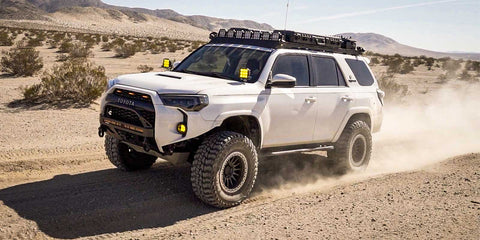
Our hill climb test is all about articulation and low-speed control. With holes big enough to swallow most of these 33" tires, being able to keep the tires firmly planted on the ground is no small task, and getting up without bouncing out of our seats is a big test of how well a set of shocks is tuned.
Despite travel gains being minimal, the 4Runner felt firmly stuck to the piste and rarely lifted a tire. When it did, the vehicle did not feel unsettled, something we can thank those top-out pistons for. In fact, we could tell they worked because of how composed they were, but we never once felt them engage abruptly, unlike some other shocks. Plus, they were really kind to our spines when they touched the tires back down, too.
If this is the driving you are doing, then you might consider installing some UCAs and rear springs to accommodate the extended travel parts, allowing for a bit of extra flex, which might just keep you from waving a tire at all, especially with the front sway bars removed. Nonetheless, they were incredibly comfortable, almost making the climb feel flat, while also having the control to keep us from taking a second or third bounce through the bumps.
It's safe to say we were off to a great start, and they just showed us a sign of how good they were going to be everywhere else.


Frame Twister Suspension Test
On the name alone, this is another articulation test, and although flex is a factor, this obstacle really shows how a set of shocks performs out on the trails we think most people are hitting. On a dry day, it could be conquered even in 2WD, but the rocks, telephone poles, and holes hidden by puddles can really jostle you. Too soft, and you won't be done bouncing before the next bump; too firm, and the driver won't have their head out of the headliner before the next hit either.
Unsurprisingly, the 500Rs were more than willing to keep us from bouncing all over the track and out of our seats. Offering a plush enough feel to take the edge off things, but communicative enough to let us know where the grip is and what is going on underneath us, just like they did on the hill climb. Again, a significant factor in this was that the secondary piston on rebound allowed the dampers to be relatively active in the middle of their stroke, while keeping us out of a pogo when they extended toward the limits of their travel.
At this point, we were racking our brains to find a single gripe, and we kept coming up short. In fact, we were getting a little bored by just how well they were doing, which, despite the optics, is the best compliment we could ever give.


Fire Road Test
Whether you are packing out to your favorite campsite or fishing hole or making your way to the trail head to get rowdy, chances are you are going to find yourself down a fire or forestry road riddled with washboards, chatter, ruts, baby heads, and the like. Heck, tons of you probably still live on a dirt road to boot. Weathering washboards is one of the great unifiers of outdoorsmen, off-roaders, and country folk alike, so it is a test we take pretty seriously.
Some shocks will punish you with rattling the hair off your head for driving too slowly. Others make you feel like you are one gentle breeze from ending up in a ditch at anything above a snail's pace, so testing the shocks at varying speeds down our favorite little dirt road is USUALLY a big tell, at least until we got our hands on these Radflos.
These were the first set of shocks we have tested that were largely unphased by speed. They were just as happy at 10 to 15 mph as they were at 45 to 50. Sure, at speeds over 55 or 60 MPH, they started to get a little floaty, but flying down a fire road at freeway speeds is far outside of what a 2.0 shock like these are made for. Even so, they still feel at least a touch more locked down than other things we have tested of a similar body size.
We hate to keep beating a dead horse, but once again, this is another place where that secondary top-out piston makes a big difference. Although often overlooked, dialing in rebound valving is crucial for achieving a smooth ride, especially on a washboard surface. It must be soft yet active enough to prevent the tires from skipping across the chatter, which is detrimental to comfort and grip, but also firm enough to avoid becoming floaty and unstable at speed. Somehow, these 500Rs seem to strike the best balance we have felt so far, and the only thing we can point to outside of the killer tuning team at Radflo are those extra top-out pistons.


Whoops Suspension Test
Hitting the whoops is all about finding the limit of the suspension and confirming the happy pace of a particular setup. Usually, we observe the speed at which the shocks prefer to operate during our fire road testing, and essentially use these whoops to confirm that the suspension can still cope with a rough section, just in case one jumps out in front of you. Since these shocks performed so well on the fire road, we were cautiously optimistic about their performance.
Now these shocks are still a 2" body, so if your main goal is to smack whoops, roast back roads, and float dunes, they might disappoint you, but we would be lying if we did not say they still punch at least a little bit over their weight class. Although nowhere near some of the higher-dollar and bigger-bodied setups we have tested on other applications, clocking 35 through this section without the vehicle being pushed to the stratosphere is no small feat. We actually went into this test wondering why they felt the need to add a reservoir option for both the front and rear, but given how much fun you can have with it, it makes a lot of sense.
These 4Runners are still a relatively new application, but it will be hard to top them in terms of high-speed off-road performance for the money until the Bilstein 6112s and 6100s are finally released. We do not even need to test to tell you that those Bilsteins will probably beat these Radflos in a race, but they most certainly will not be as comfortable as these are in every other situation.


Chicane Suspension Test
Just like we use the whoops to ensure you can survive a rough section at speeds, we take vehicles to our chicane to ensure you can still safely turn at those speeds. Hitting 35 mph in the whoops is cool, smashing a fire road and 50 is rad, but we want to make sure that you can safely turn that steering wheel and be able to manage whatever the car does after that.
Just like every other test, these Radflos did better than we could have ever expected, only swaying enough to maintain traction, and being incredibly neutral once traction was lost. They were super easy to keep in a "zero counter" condition when the speeds were right, which might lean towards a little bit of oversteer when you cooked it a little harder, eventually turning into gentle and progressive understeer when you took it a step too far.
These 4runners are relatively short at a 112" wheelbase, which can often lead to the vehicle snapping into under- or oversteer when you push past the limit, but any loss in traction did not come with a violent change in attitude. It was easy to slide, or not slide. Hang the tail out or keep it tidy. They just did what we asked until we asked too much, at which point they let us off easy.
Brands are often only concerned with managing unwanted body motions, such as brake dive and body roll, and ignore entirely the issue of limit handling balance, which is equally, if not more, important in our opinion. The heart of why we go off-road for fun is that it we are driving in a lower traction environment, which means by design we will be losing traction. Knowing that you can still easily control the vehicle after you're out of grip is critical to having the fun we like to have, and clearly, Radflo feels the same way.


Closing Thoughts
They bring:
- True daily-driver refinement
- Thoughtful engineering
- Rebuildability
- Smart use of progressive rebound support
- Options for both stock-height and moderately lifted rigs