How Much Does It Cost to Replace Shock Absorbers? Answers from an Insider
Posted by Sean Reyes on
If you have a general feeling of uneasiness or being thrown around on the streets or highways, or you're hearing a lot more clunking from underneath your car, then its possibly time for a new set of shocks. When shocks lose their damping ability, you can be running into the bumpstops a lot more often. If you've got rust or corrossion happening under your car, this can wear away at the shock mounts, producing a lot of play in your suspension (clunk clunk).
A typical shock replacement for a entry or mid-level consumer vehicle is in the $1000 range, while a luxury vehicle with air ride or electronic suspension components can be upwards of $2500-3000 (Mercedes Air Suspension, Audi Electronic Suspension). In this article we'll show you how to cut that budget down by sourcing the parts yourself, and how many hours it would take you or a professional mechanic to do the job.
Cutting Straight to the Costs
Costs of Shocks
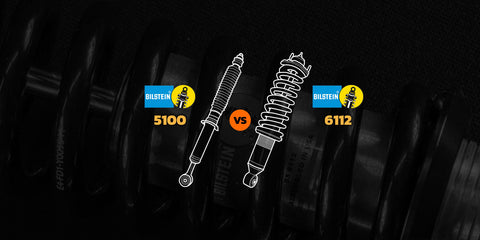
Since Shocks are a single unit, without springs, these will be the least expensive compared to struts or coilovers. Using a Jeep Wrangler, Ram 2500, or typical motorhome as example:
- $30-150 per corner. This comes strictly down to quality, whether you want to get a no-name black or white shock off an online mall, or if you go with a solid name brand known for durability and longevity ( Bilstein Shocks ).
- Labor time here is usually in the 30-60 minutes per corner, often time an experience mechanic can have all 4 corners done within 1-2 hours on popular vehicles with normal shocks.
Costs of Struts & Coilovers
Since these units often include a coil spring, there's a bit more nuance with the replacement of these parts, and can often get complicated, which drives up labor more than parts costs.
- $50-$300 per corner. Once again quality plays a big factor here in costs. No name black or white shocks that are private label imported parts with questionable manufacturing quality will get the job done, but who knows how long they will lasts. Manufacturers like Eibach and Bilstein are proven quality manufacturers of aftermarket parts for your vehicle, that often exceed the normal 50k mile intervals a driver typically sees for shock replacement.
- A strut that connects to the steering, or helps support the vehicle will need to be removed along with the springs. Sometimes the spring is the failure point a new one is needed, so now you have 2 pieces to replace. If the strut and spring are a single unit, than a coil compressor is required to disassemble them, adding about 30 minutes per corner.
- All coilovers require a spring compressor, so if you have a late model vehicle, factor in the time required here by default.
Labor Cost
- Typical shop labor is $100-150/hr, depending on your location and how many shops in the area (competition).
- Front strut installation will typically be 2-3 hours for the two front corners.
- Single shock installation shouldn't be more than 30mins on each corner, we see a 4 shock truck sometimes done inside of an hour, or a truck with two front coilovers and 2 rear shocks done in about 3 hours if there's no complication.
- Older vehicles often times run into bolt and mount issues, where there's rust, corrosion, or simply failed hardware that needs replaced.
- Coilovers are similar installation cost of struts, usually an hour per corner. That doesn't include possible height adjustment as well (take off, adjust, re-install).
- Even though a new coilover may be more expensive than just the shock piece, the time it takes to remove the springs from the old unit, and put them on the new unit, could be equivalent in labor to the new parts as a whole.
- Purchasing a single coilover unit ready for installation can take 30 minutes on labor, whereas disassembling the original units and assembling onto the new unit can take anywhere from 30-90 minutes, and you will still have a couple old components with this choice (top mounts, springs).
If you're replacing struts, a coil spring compressor is going to be required, and will probably double your labor time.
If you're considering budget level shocks, learn more about why Cheap Shocks cost more than Expensive Shocks
Do you have shocks or struts?
Both shocks and struts are dampers for a vehicle, they slow the motion of the vehicle so you have the handling needed to navigate appropriately, stop when needed, and move around the road with confidence.
A shock is typically not a structural component of your suspension, its not a part of the steering mechanisms, and if a shock blew out under the vehicle there wouldn't be a catastrophic failure of driving or incident. Its a big help though if they're doing their job correctly.
A strut is a little different in that its sometimes connected to the steering assembly, which is also connected to the wheels. Often times a strut also includes a spring, which creates a vital component to a passenger cars performance and ability to get down the road.
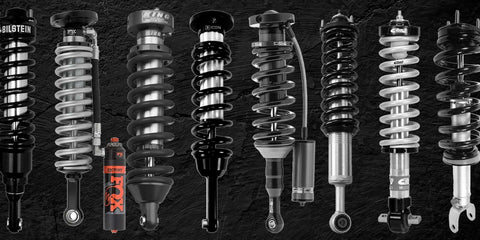
Coilovers are similar to struts, but not often connected to the wheel directly, nor the steering assembly. Its a shock, with a seat to hold a spring, as one single unit. Many late model light-trucks use a coilover (Tacoma, 4Runner, F150) to both suspend the vehicle, as well as dampen the energy, through a single unit.
The difference between these components will make a difference on expected costs for replacements. Shocks are usually a breeze for any mechanic or person familiar with tools to get the job done quickly. A strut or coilover
How do I Know If I Need New Shocks, Struts, or Coilovers?
Dont take it as a surprise if your mechanic suggests new shocks (we're going to use shocks as a catch-all term here for your dampers), as the typical OEM package do indeed last 30-50k miles, that's not just marketing jargon. We frequently see shocks lose their damping ability much sooner. And while there may not be any visible signs of failure, the internal workings can be telling a different story.
Common Symptoms of Damper Failure:
- Loud banging or clunks over bumps or potholes
- Excessive nose dive when braking
- Sloppy side to side movement up driveways or bumps
- Vehicle doesn't settle quickly after bumps or highway joints
- Uneven tire wear
- Lots of body roll around turns or freeway onramps
- Oil buildup around the shock shaft, or puddling under vehicle
Can I Repair a Shock, Strut, Coilover?
In most instances, a factory, or even aftermarket damper cannot be repaired. Higher end performance oriented dampers can be, from the likes of Bilstein, Fox, KW shocks, and others have dampers meant for repair and servicing, but those are outside the scope of this guide. ($400-1000 per corner).
Some struts have cartridges that can be replaced easily, without needing to replace the entire strut unit. If the vehicle is old, and the parts are really old, its usually a great idea to replace the entire spring and strut unit, with new top mounts, and new hardware to attach everything to the frame, leaving nothing to chance.
Can I Drive with a Bad Shock or Strut?
Yes, and you probably have already. Because shocks are generally unseen and invisible, failure is hard to diagnose. Along with that, drivers become ride-blind to the deteriorating performance of their vehicle over time. With that said, many drivers are currently driving on one or more failed shocks.
Unless the physical structure of the damper has failed, its usually ok to drive on it until the scheduled work is to be done. We wouldn't suggest you have an oil-change shop work on your suspension unless its a critical situation.
Who Should Replace My Shocks, Struts, or Coilovers? Can I?
Despite what we may think of a vehicle's inner workings, the suspension is usually the simplest system of your vehicle to do work on. Any mechanic worth their google reviews should be able to complete this job without issue.
If you want to save some dough, replacing normal shocks is usually pretty easy if you have some patience and assemble the right tools for the job; usually a few different sock wrenches, maybe a screw driver, but overall pretty simple. (2 hours for 4 shocks)
Struts and coilovers come with a lot of added work because the springs are also attached to the unit, so a spring compressor is required, and comes with inherent risk due to the amount of tension that unit is under while the springs are still installed. There are coil spring compressors to rent, or purchase for $50 or less, that are consumer-friendly, but with that said - many people opt to let an experienced mechanic do the job here. (30-60 minutes per strut/coilover)
Replacing a strut or coilover should also be followed up with an alignment. If you're looking to replace struts, springs, or coilovers on a vehicle that's had its equipment for 5-10 years, than new springs will certainly change the ride height because the old springs have sagged since new.