2022–2026 Toyota Tundra Shock & Suspension Buyer's Guide
Posted by Sean Reyes on
2022–2026 Toyota Tundra Shock & Suspension Buyer's Guide

In This Article
The 3rd Gen Tundra Is a Different Animal
The 2022+ Tundra rewrote the rulebook for full-size truck suspension. Twin-turbo V6, coil-over rear, one-ton-style wheel bearings, and a platform that finally has the bones to do something serious — but also one that punishes you fast if you pick the wrong suspension setup.
We've run this platform hard. Same test truck, multiple kits, same trails, same speeds. Here's what we know.
What You Need to Know Before You Buy Shocks
A few platform-specific things trip people up on the new Tundra. Get these right and everything else falls into place.
Shock body size matters more than you think. The Tundra is a big, heavy truck. 2.0-body shocks top out constantly under real off-road loads — especially once you go to 35s. At minimum, you want a 2.5" or 2.6" body up front. Don't skip this.
Axle shafts are a factor. There are three axle variants on this platform: black (base model, tripod-style, limited travel), red (TRD Off-Road/Pro, Rzeppa joint — the sweet spot), and silver (TRD 3" lift kit, longer extended length). Know which one you have before buying. A diff drop is cheap insurance regardless.
You don't need 3" of lift to run 35s. This one surprises people. With the correct wheel offset (17x8.5 +25 is our proven spec), 35s fit and clear at full bump with as little as 2.2" of lift. Lift restores the up-travel you limit for clearance — that's its real job here. We tested this extensively on the lift table.

The Kits We've Tested Side by Side
Eibach Stage 1 & Stage 2R
The entry point — good starting kit, but know the limits.
The Eibach system is modular, well-built, and a smart way to get into the platform without overcommitting. The Stage 1 delivers a clean leveled stance and decent daily ride quality — but the front struts are nearly stock in length, and you'll feel it. Topping out on driveways and off-road becomes a regular complaint once the truck is loaded or pushed harder. The Stage 2R fixes a lot of that: the coilover swap adds ~6" of overall shock length, nearly an inch of additional wheel travel, and the reservoir rears bring better heat management and a more linear feel off-road.
- Stage 1 lift range: 2.5–2.6" front / 1.1" rear — familiar, easy install, bolt-on
- Stage 2 coilover range: 0.8–3.2" — adjustable ride height even after install
- Stage 2R adds: reservoir rear shocks for better off-road damping and heat management
- Bottom line: Start at Stage 2 if budget allows. Eibach's modular approach means you can upgrade piece by piece without throwing money away.

Dobinsons MRR 3" Lift Kit
The wake-up call for anyone still running a spacer - and a serious travel upgrade.
This one came to us as a rescue job. The truck showed up on a 2.5" spring spacer that looked like a lift kit but had quietly killed the suspension. Spacers preload the factory spring and rob you of droop travel — this truck had gone from 7.5" of total front wheel travel down to just 1.5" of usable droop, with the shock itself acting as the limiting strap. The Dobinsons MRR coilovers fixed all of it: 3" of lift, 10 full inches of front wheel travel, and dual-rate rear springs that handle varying loads far better than a single-rate setup. We paired them with Icon UCAs and sway bar drops, which is the right call anytime you're adding real travel to this platform.
- Front travel: 10" total — a genuine 2.5" net gain over factory, even more over a spacer-equipped truck
- Lift: 3" — accomplished with proper-rate springs and longer shocks, not a preloaded spacer hack
- Rear shocks: Remote reservoir + dual-rate springs for load-varying capability; great for trucks that haul and tow differently week to week
- Bottom line: If you're running a spacer kit right now, this is what you should have installed instead. Real lift, real travel, zero of the droop-killing compromise.

Icon Stage 2 EXP (2.5 Front / 2.0 Rear)
The best overall kit we've tested on the Tundra — so far.
The Icon Stage 2 EXP was the first kit where every single metric moved forward. More droop travel than the Eibachs, better controlled rebound, true 10" of front wheel travel, and the kind of composure at 40–45 mph on washboard that makes you forget you're in a full-size truck. The front 2.5 EXP struts are the real star — with upgraded UCAs they finally give this platform the geometry it deserves. The rear 2.0s are the only weak link; they start working harder through bigger whoops and we'd push anyone serious about off-road to bump to 2.5s in the back.
- Front struts: Icon 2.5 EXP — 10" of front wheel travel, best droop we've seen at this price point
- Rear shocks: Icon 2.0 (non-reservoir) — capable, but rear-limited in aggressive whoops; 2.5s recommended if you push hard
- Requires: Upgraded upper control arms — don't skip them, they're non-negotiable with this kit
- Bottom line: Best daily + off-road balance we've tested. Some install effort required — LCA pocket cutting, sway bar clearance — but the result earns it.

Bilstein 6112 + 6100
Fast, firm, confidence-inspiring — the speed demon of the group.
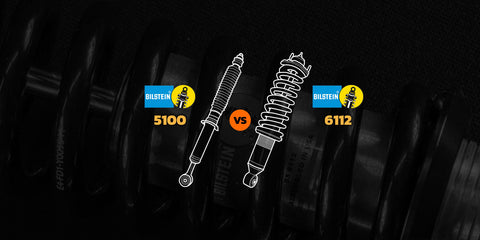
The Bilstein combo is the one you want if you're covering ground fast. The 6112 front / 6100 rear pairing is a matched set — both running 2.6" bodies — and that rear upgrade over previous setups was immediately noticeable. No more rear playing catch-up. Their signature behavior holds true here: slightly firm at slow speeds on chunky trails, but the faster you go, the smoother they feel. Adjustable ride height settings give you room to dial things in if you add a bumper or skid plates later. At just over $1,400 for the full set, it's one of the best performance-per-dollar propositions on the platform.
- Body size: 2.6" front and rear — matched damping, no weak link between ends
- Ride character: Firm at low speed / smooth at speed — "the faster you go, the smoother they get"
- Adjustable ride height: Multiple settings let you compensate for added accessory weight later
- Bottom line: Best pick for desert runners and high-speed dirt. Not the most plush crawling setup, but most drivers won't care once they're at pace.

Old Man Emu MT64
The most well-rounded kit we've tested — and the most surprising.
We didn't expect OME to land here. But after a full day of testing — washboards, whoops, rock crawling, frame twister, street — the MT64 scored at the top of the pile in almost every category. The secret is that they're genuinely longer than most kits on this platform, giving you real added travel rather than compensating with stiff valving. Washboard chatter disappears. Whoops at 48–52 mph felt relaxed. Crawling transitions were the cleanest we've experienced. The only note: the rear can get a little loose at the absolute handling limit during fast directional changes — easily fixed with a stiffer rear sway bar, and honestly not a real-world issue for 95% of buyers.
- Travel advantage: ~2" more wheel travel than Bilstein 6112/6100 — sounds small, feels massive on trail
- Off-road scorecard: A+ on washboard, whoops, rock crawling, frame twister — genuinely excellent everywhere
- Towing/load: Single-rate OME coils held up better than expected under load; heavy haulers can spec heavier-rate coils
- Bottom line: The most comfortable kit we've run on this truck. Best for overlanders, trail runners, and anyone who wants a plush street ride without sacrificing off-road capability.
How They Stack Up
| Kit | Body Size | Travel | Ride Character | Best For |
|---|---|---|---|---|
| Eibach Stage 1 | 2.0" | Stock-ish | Comfortable, limited | Entry-level upgrade, daily driven comfort |
| Eibach Stage 2R | 2.0" (front coilover) | +~1" over Stage 1 | Smooth, height adjustable | Budget-conscious off-roaders, great road comfort |
| Dobinsons MRR | 2.5" | 10" front travel / 3" lift | Capable, dual-rate springs | max height, adjustability, overlanding |
| Icon Stage 2 EXP | 2.5" front / 2.0" rear | 10" front travel | Balanced, composed | Best all-around pick |
| Bilstein 6112/6100 | 2.6" front and rear | Near stock | Firm/fast | High-speed dirt, extra support |
| OME MT64 | 2.5" | +2" over Bilstein | Plush, compliant | Overland, trail, comfort |
So What Should You Buy?
Just want a clean level and better daily ride? Eibach Stage 1 gets you there. Know going in that you'll want to upgrade the front to Stage 2 coilovers eventually.
Running a spacer kit right now? Pull it off. The Dobinsons MRR install shows exactly what you're giving up in droop travel with a spacer — and what you get back with a proper coilover setup. 3" of real lift, 10" of front travel, and dual-rate springs for trucks that carry different loads throughout the week.
Running 35s and doing real off-road? You need a 2.5" body minimum up front. The Icon EXP Stage 2 or the OME MT64 are where we'd point you. The MT64 if you want the plushest ride. The Icons if you want maximum travel and a more dialed-in feel at speed.
Covering ground fast on dirt? Bilstein 6112 + 6100. The combo is hard to beat at its price point for that use case.
Don't forget the supporting mods: UCAs (mandatory with Icon), diff drop kit (cheap, always worth it), and get your wheel offset right before you do anything else. A 17x8.5 +25 is our proven spec for 35s on this platform.
Still Not Sure?
Chat with us — we've put all of these kits on the same truck, on the same trails. We can help you match the right setup to how you actually use your Tundra.
And if you want to see the testing in action, head over to our YouTube channel — we've got the full walkthroughs for each of these kits on video.