Fox 2.5 Performance Elite Review: Tested On and Off-Road on the 2022+ Toyota Tundra
Posted by Brandon Sevestre on
So it's almost a given that when you bolt on a high-end setup like the Fox 2.5 Performance Elite coilovers and shocks, you've got a winner on your hands. Right?
Well, mostly. Let's get into it.
In This Article
- How We Test
- Specs & Fitment: What You're Buying
- Fox 2.5 Performance Elite Tundra Spec Sheet
- On the Street
- Washboard Roads
- Low-Speed Chunky Terrain
- Technical Trails
- High Speed & Fade
- Towing & Hauling
- Are the DSC Adjusters Worth It?
- Performance Scorecard
- Fox 2.5 PES vs. OME MT64
- Better Options for the Comfort-First Buyer?
- Verdict: Who Should Buy These
- Frequently Asked Questions
- What's Next

How We Test
If you're new to the Shock Surplus party, here's the deal: we test the suspension systems we carry on our own vehicles so we can give you real-world feedback beyond flashy copy and numbers on a spec sheet. We believe there's no one best suspension system out there, but there is a best setup for your specific needs, and that's what these reviews are here to help you figure out.
For this one, we put the Fox 2.5 Performance Elites through the conditions we think most people are actually getting into, plus a few only the real senders are trying, to see if they might be right for you.
A lot of what we say here is based on our experience with the many setups we've tested on this truck before. If you're not caught up on the Tundra series, check out our previous reviews and at least Part 1 of the Buyer's Guide so you have the context for everything below.
One more note: this review is about outright performance and feel. We'll be publishing a separate guide on dialing in Fox dual speed compression adjusters (which applies to any rig running DSCs, Fox or otherwise), so if you came here for a tuning tutorial, stay tuned for that.


Specs & Fitment: What You're Buying
Before we get to the fun part, we have to read off the spec sheet a tiny bit so you know what these shocks are all about. We'll be quick.
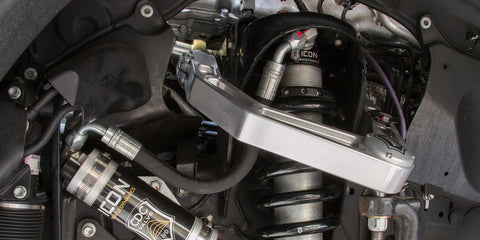
Aluminum Bodies
Starting at the top, these use aluminum bodies, which means we'll all be long gone before they corrode. That's a huge plus if you're in the Rust Belt. The trade-off is that the coilovers need to go on a spring compressor for any preload adjustment, and an aluminum bore has a greater chance of scoring than a steel body if you put off your rebuild longer than you should.
So what you save in rust-prevention upkeep, you sacrifice in the ability to procrastinate on rebuilds. Although if you're trying to put off an inexpensive rebuild on a set of shocks this expensive, you might want to reevaluate your priorities.
2.5″ Bodies, Remote Reservoirs, and DSC Adjusters
As with any Fox Performance Elite Series product, these are 2.5″ body coilovers and shocks with external reservoirs and dual speed compression (DSC) adjusters. On the Tundra they use remote reservoirs front and rear and include all the brackets and hardware you need to mount them.
Fox has also just started shipping these with their new DSC EVO adjusters, which supposedly allow a greater total range of adjustment and more separation between low-speed and high-speed compression with less cross-talk between the two. In theory that should be a noticeable improvement on both ends of the scale.
Lift Ranges and Required Supporting Mods
The rear shocks come in two lengths: one for stock height to 1.5″ of lift, and one for 1.5–3″ of lift.
The front coilovers are currently only offered in a 0–3″ “extended travel” variant. That variant requires aftermarket upper control arms, and it will require a diff drop or an axle upgrade if you don't have the factory red axle shafts (TRD Pro and TRD Off-Road) or the silver shafts that come with the TRD lift kit.
Let's be honest, though: if you think you'd remotely benefit from 2.5″ body coilovers with reservoirs and adjusters, your stock upper control arms are going to make the upgrade decision for you. Every coilover we've tested that works with the stock base-model black axle shafts in the stock position has been really limited on travel, and it suffers everywhere because of it.

Fox
2.5 Performance Elite Series Lift Kit
2022+ Toyota Tundra
Not sure which axle shafts your truck has? Call us at (213) 433-3616 and we'll sort out what you need.
Fox 2.5 Performance Elite Tundra Spec Sheet
- Application - 2022+ Toyota Tundra (3rd Gen), hybrid and non-hybrid
- Body Diameter - 2.5″ front coilover and rear shock
- Body Material - Aluminum (corrosion-proof; spring compressor required for preload changes)
- Reservoir - Remote reservoir front and rear, mounting brackets and hardware included
- Adjustment - Dual speed compression (DSC) adjusters, independent low-speed and high-speed circuits
- Front Lift Range - 0–3″ extended travel (only variant offered)
- Rear Lift Range - Two lengths: 0–1.5″ or 1.5–3″
- Required Supporting Mods - Aftermarket upper control arms (all trucks); diff drop or axle shaft upgrade unless equipped with red (TRD Pro/Off-Road) or silver (TRD lift kit) shafts
- Seals & Oil - Viton seals and Fox oil rated for higher heat and load; service parts readily available
- As Tested - Non-hybrid truck, ~2–2.5″ front lift, 1.5–3″ rear shocks, street tire pressures throughout

On the Street: Initial Feel
Before we even made it to the fun part of our testing, both Jeff (whose truck this is) and I noticed some tendencies on the road that made us think these things were going to top out like pigs the whole way down the trail. We were pretty much dead wrong on that, at least under most conditions, but the road complaints are still worth unpacking.
Jeff's Take: It's the Spring Rate
Jeff's read on it was that the front is slightly oversprung for a stock-weight, non-hybrid truck. Super tiny suspension events like surface changes and cracks in the pavement didn't generate enough force to overcome the spring, so the truck read a little firm over the small stuff. That's usually something you feel on a setup with too much preload, and it usually means harsh top-outs. But these Fox coilovers had enough travel and enough rebound damping to keep it under control when really pushed.
Keeping It in Perspective
When it comes to those small events on the road, we're being really nitpicky, largely because this is a high-dollar setup that should be held to a high standard. Without question, these are more comfortable than stock, and more comfortable than the Bilstein 6112 and 6100 and the Eibach kits we've tested previously.
We also have a hard time saying the spring was the absolute wrong choice. It's a little much for this particular truck, but the hybrid adds something like 300–400 lbs, which would make this spring rate almost perfect. And if you're shopping coilovers at this level, a little extra weight from a front bumper or skid plate is probably in the cards anyway. A few turns of preload and a few clicks of compression will more than compensate for it.
Not the softest thing out there, but very livable, and that spring is a big part of why these party so hard when you put the pedal down.

Washboard Roads
A big part of our testing was driving the truck the way we think most people actually drive their trucks, and the thing that pushes most people to upgrade is how awful their truck feels on a washboard road.
Jeff's Take
They performed as well as we hoped. More than tolerable, far more comfortable than stock at lower speeds, and on the washboard side of the road they'll let you go as fast as your tires have traction. Does it ride like a Cadillac down a chopped-up forest road? No. But it's not half bad, especially considering what else they're capable of.
They Don't Punish You for Driving Slow
What kills a lot of shocks for a lot of people is that their “happy pace” down an average dirt road isn't the pace most people want to drive. We won't say these are unflappable at almost any speed within reason like some other options we've tested, but they also don't punish you for driving too slow the way many shocks do.
The best way to describe them: they let you drive down a dirt road the way you'd drive around town, with enough support to keep you out of a ditch if you smack something big you weren't expecting. And they might just goad you into having a little fun from time to time.

Low-Speed Chunky Terrain
For most people, terrain more challenging than a manicured fire road means a dirt road that isn't regularly maintained: ruts, rocks, and sometimes roots that force you to take it easy. If your camp site, fishing hole, or hunting spot is a click or two off the beaten path, you'll be hitting stuff that, while far from difficult, is chunky enough to keep you at a snail's pace. Those sections don't usually last long, but they're arguably where you'll be most miserable.
Not to harp on an old point, but this is where those stiff front springs showed their least flattering side.
Jeff's Take
Jeff would be lying if he said he was happy with the performance here. Even with the adjusters backed off to full soft, the truck tossed us around a bit, and that's all down to the springs. In his view it's a fair compromise, all things considered. Worth noting: we did all our testing at street tire pressures, which is suboptimal for this kind of driving. Airing down would fix a lot of the complaints, although it probably wouldn't have been necessary on something like the OME MT64s we ran previously.
The Weight Caveat, Again
It definitely jostled the old organs, but it was still far better than stock and at least a couple of the aftermarket options we've tested on this truck. If you have a hybrid, or additional weight on the front of a non-hybrid, we think these complaints disappear. A softer ride here would certainly be nice, but for the non-hybrid crowd we think it's a worthwhile trade for having the adjustment range to handle heavy weight upgrades down the road.

Technical Trails
Very few people are going to take one of these trucks down a serious rock trail. But trail systems are getting dug out so badly from big-tire traffic that stuff which used to be easy is getting harder by the day. Neither this truck nor these shocks would be our first choice for technically difficult trails, but that choice isn't always on the table.
Jeff's Take
Same story as the chunky stuff: just a tiny bit oversprung for this kind of driving with his particular setup. The suspension events are large, but they happen so slowly it's hard to overcome all that spring rate. There's still sufficient travel to articulate decently at 2–2.5″ of front lift, but you have to assume the stiff springs limit it some. Jeff is probably spoiled by the extra travel and the secondary top-out piston on the MT64s, but it did feel a little harsh when it ran out of travel on extension and topped out.
That said, the 1.5–3″ rear shocks are super long, which made up for a lot of the front's limitations. The truck still had good traction, which is a good sign it articulated well enough to keep all four tires planted most of the time.
Set the Truck Up for the Job
If you're brave enough to regularly hit hard trails in a full-size truck with this much front fascia, an aftermarket bumper and skid plate are a must, and as we've already established, that added weight makes the spring rate question moot. So yes, they could be a little softer here, but they would be if the truck were actually set up for that driving. If you have a hybrid, expect a noticeably softer feel.
When a setup has to do a bit of everything, on everything, there are going to be compromises somewhere, and being a little firm here is a worthwhile one. Especially when you consider how much fun you can have once you pick the speeds up.

High Speed & Fade
The goal with this round of testing was to realistically simulate the driving most of you are actually doing. But every time we took it easy, we could feel these things begging for more, so it was hard not to let the baby girl eat. Floating rollers and smacking whoops isn't a priority in most people's plans, but if you buy a set, we think you'll have a hard time not getting a little excited from time to time.
Jeff's Take: Hard to Drive Slow
The truck is just flat-out fun and very intuitive. As with anything, you can find the limit, but something Fox does well with their valving is give you just enough communication to hold the shocks right at or below their limit. That makes them easy to figure out and easy to get the most from. And a lot of the firmness we complained about earlier is more than worthwhile when you're airborne and know the landing isn't going to be a big deal.
They were more than good enough everywhere else with the adjusters backed off. Tighten them up a few clicks, put the pedal down, and boy were they a hoot.
Zero Noticeable Fade
We were basically hot-lapping the rollers and rough sections we tested on, and we didn't notice any fade. The shocks surely got warm at some point, but nowhere near enough to lose an appreciable amount of performance, which is a real testament to the external reservoirs. Lesser-priced options without reservoirs like the OME MT64 or the Bilstein 6112 and 6100 had much more fade on much shorter days.
We like to say that 2.5-ish″ body shocks without reservoirs write checks they can only cash once or twice. They'll take a big hit or two and be no worse for wear, but they struggle to keep doing it without overheating and needing a break. And if you're doing long treks in the dirt, that's something you might notice after a few hours even at reasonable speeds. Few things kill the fun of going off-road more than having to stop so your rig can recover. These have enough heat dissipation that the vast majority of people could have their fun, or do almost any of the wheeling they plan on, and rarely worry about overheating the shocks. Unless you're sending it to the moon.

Towing & Hauling
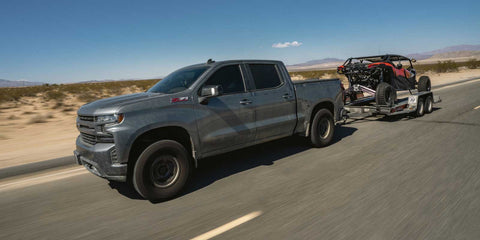
Before we address the Australian-bird-shaped elephant in the room, this is a truck, and for a lot of people that means doing truck stuff. Jeff has done plenty of truck stuff with this truck: dirt bikes and a ton of gear in the bed, camping trailers on the hitch, and more.
Jeff's Take: Best Under Load So Far
These might be the best option we've tested under load, or at least the one that can be set up for the best overall compromise. Up until now, nothing was as stable as the Bilsteins under load, but nothing we've tested before or since was as stiff unloaded. With the dual speed compression adjusters, the Fox can easily be set up to be just as stable, if not more stable, than the Bilsteins with a load, while being leagues ahead in comfort when the load comes off. We'll probably find something better for load specifically as we keep testing, but Fox nailed the balance between stability with a load and livability without one.
I wasn't able to experience the truck loaded myself, but it was apparent just from feeling them unloaded that they have a lot of prowess in the load department.
Tow or haul with your Tundra?
Shop Fox 2.5 Performance Elite for the Tundra
Call (213) 433-3616 and we'll talk through rear shock length and a starting point for your adjusters based on what you carry.

Are the DSC Adjusters Worth It?
There's an argument that an external reservoir on a 2.5″ or larger shock is overkill for the average driver, and for plenty of enthusiasts. But it's the only way to get external compression adjustment on these shocks. So setting aside the reservoir benefits, do the dual speed compression adjusters make a shock like this worthwhile over the non-adjustable options we've tested?
Jeff's Take: For the Right Buyer, Absolutely
These are a perfect choice for the person whose budget ends here, who does a little bit of everything with their truck, and for whom a big piece of that “everything pie” is going fast off-road or running varying loads. The only way one setup can be somewhat comfortable at lower speeds off-road and around town unloaded, while also being absolutely locked down at higher speeds or under load, is with those adjusters. For that person, the adjuster alone could be the reason to buy them.
Even If You Set and Forget
The DSC adjusters create an external circuit that lets you independently adjust low-speed and high-speed compression. So even if you're like me and you set your shocks once and leave them alone, you can still land on a better balance of ride and handling than you'd get without them.
Performance Scorecard
How the Fox 2.5 Performance Elites stacked up on our non-hybrid test truck, condition by condition. Ratings are relative to the other 3rd gen Tundra setups we've tested, not to shocks in general.
| Condition | Rating | Notes |
|---|---|---|
| Street / Daily Driving | 3.5 / 5 | More comfortable than stock, Bilstein 6112/6100, and the Eibach kits. Slightly oversprung on a non-hybrid; small-bump firmness is the only nitpick. |
| Washboard Roads | 4 / 5 | As fast as your tires have traction. Doesn't punish you for driving slow. |
| Low-Speed Chunky Terrain | 3 / 5 | Weakest area on a stock-weight non-hybrid. Tossed us around at full soft. Airing down or added front weight fixes most of it. |
| Technical Trails | 3 / 5 | Decent articulation at 2–2.5″; long rear shocks help. Occasional harsh top-out on extension. |
| High-Speed Off-Road | 5 / 5 | Flat-out fun and intuitive. Communicative valving makes the limit easy to find and hold. |
| Heat / Fade Resistance | 5 / 5 | No noticeable fade after a full day of hot laps. Non-reservoir options faded on much shorter days. |
| Towing & Hauling | 4.5 / 5 | Best overall compromise we've tested: Bilstein-level stability loaded, far more comfort unloaded. |
| Adjustability | 5 / 5 | Independent low- and high-speed compression. Worth it even for set-and-forget owners. |
| Serviceability | 4.5 / 5 | Viton seals, readily available rebuild parts, easily replaced bushings and bearings. Aluminum bodies need a spring compressor for preload. |

Fox 2.5 Performance Elite vs. OME MT64
We've danced around the real question long enough. It's no secret we were big fans of the OME MT64s we took off this truck, and we even said they're probably the right choice for the vast majority of drivers, provided they can live with the roughly 3″ minimum lift.
So does the average person actually benefit from spending the extra money on the Performance Elites? Or more simply, how do the two compare in real-world feel and performance?
Jeff's Take: Rip the Bandaid Off
The MT64s are probably the better choice for the average person, especially once you compare pricing. That doesn't mean the Fox doesn't have its place.
The MT64s were flat-out softer and more comfortable pretty much everywhere, and they have more travel. Their secondary top-out piston meant we never felt a harsh top-out, which, while not a huge issue on the Fox, was noticeable. So although the MT64 isn't quite as good at higher speeds off-road, the extra travel and progressive support on rebound kept it close enough to do stuff most people wouldn't be comfortable with anyway. They also have the potential to last significantly longer if you're not too rough on them.
Where the Fox Wins
The Fox offered tighter handling and more stability, loaded and otherwise, and it parties just that little bit harder. More importantly, the Fox is better at withstanding serious abuse:
- Heat: the reservoirs dissipate enough heat that we never had to let the shocks cool down, and that will improve oil life.
- Bushings and bearings: much stronger and smoother operating, which means less deflection and a potentially longer life if you send it hard. They're also much more easily replaced.
- Seals and oil: Fox's Viton seals and oil take more heat, load, and everything else, and they're readily available.
- Serviceability: as of right now, MT64 seal kits, bushings, and other service components aren't readily available to the general public. That means they may get burned up faster if you really beat on your truck, and getting them rebuilt is a bit of a task.
If you've watched enough of our videos, you already know durability and longevity are often mutually exclusive when it comes to shocks, and that's the great determinant here. If you like to send it hard off-road, you almost can't afford to go with anything less than the Fox, because you'll be fixing lesser shocks constantly. If you're driving your truck hard enough to need something at this level, the Fox is arguably one of the best choices out there.
So while most people are probably fine with the MT64 or similar options, and may even be better off, if you need the durability and adjustability of something bigger and badder, you're on the right track with the Fox.
Still deciding between the two?
Shop Fox 2.5 Performance Elite for the Tundra
Call (213) 433-3616 and tell us how you actually drive. We'll tell you which one fits.
Better Options for the Comfort-First Buyer?
We've both been doing this long enough to know that a lot of people, especially on full-size trucks, are more likely to spend big money for more comfort than for high-speed off-road prowess. So are there better options than the Performance Elites for the more average driver with a bigger-than-average budget?
Jeff's Take: OME BP-51 and Dobinsons MRR
Yes. Both the OME BP-51 and the Dobinsons MRR offer a notably more plush feel in the vast majority of conditions. The only compromise is that they're arguably not quite as good at higher speeds off-road. But with the internal bypass design on the OME and the rebound adjuster on both, the divide is probably smaller than you think. Even the MT64s had more high-speed potential than most people need, so if these are even as good as the MT64 while being more plush, they'll be strong winners.
The good news: the first thing we tested on this Tundra platform was the MRRs, so if you want to see how they do on the street, check out our Dobinsons MRR review. We still owe you a BP-51 test on our own truck and a real off-road thrashing of the MRRs, so expect those soon.
Comfort is the priority?
Verdict: Who Should Buy the Fox 2.5 Performance Elite
- You do a little bit of everything, and a big piece of that is going fast off-road or running varying loads: this is your shock. The DSC adjusters are the only way one setup covers comfortable-unloaded and locked-down-loaded, and the reservoirs mean you never have to stop and let them cool.
- You have a hybrid, or a non-hybrid with a bumper and skid plate: the spring rate we called “a little much” is close to perfect for you. Most of our comfort nitpicks go away.
- You tow or haul regularly but hate how a load-tuned shock rides empty: best overall loaded/unloaded compromise we've tested on this truck.
- You send it hard and don't want to rebuild constantly: Viton seals, stronger bushings and bearings, readily available service parts. Durability is the reason to spend this much.
- You're the average driver who wants a better truck and can live with ~3″ of lift: the OME MT64 is probably the better buy, and cheaper.
- You have the budget but comfort matters more than speed: look at the OME BP-51 or Dobinsons MRR first.
Frequently Asked Questions
Yes. The front coilover is only offered in a 0–3″ extended travel version, and Fox requires aftermarket upper control arms with it. In our experience every coilover that works with the stock upper control arms on this truck is badly limited on travel, so if you're shopping at this level, plan on control arms from the start.
It depends on your axle shafts. TRD Pro and TRD Off-Road trucks with the factory red axle shafts, and trucks with the silver shafts from the TRD lift kit, are fine. Base model and SR5 trucks with the black axle shafts need either a diff drop or an axle shaft upgrade to run the extended travel front coilover.
The front coilover is adjustable from 0–3″ of lift. The rear shock comes in two lengths: one for stock height up to 1.5″ of lift, and one for 1.5–3″ of lift. We tested at roughly 2–2.5″ of front lift with the longer rear shock.
They're slightly oversprung for a stock-weight, non-hybrid truck, which shows up as a little firmness over small road imperfections and in slow, chunky terrain. They're still more comfortable than stock and more comfortable than the Bilstein 6112 and 6100 or the Eibach kits we've tested. On a hybrid, or a non-hybrid with a bumper and skid plate, the spring rate is close to ideal.
For the right buyer, yes. The adjusters are the only way one setup can be livable around town and at low speeds off-road while also being locked down under a heavy load or at high speed in the dirt. Even if you set them once and forget them, the independent low- and high-speed circuits let you find a better ride and handling balance than a non-adjustable shock.
For the average driver, the OME MT64 is probably the better choice, especially on price. It rides softer, has more travel, and its secondary top-out piston eliminates harsh top-outs. The Fox is the better choice if you drive hard: it handles tighter, is more stable under load, resists fade far better thanks to the reservoirs, uses stronger and more easily replaced bushings and bearings, and its rebuild parts are readily available.
Not in our testing. We hot-lapped rollers and rough sections all day and never felt an appreciable loss of performance. Non-reservoir options like the OME MT64 and Bilstein 6112 and 6100 showed much more fade on much shorter days. The external reservoirs give these enough heat capacity for almost any wheeling the average buyer plans on doing.
They may be the best option we've tested so far under load. With the compression adjusters clicked in, they can be set up as stable as, or more stable than, the Bilsteins under a load, while being far more comfortable than the Bilsteins when unloaded. Back the adjusters off when the trailer comes off and you get your ride quality back.
Two. The coilovers need to go on a spring compressor for any preload adjustment, and an aluminum bore has a greater chance of scoring than a steel one if you push your rebuild interval too long. The upside is they will essentially never corrode, which is a big win in the Rust Belt. Stay on top of rebuilds and the aluminum body is a net positive.

What's Next
We still owe you a BP-51 test on our own truck, a proper off-road thrashing of the Dobinsons MRRs, and that DSC tuning guide, so keep an eye on the channel and the blog for those.
More from the 3rd Gen Tundra series:
- 3rd Gen Tundra Suspension Buyer's Guide, Part 1
- OME MT64 Review
- Dobinsons MRR Review
- Fox DSC Tuning Guide (coming soon)
Ready to Upgrade Your Tundra?
Interested in the Fox 2.5 Performance Elites, the OMEs, or anything else we talked about today? Shock Surplus is your place.
Shop All 3rd Gen Tundra Suspension
Phone: (213) 433-3616