The Ultimate Ford Bronco Suspension Guide - Part 4: Best High Performance Coilovers & Struts
Posted by Sean Law-Bowman on
In This Article
- What Do We Mean by "Premium"?
- Side-by-Side Comparison Chart
- Icon 2.5 IR: The No-Reservoir Original
- Icon 2.5 RR: Remote Reservoir for Extended Abuse
- Icon 2.5 CDCV: Single-Speed Adjustable
- Icon 2.5 CDXS: Dual-Speed Damping Done Right
- Fox 2.5 Performance Elite: The Communicator
- King 2.5: Soft to Savage
- Dobinsons MRR: The Swiss Army Knife
- Frequently Asked Questions
- Recommendations by Driving Style
In previous episodes of this Bronco Buyer's Guide series, we covered the important fundamentals you need to know about modifying these Broncos, plus the entry-level and intermediate options. This episode is finally about the higher-end options.
If you haven't already, check out Part 1, Part 2, and Part 3 for the foundation. Make sure you hit subscribe and the bell icon so you stay up to date on all the fun stuff we get into.
Believe it or not, there are shocks that actually outprice and outperform even the stuff we're talking about today. There's more to come even in this series.

What Do We Mean by "Premium"?
One reason you want to watch the previous episodes is that we broke down the different factory suspension options. You gotta know what you got to know what you should get.
With three - technically four - different factory suspension options, these Broncos are a perfect example of that. Here's the quick breakdown:
All of these premium options far outperform the HOSS 1.0 black Hitachi shocks and HOSS 2.0 yellow Bilsteins. However, they're more of a lateral move for the HOSS 3.0 Fox shocks.
None of these options are truly position-sensitive (like the factory HOSS 3.0), but they offer more travel for better articulation and more overall support. So what you lose in comfort, you somewhat make up in performance.
When You Need the Next Tier Up
Ultimately, if you want to have your cake and eat it too - true position sensitivity paired with extra performance - you'll need to wait for the final episode where we shoot on position-sensitive options like the Fox Factory Race Series 3.0s and Bilstein 8112s, electronically controlled options like the Icon CDEV, or things that do both like those fancy new Fox 3.2 Live Valves.
But for the vast majority of off-road enthusiasts, what we're covering today hits the sweet spot: maximum performance without the complexity of electronic damping control.
Side-by-Side Comparison Chart
| Feature | Icon 2.5 IR/RR | Icon CDCV | Icon CDXS | Fox 2.5 PES | King 2.5 | Dobinsons MRR |
|---|---|---|---|---|---|---|
| Price Tier | Mid | Mid-High | High (Best) | High | High | Mid-High |
| On-Road Comfort | Firm | Firm | Improved Firm | Balanced | Very Soft | Very Soft |
| Low-Speed Off-Road Feel | Harsh | Adjustable | Adjustable | Communicative | Compliant | Compliant |
| Front Travel | 11.5" | 11.5" | 11.5" | 10" | 11" | 11" |
| Rear Travel | 14" | 14" | 14" | 11" | 12" | 13" |
| 37" Tire Clearance | Spacers Needed | Spacers Needed | Spacers Needed | Bolt-On Ready | Spacers Likely | Spacers Likely |
| Handling Balance | Firm/Predictable | Adjustable | Excellent | Forgiving at Limit | Minimal Info | Excellent |
| High-Speed Desert Performance | Excellent | Excellent | Excellent | Very Good | Exceptional | Exceptional |
| Technical Trail Capability | Very Good | Very Good | Very Good | Very Good | Good | Excellent |
| Service Life | Very Long | Very Long | Very Long | Very Long | Very Long | 60k+ miles |
| Compression Adjusters | None | 1-way (10 settings) | 2-way (Separate circuits) | 2-way (DSC-style) | Single-speed (Optional) | Dual (+ Rebound Adj.) |
| Rebound Adjustment | No | No | No | Yes (DSC) | No | Yes (3-position) |
| Load Customization | Heavy Spec Kits | Adjustable | Adjustable | Preset | Adjustable | Door/Engine Optimized |
| Typical Lift (Non-Sasquatch) | 3-4" F / 2-3" R | 3-4" F / 2-3" R | 3-4" F / 2-3" R | 4-4.5" F / 3-3.5" R | ~1" F / ~0.75" R | 2-3" F / 1.5-2" R |
| Best For | Heavy Load, Performance | Adjustable Performance | Versatile Performance | Easy Bolt-On, Handling | Comfort + Speed | Daily Driving, Tech Trails |

Icon 2.5 IR: The No-Reservoir Original
Now we're going to start with Icon, as they have the widest selection at this performance level. In fact, they're the only coilovers on this list that come without reservoirs.
Despite the lack of a second cooling canister, I can confidently say all the travel you gain with the 2.5 IRs still makes them more than deserving of sitting with the present company.
Travel & Articulation
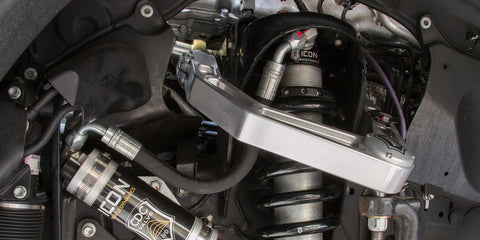
The whole Icon fleet of coilovers is built to offer around 11.5" of travel in the front and over 14" in the back - absolutely insane numbers for any bolt-on setup.
They were able to achieve that in the front because their DJ Pro control arms have the most articulation on the market. If you want everything they have to offer, those are the only UCAs worth considering.
The Secret: Compact Compressed Length
The other secret sauce is that they're much shorter when compressed than other options. On paper, that would make you think clearing a 37" tire is out of the question. However, Icon spent the time to develop bump stop spacers in the exact height you need for those big meats.
The best part? They can be installed with the coilovers already on the vehicle. So they give you a super simple solution to clear big tires without trimming, without forcing you to give it up if you don't have quite as lofty goals.
Ride Quality: Firm, Especially Unloaded
Icon is really the original "Prerunner" shock choice, giving you prerunner performance with overland loads. All that extra travel keeps you flexing instead of waving a tire when the trails turn technical.
When I explain it like that, they sound without flaw. However, without a load, they're probably the firmest riding on this list.
My Bronco was a 2-door, 2.3, with a manual transmission - putting me on the lighter end of the scale. Despite that, I still found them to ride much better than stock HOSS 2.0 Bilsteins. They're definitely harsh at lower speeds, but get better the faster you go.
That said, I could totally understand how a lot of people would find them a touch too firm - at least without additional constant load, especially if they're coming from HOSS 3.0 shocks.
Who Should Buy Icon 2.5 IR?
If you were planning on or already had extra weight from a big bumper, winch, rooftop tent, etc., they're certainly the best in this list out of the box. Heck, they even have heavy-load spec kits with stiffer springs for the extra heavy guys.
Ultimately, these shocks are capable of such performance that it's easy to be surprised by the fade. All that extra travel and overall support can quickly bring your confidence up to a level where you might get a little greedy and overheat them.

ICON Vehicle Dynamics
2.5 IR
2021+ Ford Bronco

Icon 2.5 RR: Remote Reservoir for Extended Abuse
Although they can keep you rolling after some pretty big hits, it only takes a few minutes of sending it to get them hot. If you're spending a fair amount of time having fun in the desert, dunes, or anything more intense than crawling tough trails or cruising down a fire road, you might want to consider spending that little extra money for the remote reservoir coilovers.
Tuning is essentially identical to the IR, so you'll hardly notice a difference when your tires first touch the dirt. But after a few minutes of mobbing, you'll be happy you sprung for them.

ICON Vehicle Dynamics
2.5 RR
2021+ Ford Bronco

Icon 2.5 CDCV: Single-Speed Adjustable
The first of Icon's three damping-adjustable coilovers is the CDCV, which features their original Compression Damping Control Valve adjusters.
Adjustment Range & Tuning Philosophy
These are single-speed (one-way) compression adjusters with 10 total settings and an absolute metric ton of range. For reference, the standard non-adjustable 2.5 coilovers usually offer a similar feel to the CDCVs at the fourth setting.
This means they can be both significantly softer and stiffer than the non-adjustable stuff, which really makes a huge difference.
I'm pretty confident that at the softest setting these would be marked as "acceptable" in terms of comfort on the road and at lower speeds off-road for the vast majority of buyers with unloaded Broncos. At the stiffest settings, they offer more than enough support even for the heaviest Broncos or the heaviest drivers.
The Compromise: Single-Speed Limitation
Icon generally does a good job of building you a package that can grow with you and the curb weight of your rig. But the CDCVs take a huge leap forward in making it both a lot more livable initially - before you have all your armor and gear built in - as well as much more stable when you eventually get everything built out the way you want.
The flaw is that they're single-speed adjusters, which means your ideal settings will often involve a bit of compromise.
If the handling feels sloppy, you'll have to sacrifice some comfort to mitigate unwanted body motions. If it rides too harshly, you may have to sacrifice some stability to gain comfort.
Now it might sound like I'm talking smack on the CDCVs, but believe me when I tell you I'd much rather have these than no adjuster at all. However, Icon does have a line that largely eliminates those compromises.

ICON Vehicle Dynamics
2.5 CDCV
2021+ Ford Bronco

Icon 2.5 CDXS: Dual-Speed Damping Done Right
Dual-speed compression adjusters have started to become so commonplace in the market that we've somewhat come to expect them. So when Icon dropped their CDXS line, we were stoked to the moon - but not necessarily surprised.
Icon's Custom Dual-Speed Design
What did take us by surprise is that they didn't opt to copy or license a "Fox DSC" type design like many other brands have. They took the time to actually develop their own, which we'd argue is superior in most facets.
This design does a much better job of separating low and high-speed oil flow, resulting in less cross-talk between the adjusters.
On many dual-speed compression adjusters, you can get weird tendencies when your low and high-speed settings are too disparate, because oil flows through the path of least resistance. We're at least somewhat confident you could have more flexibility with your settings on these, since it'll be harder for oil to flow into the wrong circuit.
Low-Speed vs. High-Speed Compression: The Distinction
Your low-speed compression usually relates to body roll, brake dive, and unwanted body motions, as well as stiffness over long rolling bumps and road feel.
High-speed compression is the majority of your bump stiffness. This means you can largely tune handling independent of most of your ride quality for far less compromise in your overall setup.
By creating separate circuits for low and high-speed compression flow aft of the valving on the piston, Icon doesn't have to do as much low-speed valving on the piston itself.
Often, so much valving is required on low-speed to get handling under control on non-adjustable shocks that smaller or lighter bumps - which are technically high-speed compression events - go into the stiff low-speed side and make for a harsh ride.
Icon updates their valving to maximize those adjusters, so you get better small-bump compliance with the potential for fewer unwanted body motions. This effectively makes for a better ride overall.
Load Handling & Weight Distribution
Although high-speed compression is still a big factor, you generally need to increase low-speed compression more drastically as weight increases - especially if that weight is up high.
Being able to stiffen low-speed independently of high-speed means you can get a much more stable and locked-down feel, with less sway and porpoising, without really sacrificing comfort as your Bronco gets heavier.
Lift Heights Across All Icon Models
Before we jump to other brands, let's talk about lift heights. Regardless of whether you go IR, RR, CDCV, or CDXS, the basic lift is the same:
- Non-Sasquatch models: 3-4" front / 2-3" rear
- Sasquatch-equipped: 2-3" front / 1.25-2.25" rear
- Badlands models: 2.5-3.5" front / 1.75-2.75" rear
Icon sets these up to be right in the middle of their adjustment range on 4-door 2.7 V6 Broncos. If you have a 2.3 up front, the front coilovers might benefit from backing off the preload a bit. The same goes for the rears on two-door models.
That said, I ran mine at their out-of-the-box settings on my 2-door 4-banger, and they felt mint.

ICON Vehicle Dynamics
2.5 CDXS
2021+ Ford Bronco

Fox 2.5 Performance Elite: The Communicator
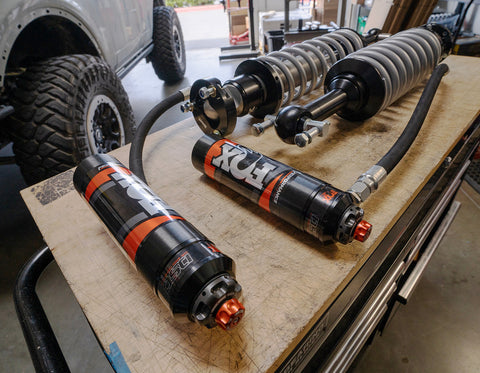
Of all the many shocks we tested on my Bronco, the Fox 2.5 Performance Elite coilovers were the ones I ran the longest. I'd be lying if I said I didn't feel lucky to enjoy them for so long.
Ride Quality: Perfectly Balanced Communication
They're nowhere near the softest shocks on this list, but definitely not the firmest. They offer a very communicative feel I came to really appreciate.
Where the Icons start stiff and get firmer the faster you go, and the Kings start soft and gain support as speeds increase, the Fox keeps a very middle-of-the-road feel. It lets you know just enough to understand what's happening underneath you, but not so much that you're chasing your fillings down the trail or interstate.
Handling: Educational & Forgiving
That extra bit of communication really made it easy to find and hold them on their limit when I was ripping through the desert and really helped me find traction when I was crawling through the rocks.
I can confidently say these were the easiest and most educational to drive, which extends to their handling as well.
Obviously, Fox is the main progenitor of dual-speed compression adjusters in the off-road industry. You can really tell they've been tuning with that not-so-secret weapon in their back pocket for many years.
The balance of handling and comfort these are able to achieve with dual-speed compression adjusters set properly is certainly award-worthy.
Again, these aren't the most comfortable things out there. They'll still tell you the exact molecular makeup of the surface you're on. But they ride better than HOSS 2.0s, and the secure feeling you get when you huck them into a corner is nothing to shake a stick at.
Cornering & Limit Behavior
They may not corner as flat as, say, a Dobinsons MRR with everything dialed in, or even an adjustable Icon. But weight transfers gently and progressively, and the balance beyond the limit is absolutely sublime.
At the limit I set mine up to be incredibly neutral, leaning into oversteer when you pushed past it, and progressing into gentle understeer when I completely overcooked the corner.
They made my Bronco easier to slide down a dirt road than any of my actual drift cars - which is a real testament to the setup.
The Drawbacks: Limited Travel & Bump Stops
Now I've been glazing these things slicker than a Slip N Slide, so let's get to the bads.
These are by far and away the shortest travel coilover on this list. They're optimized for 37" tires out of the box, which limits up travel. All in, we measured these at around 10" of travel in the front and 11" of travel in the rear - good numbers compared to other mid-sized SUVs, but not great for a Bronco.
In the front, I found these more prone to topping out than anything else we tested. It was really easy to bottom out the rear end, which - due to their abysmal bump stops - would cause the rear to buck. Because of the limited droop travel, it would leave the ground.
Although the easiest to hold at the limit, they punish you the most of anything on this list when you go past it - something I found out many times.
Additionally, although knowing you can pretty much just slap on 37s is a nice plus, forcing everybody else who wants to keep things more tame to sacrifice travel isn't necessarily the best approach - especially when Icon figured out a much better solution.
Lift & Load Sensitivity
The long compressed lengths and limited bump travel also influence lift height:
- Non-Sasquatch models: 4-4.5" front / 3-3.5" rear
- Sasquatch models: 3-3.5" front / 2-2.5" rear
Compared to Icons, which offer somewhat similar lift heights out of the box and would still work half-decently if you sag down to stock height due to load, these really punish for going any lower. You'll bottom out often, and you'll feel every bump due to those inadequate bump stops.
Who Should Buy Fox 2.5 PES?
If you're being a little taller and running 37s is in the cards, and you want your Bronco to really feel like an extension of you behind the wheel - even if it means feeling a little more of the road - they're easy to like and hard not to love.

FOX
Performance Elite Series
2021+ Ford Bronco

King 2.5: Soft to Savage
The King 2.5s get better the faster you go - but for the opposite reason than something like an Icon.
Speed-Dependent Performance: Soft Becomes Supportive
Rather than needing your speed to feel less of the terrain, these Kings offer more support the harder you push them.
They're incredibly soft at lower speeds, over chatter, and long rolling bumps - making them super comfortable crawling in the rocks, commuting, or taking it easy down a dirt road or light trail. But they're almost physics-defying when you throw caution to the wind and let baby girl eat in the desert.
The Gap: Middling Speeds Are Dangerous
The problem is they seem to suffer in the in-betweens - or more succinctly, there's a gaping hole in their performance at middling speeds.
We discovered quite quickly in our testing that this feels like "if you had just gone faster, you would not have bottomed out." There were many times during off-road tests when we were far from driving slowly but also far from the absolute limit when these were flat-out getting overwhelmed.
But when we turned around and hit the same section at double the speed, the Bronco skimmed over the top as if the section that just felt like it was out of these shocks' pay grade was now light work.
The "Pin It and Pray" Factor
We have a lot more seat time than most, driving like hooligans off-road, so we could operate with at least a modicum of confidence about how fast we could and should go. But to the uninitiated, you drive with faith the shocks can do more than you might be able to fathom.
Which is not only more than a bit scary, but obviously a little dangerous. That said, if you're an experienced driver who wants something as comfortable cruising to work or crawling on the trail as it is breathtakingly supportive when you're ripping in the desert, these Kings can really give you the best of both worlds - without too much compromise.
Lift & CV Bind Considerations
In terms of lift height, these are going to be the shocks for those trying to keep things low or as close to stock height as possible. Our set barely came out at 1" of lift over Sasquatch height on the 4-door we tested, with a little bit of preload required to get over 1.5".
We're strong believers in "lower is always better," so that's not really a drawback in our books. In this case, it's particularly auspicious in that these are just long enough when fully extended to cause the slightest bit of CV bind on the front axles.
Being lower is actually beneficial for keeping those axles alive, because the tendency for the suspension to extend to the point of bind will be significantly reduced. In either case, these are one of the few coilovers where you'd benefit from a differential drop.
Travel & 37-Inch Tire Fitment
These are a little longer fully compressed all around and shorter when fully extended in the rear than the Icons, netting you around 11" of travel in the front and 12" in the rear.
This means most people end up needing to throw a couple of extra washers under their bump stops for most 37" tires if they're seriously wheeling.
That said, if you're snagging a tire that might run a little small (like a BFG) and you're mostly keeping it on the street with no harder wheeling than a light rock trail, you can probably skip spacing out the bumps.

Adjustable vs. Non-Adjustable
These shocks are available with and without compression adjusters. We think everybody should try to spring for the adjusters. All of these coilovers are far from cheap, and it's a lot of money to spend without something you can tailor to your preferences and the driving you're doing.
Having the ability to adjust stiffness to your preferences, the weights you have, or the driving you're doing is an invaluable luxury - and it's certainly worth the extra money.
Although technically a single-speed compression adjuster, they mostly make equal adjustment across the compression curve through most settings. However, the first couple settings from full soft largely do low-speed compression, making them really easy to dial in.
Easy tuning strategy: Run them at the end of those first few soft settings on the street so you get a soft ride with stable handling. Back them all the way off in the rocks or technical trails. Turn them up when you want to go fast or as you add weight.
Although most people end up making some compromises in ride and handling when setting these up, there's certainly something to be said about their simplicity. It doesn't take a suspension engineer to get them close enough. A layman could just as easily ruin their ride and handling with the adjusters as an expert could improve them. So if screwing up your setup scares you, Kings are the safest bet.

King
2.5 Performance
2021+ Ford Bronco

Dobinsons MRR: The Swiss Army Knife
Where the Kings keep it simple on adjusters, Dobinsons gives you all the knobs you could ever ask for. They tune their shocks specifically to make the most use of those adjusters.
Adjuster Philosophy: Control Where It Matters Most
Whereas every other shock on this list gains most of its overall feel from the base valving - with adjusters there to fine-tune that last 10-20% - Dobinsons stacks its super high-flow pistons chock-full of shims to prioritize oil flow to those adjusters. This makes them the real determinant of overall feel and performance.
Since most of your feel is coming from how those adjusters are set, they give you three of them:
- Low-speed compression adjuster
- High-speed compression adjuster
- Single-speed rebound adjuster (the real secret weapon)
That rebound adjuster is the reason we think we were able to get these to do a little bit of everything so darn well.
Real-World Performance Across All Conditions
They rival the Kings for on-road comfort, outperformed the Icons at reducing unwanted body motions, were almost as composed beyond the limit as the Fox, came close to - or potentially outperformed - everything else at speed off-road, and felt better the more technical the trail got.
Heck, they even last longer than most things on this list at over 60k miles for most buyers, while being no different to rebuild.
Lower Mount Design: A Double-Edged Sword
They use OE-style bushings on the lower mounts that last longer than any of the spherical bearings the rest of these coilovers use. However, they may have been the source of our primary complaint.
Dobinsons usually aims for a more trail-oriented tune rather than the racier feel these other shocks are going for, which usually makes for a more comfortable overall experience. They certainly were successful at that, but they undoubtedly surprised us with what they could do when we turned the wick up a bit.

High-Speed Capability: Surprising Performance
Admittedly, we ran out of space when trying to find the limit of these shocks. On its own, that's a testament to their performance - but it was surprising considering they're so obviously optimized for lower-speed technical trails rather than smacking whoops with the skinny pedal pinned.
This is where the rebound adjuster really made all the difference. We could run the front end tighter to pack a little bit over those big successive hits, allowing the tires to skim on top with the nose up high, rather than getting dragged into them with a nose-down attitude.
Spring Optimization by Door Count
The time they took to actually optimize different springs for both the 2-door and 4-door models is another big factor in why they just flat out worked everywhere. The travel numbers can't be ignored either.
At just under 11" in the front and 13" in the rear, they're only outpaced by the Icons - and technically the King front coilovers, although Kings were smart enough to limit things to avoid CV bind.
Suspension is just as much about quality as it is quantity, and it certainly helps to be pulling numbers that big.
The Bushings Problem: NVH at Speed
So what's the catch?
Well, those OE-style bushings in the lower mounts are just as much to their benefit as they are their detriment. These have so much performance on tap. If you have a penchant for frequently finding their limits by going fast off-road, you'll be swapping those bushings a lot more often than somebody with one of these other coilovers using spherical bearings.
Under normal conditions, a natural rubber bushing should last longer. But it's certainly less robust and prone to significantly more deflection - some of which we definitely experienced even on washboard roads.
The Bronco we tested had a lot of stuff mounted in it and on it that rattled, which made us more sensitive to it. But when we increased speeds down our usual washboarded road, the cabin erupted with noise, despite the ride being absolutely sublime.
We played with all the settings multiple times, but not only did the settings negatively affect ride and handling - the noise was unchanged. After reviewing GoPro footage, the only culprit we could find was excessive deflection at those bushings on the rear coilovers.
Now, if 50 mph down a washboard road causes enough deflection to increase NVH, 50 mph through whoops is beating those bushings senseless.

Installation Challenges
Keeping with the theme of the lower mounts: the rebound adjusters can't be accessed with the included tool after the coilovers have been installed in the rear. We had luck using coins, but they dampened feedback from the detents, making it harder to know where you set them. The lack of leverage on a tiny coin is also hard on the old filanges.
If it were my Bronco, I'd have drilled a hole in the lower mount to fit the tool or a flathead screwdriver - something viable for anybody using these as well.
Lastly, these are just flat-out finicky and a little more irritating to install than some of these other options. The coil springs aren't mounted on the coilovers as standard. They use Allen bolts and screws in a lot of places that need a lot of torque and lack the space for the tool, generally making installation more annoying than other brands.
Who Should Buy Dobinsons MRR?
These are probably the most well-optimized for daily drivers. On the road, those OE-style rubber bushings will be the lowest maintenance, quietest, and longest lasting - and they absorb the most NVH. They also have the longest-lasting seals and offer the second plushest ride with the second best handling.
They do a little bit of everything well, and their springs allow them to grow with you almost as well as the Icons. Although they can perform at least in the same league as other shocks when you're ripping it off-road, those bushings are going to be a liability if you like to go fast off-road frequently. If that occupies a large percentage of your use, they may not be for you.
That said, they're amazing at whatever else you throw at them and will still surprise you with what they can do in the desert.

Dobinsons
MRR Coilovers
2021+ Ford Bronco
Frequently Asked Questions
IR (No Reservoir): Fine for trail crawling, light off-road use, and hauling loads. More compact, less costly.
RR (Remote Reservoir): If you're spending extended time in the desert or dunes pushing high speeds, the remote helps dissipate heat. Recommended for serious prerunning or back-to-back aggressive runs.
Our take: If budget is tight and you're 80% trail use, IR is fine. If you're regularly "sending it," RR is worth the premium.
CDCV (Single-Speed): 10 settings that mostly adjust the whole compression curve. Good range, but may require compromise between handling and comfort.
CDXS (Dual-Speed): Separate low and high-speed circuits with Icon's custom design. Better separation means less compromise - you can tune comfort and handling more independently. Worth the premium if you want maximum flexibility.
Our recommendation: If you're building a rig that will constantly evolve and you want maximum adjustability, CDXS. If budget is tighter and you want a good range, CDCV is solid.
This is impossible to answer with a single choice. It depends on your priorities:
Icon CDXS: More travel (11.5" F / 14" R), can be tuned to be softer, excellent for loads, works great with bumper/winch weight. Rewards adjustment knowledge.
Fox PES: Less travel (10" F / 11" R), easier to drive at the limit, more communicative feedback, 37-ready out of the box, forgiving handling. Easier to dial in.
General rule: If you already have or plan a big bumper/winch/RTT, Icon. If you want maximum drivability and your Bronco will stay relatively stock-weight, Fox.
Short answer: Proceed with caution. Kings have a significant performance gap at middling speeds - they're soft at crawl speeds and supportive at high speeds, but sloppy in between.
For inexperienced drivers, this means you could get overconfident at moderate speeds and bottom out or lose control unexpectedly. You have to be able to either drive slowly or drive fast; there's little margin in between.
Better choice for beginners: Fox PES or Icon CDXS. Both communicate more consistently across speed ranges, making them more forgiving and educational.
For daily driving and light-to-moderate trail use: No. The OE bushings are excellent for NVH, longevity, and comfort.
For frequent high-speed off-road use (desert runs, whoops, aggressive rock crawling): Yes. The additional deflection will cause NVH issues at speed and the bushings will wear faster than spherical bearings.
Solution: If you buy these for high-speed use, plan on replacing bushings more often or consider spherical bearing upgrades (aftermarket option).
King 2.5: Yes, simple single-speed adjuster. A beginner can dial these in.
Fox 2.5 PES: Yes, but dual-speed takes some learning. Read the manual and understand low vs. high-speed before adjusting.
Dobinsons MRR: Yes, but three adjusters (dual low/high compression + rebound) mean more complexity. Starts challenging, gets easier with seat time.
Icon CDCV/CDXS: Yes. The CDCV is simpler; CDXS dual-speed is more involved. Both benefit from reading documentation first.
General tip: Start conservative (middle settings), test, adjust incrementally. Don't go to extremes on your first try.
Yes all of these shocks require aftermarket upper control arms for clearance both from the springs of the coilovers and the reservoir hose. Some billet arms can be finnicky as well, so check with us before pulling the trigger that the combination between the billet UCA and the coilovers you choose will not require additional modification. If you want a guaranteed fit, try Icon as both their tubular and billet arms clear everything.
Position-sensitive shocks (like HOSS 3.0 Fox 3.0) adjust their damping based on where they are on their travel. Because of this small bump compliance may be slightly better than the rest of these shocks, however these shocks offer more travel and big bump support.
These are all great upgrades if off-road performance specifically, but if you do not want to sacrifice comfort you want something that is also position sensitive or electronically controlled, which these shocks are not. Future installment: We'll cover position-sensitive and electronic options in Part 5 of this series, including the Fox 3.2 Live Valve and Bilstein 8112s.

Quick Recap: Recommendations by Driving Style
Heavy Load / Prerunner
Icon 2.5 CDXS (or IR/RR)
Most travel, best for weights. The firmest unloaded, but exceptional with bumpers, winches, RTT. If you're building heavy or planning to add weight, Icons reward you with maximum performance.
Daily Driver + Versatile
Dobinsons MRR
Best on-road comfort, excellent off-road capability. Most adjusters, great for technical trails at lower speeds. Watch out for bushing NVH if you spend a lot of time at speed in the dirt.
Easy Bolt-On Performance
Fox 2.5 Performance Elite
Communicative feel, forgiving handling at the limit, 37-ready out of the box. Most educating to drive. The drawback: least travel and harsh bump stops.
Comfort + Speed
King 2.5 (Adjustable)
Softest ride at low speeds, exceptional high-speed performance. The catch: dangerous gap at middling speeds. For experienced drivers only. Single-speed adjustment is easiest to dial in.

Final Thoughts
There are few vehicles that rip as hard as new Broncos with a good set of premium coilovers and matched UCAs. The shocks in this guide represent years of collective testing and real-world feedback.
Believe it or not, there are shocks that outprice and outperform even these options - things like position-sensitive Fox Factory Race Series 3.0s, electronically controlled Icon CDEVs, and the upcoming Fox 3.2 Live Valves. A future installment will cover those ultimate options.
But for now, whether you go Icon, Fox, King, or Dobinsons, you're picking from the best performers on the market. The right choice comes down to your vehicle's intended use, your budget, and your driving style.
Choose wisely, and we'll see you out on the trails.