2022+ Toyota Tundra Suspension Buyer's Guide Part 2: Best Entry-Level Shocks & Leveling Kits
Posted by Sean Law-Bowman on
Last time it was all about the details surrounding these trucks: the differences between the stock suspension systems, differential and sway bar drops, axle options, control arms, links, you name it. If you haven't read it yet, our Tundra Buyer's Guide Part 1 is a must-read before you get into the good stuff here, because a lot of the fitment rules below assume you already know which truck you have and what it needs.

Who This Episode Is (and Isn't) For
Part 2 of the Buyer's Guide series is all about the entry-level shock options out there. When we say entry-level, it's less about price (although price is a big factor) and more about the intended use and performance of the product. So just because something lands in this article doesn't mean it's a bottom-dollar option.
Since we're covering the basics, this is the point where those of you with more serious off-road aspirations, along with the TRD Pro crowd, can skip ahead and come back for a later episode. Nothing here is built for hard chargers. Every option below is a real improvement over the base and SR5 suspension, and most improve on the TRD Off-Road setup too, but none of them can hold a candle to the stock TRD Pro Fox shocks. We'll get to options for you Pro guys later in the series.
Got it? Good. Let's get after it.
Entry-Level Tundra Shock Comparison Chart
| Shock / Kit | Design | Front Lift Range | Ride Feel | Extra Parts Needed | Max Tire Size | Best For |
|---|---|---|---|---|---|---|
| Bilstein 5100 | Monotube, stock-length, ride-height adjustable (stock springs) | Stock to 2 ¼″ | Firm, digressive; harsh on small bumps, very planted under load | None (add rear lift spring for rear height) | 33–34″ | Leveled daily drivers that tow or haul; drivers who want tight handling |
| Eibach Pro-Truck Sport / Stage 1 | Monotube, stock-length strut (Stage 1 adds lift springs) | ~2″ on stock springs via circlip; 2.6″ with Stage 1 springs (not recommended) | Soft, OEM+; comfortable on small bumps, less support under load | None | 33–34″ | Comfort-first daily drivers; skip Stage 1 front springs unless running a front load |
| Eibach Pro-Truck Stage 2 / 2R | Monotube 2.0 threaded-body coilover, steel body | Adjustable; ~2″ sweet spot; ~1″ more usable travel than stock-length | Better than stock on and off road; comfortable, still tops out on bigger hits | None; preload adjusts with included tool, no spring compressor | 33–34″ (35s felt worse) | Our pick for most buyers: daily driving, light trails, light overlanding |
| Fox 2.0 | Monotube 2.0 coilover, aluminum body | Adjustable leveling | Very soft and comfortable; less load control | None; spring compressor required for preload changes | 33–34″ | Rust Belt trucks; comfort-only leveling; otherwise Eibach Stage 2 wins on value |
| OME Nitrocharger Plus | Twin-tube, max-travel kit with load-rated springs | 3″ minimum on stock weight; preload spacers offset added weight | Big articulation; ride quality limited by twin-tube design | Diff drop or upgraded axles (non-TRD OR/Pro) + upper control arms | Build dependent | 1,000+ lb overland builds; slow, technical wheeling |

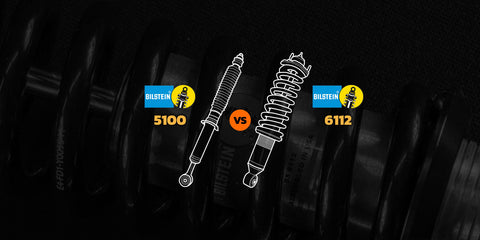
Bilstein 5100
You can't talk basic without talking Bilstein 5100. They're the quintessential ride-height-adjustable, two-ish-inch-body monotube strut that lets you reuse your stock springs, with matching rear shocks to boot.
Lift Range and Fitment
Both the front and rear are good at stock height. The front is adjustable up to 2 ¼″ of lift, and the rear can handle up to an inch or so if you upgrade the rear springs. Bilstein also makes a heavy-load rear shock for trucks carrying 500 lbs or more of constant load in the bed, tuned to work with their matching 1″ heavy-load springs.
Because these are essentially stock-length, they work with every other factory component. Grab the struts and shocks, add a Bilstein B12 or another 1″ rear lift spring, and you're on your way.

Bilstein
B12 Rear Springs
2022+ Toyota Tundra
How They Ride
We'll come out and say it: these are not the softest-riding shocks out there. In fact, they're far from it. The digressive valving means they can be fairly firm and harsh over smaller bumps at lower speeds. Most of our customers prefer the ride over their stock shocks, but soft they are not.
That same digressive valving is what makes them so stable under a load and gives them noticeably tighter handling. They pack a fair amount of punch for the price.
Who They're For
If you want to level your daily driver, aren't running much more than a 33 or 34″ tire, and have the occasional load or twisty road to contend with, the 5100 is a great option. Travel gains in the front are minimal, so keep front lift as low as possible and as high as absolutely necessary.

Bilstein
5100 Series
2022+ Toyota Tundra

Eibach Pro-Truck Sport & Stage 1 Kit
If the firmer feel of the Bilsteins has you worried, Eibach's Pro-Truck Sport struts and shocks are a great alternative that, in our experience, have similar if not the same lofty levels of longevity.
How They Ride
They definitely aren't as good at handling, carrying load, or keeping you planted over big bumps as the 5100s. But they also don't beat you up over the small stuff nearly as much, which a lot of buyers will appreciate. In our testing they delivered a very OEM+ feel: a nearly identical ride in the areas where our stock TRD Off-Road Bilsteins felt great, with a little extra support in the areas where they fell short.
Why We Skip the Stage 1 Front Springs
We're going to talk about the Pro-Truck Sports and the complete Stage 1 kit together, because a less-is-more approach is best here. The strut tuning is right where it needs to be for the average person, but we found the front springs included in the Stage 1 kit to be too much.
These struts, like the Bilstein 5100s, are pretty much the same length as stock. That's good news for fitment: no diff drop or axle shafts on a non-TRD Off-Road or Pro, no control arms, none of that. But it also means the 2.6″ of lift the Stage 1 springs provide on a non-hybrid leaves you with next to no down travel.
The 0.7–1.1″ rear springs are definitely keepers. Up front, we ended up reverting to the stock springs and using the strut's circlip grooves to land around 2″ of lift, and we were much happier with the ride and overall performance.
The only time anyone should consider the full Stage 1 kit is if you currently have, or plan to add, a constant load at the front, like a bumper and winch. Otherwise, skip the front springs and buy the rear springs plus the Pro-Truck Sport struts and shocks instead.

Eibach
Pro-Truck Lift System Stage 1
2022+ Toyota Tundra
Pro-Truck Lift System Stage 1 for Hybrid/Iforce Max equipped Tundra models

Eibach Pro-Truck Stage 2 (and 2R)
Truthfully, the kit you want in the Eibach catalog is Stage 2.
What Makes Stage 2 Different
The main difference from Stage 1 is the front: Stage 2 uses Eibach's threaded-body 2.0 coilovers, and that made all the difference for us. Since Eibach had near-complete control over the design of the whole assembly, they were able to give it about a full inch more usable travel, which means it tops out far less frequently at the same lift height.
We found them best at the same 2-ish-inch lift mark as the Stage 1, but the real win was not having to pull the strut, put it on a spring compressor, and disassemble it to change springs or settings. We put the front on jack stands, backed off the preload exactly as much as Eibach said we should with the included tool, and were off to the races.
How They Ride
They still topped out in the front more than we'd like, but the overall feel was much better than stock on the road and even on the trail, so it's well worth the upgrade over Stage 1. We ran 35″ tires in our testing and think the truck was worse for it. We definitely found their limits off-road, but for light trails, overlanding without a ton of weight, or daily driving, they were worth writing home about.
What About Stage 2R?
Eibach also sells the Stage 2R kit, which swaps the standard Pro-Truck Sport rear shocks for a Pro-Truck reservoir shock. They say the valving is different, but we had a hard time feeling it, or feeling enough of a positive difference to justify the cost.
We won't deny the heat-dissipation benefits of an external reservoir, but it's the front coilovers that give up the ghost first. Even if the rear shocks are running cooler, the front would be well out of its pay grade long before rear temperature becomes a concern. We always say: if you think you need a reservoir in the rear, you probably need more than a 2.0 in the front. If that sounds like you, stay tuned for Part 3.

Eibach
Pro-Truck Stage 2
2022+ Toyota Tundra
Pro-Truck Lift System Stage 2 for Hybrid/Iforce Max equipped Tundra models

Fox 2.0
The 2.0 more of you are probably aware of is the Fox 2.0. These are known for their super soft ride and their ability to bolt on with no other parts and level your truck with ease.
Where They Shine
In a vacuum, these are a spectacular option, and they absolutely deliver in the comfort department. The aluminum bodies also make them a very appealing choice in the Rust Belt.
Where the Eibachs Win
We'd argue the Eibach Stage 2 is not far off in comfort, handles and takes load better, has a much longer service life, and costs significantly less. The Fox aluminum bodies also mean you need a spring compressor for any preload adjustment on the front coilovers, which the steel-body Eibachs don't require.
And the upkeep on zinc-plated steel really isn't all that bad. We have a video on our channel going over it, but it's as simple as keeping them clean and hitting them with a silicone-based lubricant spray.
The Bottom Line
If you're looking at the Fox 2.0 for what it's best at, meaning leveling your daily driver and getting a touch more comfortable ride, the Eibach Stage 2 might be the better option. And if you're looking at the Fox 2.0 for the serious off-road performance many people expect from the Fox name, there are options in Part 3 like the Icon Stage 1 2.5 EXP kit that cost less, offer arguably just as much comfort, and deliver a lot more performance across the board.

OME Nitrocharger Plus
To wrap things up with one more option for a very specific kind of driver, let's talk Old Man Emu Nitrocharger Plus.
The Elephant in the Room
The big one with these is the price of the complete kits when you consider the twin-tube design. But what they look like on paper does not necessarily equate to their value on the trail.
People are finally figuring out that if they're going to build 1,000+ lbs into a rig for overlanding, a midsize just ain't gonna cut it, and the Tundra has rapidly become the application of choice. Under the right conditions, that makes the Nitrocharger Plus a strong contender.
Who They're For
If you already have, or are planning, a super heavyweight overland build and the wheeling you're doing is largely at lower speeds, especially if it leans technical, these become a very compelling option.
OME pushed the travel numbers as far as they could on all of their kits, which means articulation is spectacular, and that's always something we want more of on an IFS truck on a technical trail or tough obstacle. They also had the great idea, on their standard-load kits, of giving you a front spring that does all the lift on a stock-weight truck, then offering preload spacers to offset the height you lose as you add bumpers and winches. And of course there's a multitude of rear spring pairings for loads from stock to over 1,000 lbs.
So What's the Catch?
All that front travel means if you don't have a TRD Off-Road or Pro, you're upgrading your axles or dropping the diff. The minimum 3″ lift on a stock-weight truck also means you need control arms. As you'll find throughout this series, the more travel we gain, the better the ride and performance get, so we think the gains are worth the extra cost and effort. But it does bring the total package, with the required springs, to just under $2,000.
Pair that with the fact that even with all that travel, the twin-tube design still limits ride quality and overall performance, and the few hundred bucks it takes to step up to something like OME's own MT64, which is in another league in performance and even comfort, doesn't seem like that big of a jump. More on that in Part 3.

Old Man Emu
Nitrocharger Plus
2022+ Toyota Tundra

Which One Is Right for You?
- You want a leveled daily driver that tows or hauls, and you don't mind a firm ride: Bilstein 5100 with a B12 or 1″ rear spring.
- You want a leveled daily driver and comfort over small bumps matters most: Eibach Pro-Truck Sport struts and shocks with the Stage 1 rear springs. Skip the Stage 1 front springs unless you're running a front bumper and winch.
- You want the best all-around entry-level kit for daily driving, light trails, and light overlanding: Eibach Pro-Truck Stage 2. It's the kit to buy in this price range.
- You live in the Rust Belt and comfort is the only goal: Fox 2.0 is a fine bolt-on, but price it against the Eibach Stage 2 first.
- You're building a 1,000+ lb overland rig for slow, technical trails: OME Nitrocharger Plus, with the understanding that you're buying control arms and either a diff drop or axles too, and that the MT64 is only a few hundred dollars further up the ladder.
Frequently Asked Questions
For most daily drivers that want a level stance and a better-than-stock ride, the Eibach Pro-Truck Stage 2 kit is our pick. It gives you about an inch more usable travel than a stock-length strut, adjusts without a spring compressor, and outlasts the Fox 2.0 for less money. If you tow or carry weight regularly and prefer a firmer, more planted feel, the Bilstein 5100 is the better value.
They are firm. The digressive valving makes them harsh over small bumps at low speed, and they are not a comfort shock. Most of our customers still prefer them over stock, but if small-bump comfort is your priority, the Eibach Pro-Truck Sport strut is the softer alternative with similar longevity.
The front strut is ride-height adjustable from stock up to roughly 2 ¼″ of lift using your factory springs. The rear shock works at stock height or with up to about an inch of lift if you add a taller rear spring such as the Bilstein B12. Because front travel gains are minimal, we recommend running as little front lift as you can live with.
Stage 2. The Stage 1 front springs lift about 2.6″ on a stock-length strut, which leaves almost no down travel. Stage 2 swaps in a threaded-body 2.0 coilover with about an inch more usable travel and lets you set preload with a wrench instead of a spring compressor. The only reason to consider the Stage 1 front springs is a constant front load like a bumper and winch.
In our testing, no. We had a hard time feeling a meaningful difference from the reservoir rear shocks, and the front 2.0 coilovers fade well before rear shock temperature becomes a problem. If you think you need reservoirs in the rear, you probably need more than a 2.0 up front, which points you toward the intermediate options in Part 3.
They are a very comfortable bolt-on leveling option, but the Eibach Pro-Truck Stage 2 is nearly as comfortable, handles load better, lasts longer, and costs less. The Fox aluminum bodies are a real advantage in the Rust Belt, but they require a spring compressor for any preload change. For serious off-road use, the intermediate shocks in Part 3 offer far more performance for similar money.
Yes, unless you have a TRD Off-Road or TRD Pro. The OME kit maximizes front travel and starts at a minimum 3″ lift on a stock-weight truck, so base and SR5 trucks need either a diff drop or upgraded axle shafts, and every truck needs aftermarket upper control arms. Budget for the complete package at just under $2,000 with the required springs.
We ran 35s on the Eibach Stage 2 and felt the truck was worse for it. The Bilstein 5100 is best kept to 33s or 34s. These entry-level options are happiest with modest tire sizes and modest lift. If 35s are the plan, the extra travel from the intermediate options in Part 3 makes a bigger difference than any shock in this article.

What's Next in the Series
You've probably noticed we kept pointing at the intermediate shocks coming in Part 3. That's because we think they're not only the sweet spot in most brands' catalogs, but the real sweet spot for most people: the same or better comfort than the best of today's options, with significantly more performance potential, and in some cases without a huge jump in price.
Today was all about the stuff that gets the job done. Next time we're talking about the stuff that gets the job done well, without the extra fluff most of you don't benefit from.
Series so far:
- Part 1: Factory Systems & Setup
- Part 2: Entry-Level Shocks & Leveling Kits (you are here)
- Part 3: Intermediate Shocks (coming soon)
Ready to Upgrade Your Tundra?
Interested in any of the shocks we covered today, or anything else for your Tundra or whatever else you're whipping? Shock Surplus is your one-stop shop.
Shop All 3rd Gen Tundra Lift & Leveling Kits
Phone: (213) 433-3616
Web: ShockSurplus.com
We'll see you out on the trails.